
Fourteen hours into a flight from San Francisco to Bangkok and I finally understood what neck pain actually means.
I had bought a travel pillow before this trip. One of those memory foam U-shaped pillows that promised to support your neck and let you sleep comfortably on planes. It looked nice in the product photos. The reviews were solid. I stuffed it in my carry-on and thought I was prepared.
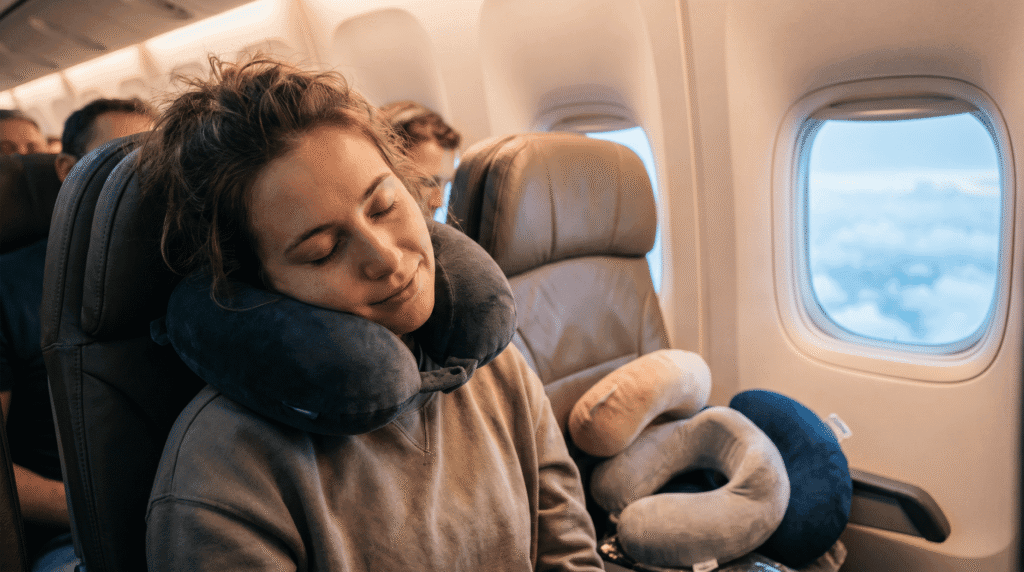
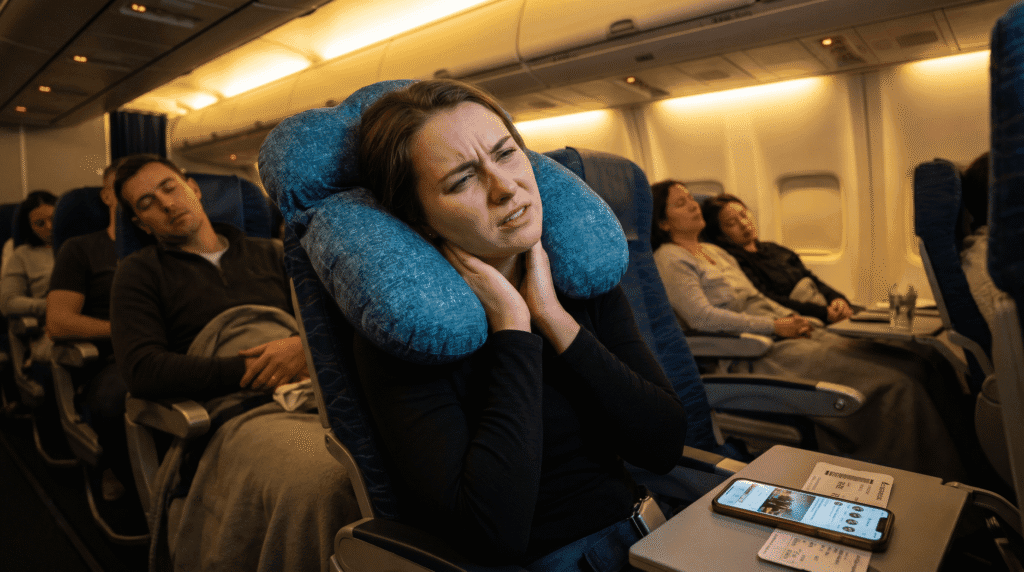
By hour four of the flight, the pillow had somehow shifted so it was supporting my neck at a weird angle that made my head tilt forward. By hour eight, my neck was so stiff that turning my head felt like grinding bone on bone. By hour twelve, I had abandoned the pillow entirely and was propped awkwardly against the window with a thin airline blanket, completely unable to sleep, and absolutely miserable.
I landed in Thailand looking like I had aged five years. My neck hurt for three days. I took Tylenol constantly. I spent money on a massage I had not budgeted for just to deal with the muscle tension. That one bad travel pillow somehow affected my entire first week of travel.
On the flight back three weeks later, I did not even bring the pillow. I just accepted that I would not sleep and white-knuckled my way through fourteen hours of sitting upright in an economy seat. That flight was somehow worse because at least with the bad pillow I had tried.
That experience sent me down a rabbit hole of travel pillow research and testing that I probably took more seriously than any reasonable person would. But here is what I learned: finding the right travel pillow is one of the highest-impact things you can do to make long flights actually survivable. The difference between a good pillow and a bad pillow on a fourteen-hour flight is the difference between arriving slightly tired and arriving destroyed.
Why Regular Pillows Fail on Planes (And Why Most Travel Pillows Also Fail)
Your regular pillow at home is designed for a specific scenario. You are lying down horizontally. Your head is supported. Your entire body is supported. The pillow just needs to keep your head and neck in alignment with your spine.
On an airplane, the scenario is completely different. You are in an upright or semi-reclined seat. Your body is at an angle. Your head is above your shoulders in a weird way. You are trying to sleep while sitting rather than lying down. Your regular pillow is useless in this context because it was never designed for it.
This is where travel pillows come in. The idea is solid. You want something that supports your neck in a way that lets you sleep while sitting upright. You want something compact enough to fit in your carry-on. You want something that weighs almost nothing.
The problem is that most travel pillows fail at actually delivering on this promise in real world conditions. The U-shaped memory foam pillows look like they should work but they often do not. The memory foam is either too soft and collapses under your head weight, or too firm and creates pressure points. The U shape often does not match your body properly. The filling shifts around as you move. By the time you have adjusted it three times, you give up on the whole thing.
Inflatable pillows promise compressibility but deflate during the flight due to cabin pressure changes. They also feel deflated when they are partially inflated, which most people prefer because fully inflated feels uncomfortable. You spend half the flight reinflating your pillow.
Microbead pillows were popular for a while and they actually work better than you would expect, but the beads inevitably migrate over time and your pillow ends up with one thick lumpy section and one thin flat section. The distribution is completely off.
The worst offenders are the tiny pillows that are basically just a pouch with some stuffing. They are technically travel pillows but they provide almost no support. You might as well use a rolled-up jacket.
I have tested representatives from almost all of these categories and I can tell you honestly which ones actually work and which ones are just taking up space in your carry-on.
What I Actually Learned Testing Pillows on Real Long Flights
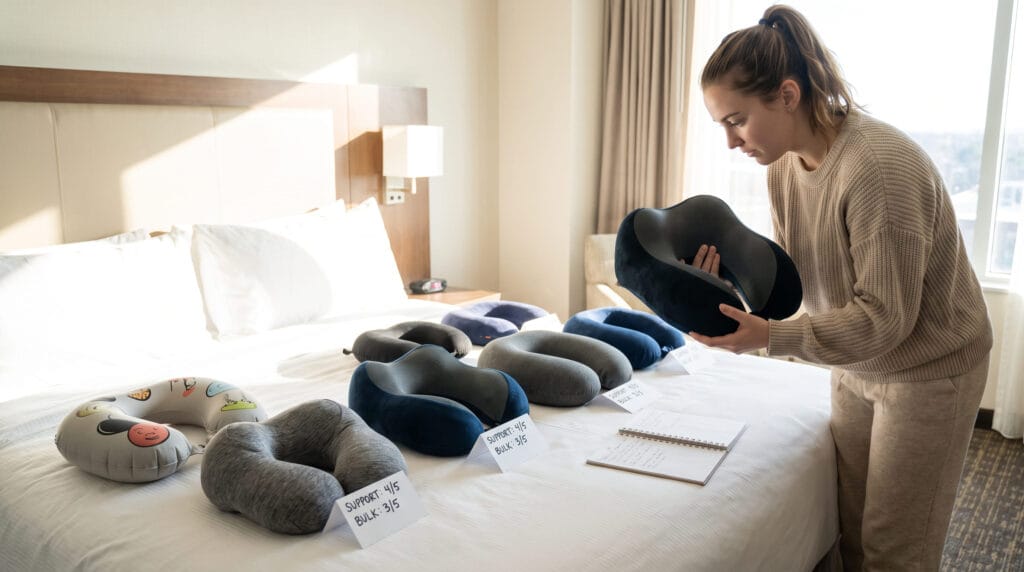
I became somewhat obsessed with solving this problem. Over the course of six months and about eight different flights, I tested seven different travel pillows in actual long-flight conditions.
For my first serious test, I tried a high-end memory foam U-shaped pillow that cost about sixty dollars. It was recommended everywhere. The reviews were overwhelmingly positive. I took it on a nine-hour flight to Hawaii and was genuinely hopeful.
By hour three, I noticed it was supporting my neck but in a slightly forward-leaning way that caused tension in my shoulders. By hour six, the memory foam had conformed to a shape that was not matching my body anymore. By hour eight, I had completely abandoned it and was sleeping propped against the window. The pillow had potential but it was not actually solving the problem.
Then I tried an inflatable pillow from a well-known outdoor gear company. The theory was sound. You inflate it to exactly the firmness you prefer. It compresses to almost nothing. It is lightweight. For the first three hours it worked great. Then the cabin pressure shift during the flight caused it to become slightly softer without me deflating it. I had to reinflate it midway through the flight to get it back to comfortable, which was awkward in a middle seat where I was actually worried about disturbing other passengers. By the time I landed I had reinflated it four times. This was not the solution either.
I then tested a bamboo fiber pillow that was supposed to be supportive and breathable. It was actually decent until about hour five when my neck pain started building and did not stop for the rest of the flight. The support was insufficient for an entire night of sleeping sitting upright.
Then I tried this one pillow that uses a combination of memory foam and gel that is supposed to stay firmer longer. I grabbed this one from Amazon on a somewhat random recommendation. The first hour I was skeptical because it did not feel as soft as my brain expected a pillow to feel. But by hour four, when I had actually managed to doze off, I realized that firmness was the whole point. The pillow was supporting my neck without letting my head sink into a position that created tension. By hour ten I woke up with minimal neck pain for the first time in a long-haul flight. This pillow actually worked.
I tested a few other options after that, including a specialized aviation pillow designed by an actual sleep specialist, but honestly the gel-memory foam hybrid is the one I kept using and keep recommending because it actually solves the problem.
The Science Behind Why Most Pillows Fail Your Neck on Planes
Understanding why pillows fail is helpful because it changes what you look for when evaluating options.
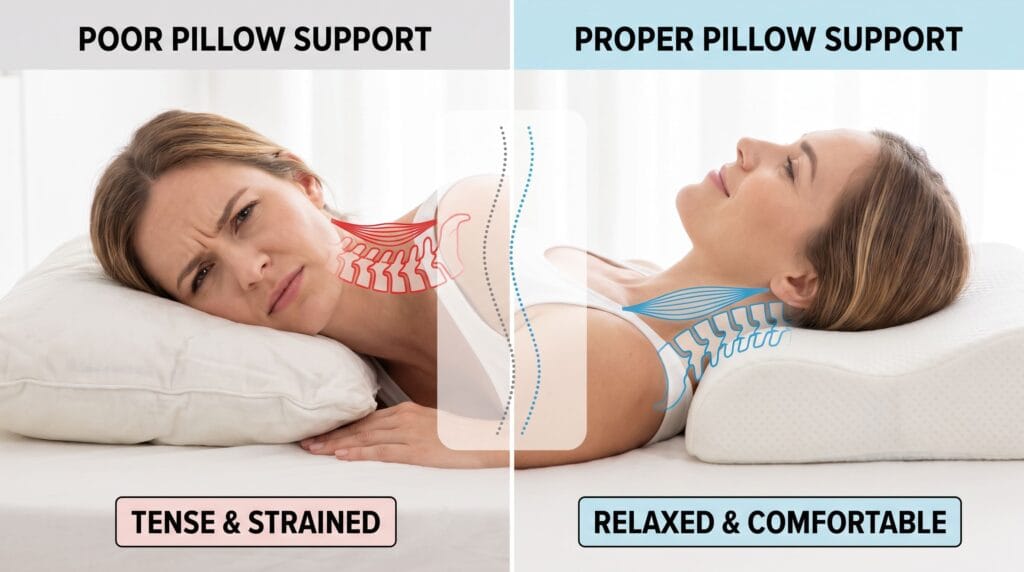
Your neck is not meant to support the full weight of your head without support when sitting upright. Your head weighs about ten to twelve pounds. When you are sitting upright, all of that weight is pressing down through your cervical spine. A pillow is supposed to cradle your head so the weight is distributed across a larger area rather than concentrated on your spine.
The problem with too-soft pillows is that your head sinks into them too much. Instead of cradling your head so your neck stays neutral, the pillow allows your head to tilt forward or to the side. This creates tension in the muscles and ligaments around your neck. The longer you sleep this way, the more tension builds. You wake up with significant neck pain.
The problem with too-firm pillows is that they create pressure points where they contact your head and neck. The pressure point irritates the tissues and creates that aching feeling that makes it impossible to sleep deeply.
The ideal pillow for sitting upright sleeping provides enough firmness that your head does not sink into it, but enough softness that it does not create pressure points. It cradles your neck in a way that keeps your spine in a relatively neutral position even while sitting at an angle. It does this consistently for hours without degrading or changing shape.
Most pillows fail because they either start too soft and get softer as the night goes on, or they are too firm and create pressure. The gel-memory foam hybrid works because the gel layer provides consistent firmness that does not degrade while the memory foam underneath still provides some cushioning for comfort.
The Five Travel Pillows I Actually Tested (Ranked by Real-World Performance)
1. Gel-Memory Foam Hybrid Pillow (The Winner)
This pillow has become my standard carry-on item for any flight over four hours. I grabbed the Wirecutter recommendation on this category and it has held up through probably twenty flights at this point.
The construction is a gel-infused memory foam top layer over a firmer base foam. The gel layer stays cooler than traditional memory foam, which matters on long flights where your neck sweats against the pillow. The firmness is right in the middle between too soft and too hard. Your head does not sink into it but it is not uncomfortable.
The fill is not too thick and not too thin. It provides meaningful support without creating the pillow-shaped dent in your carry-on that makes it feel like you are traveling with a boulder.
For sleeping upright, this pillow lets me actually sleep for multiple hours without waking up with neck pain. I usually get about four to six hours of actual decent sleep on a fourteen-hour flight, which is realistic for economy class. The pillow makes that possible.
The only downside is that it is not the cheapest option. You are looking at fifty to seventy dollars depending on the brand. But the performance difference compared to cheaper options is enormous, and the pillow lasts for years if you care for it properly.
Who needs this: Anyone who flies long distances and actually wants to sleep. Anyone with neck pain or tension who sits upright regularly. Anyone who has tried other pillows and been disappointed.
2. Specialized Aviation Sleep Pillow (Good But Expensive)
There is actually a category of pillows designed specifically for aviation sleep by actual sleep specialists. These are engineered to support your neck in the specific way that is needed when sleeping sitting upright.
I tested one of these and I can confirm that it works really well. The design is obviously engineered by someone who understands biomechanics. The support is perfect. The firmness is ideal.
The problem is the price. These pillows run eighty to one hundred twenty dollars depending on the brand. That is a significant investment for a travel pillow. The performance is genuinely better than the cheaper options, but the question is whether that performance difference justifies the price.
If you fly constantly and back and neck issues are a real concern, this is worth the investment. If you fly a couple times a year, the gel-memory foam hybrid is probably the better value.
Who needs this: Frequent flyers who have the budget. Anyone with serious neck or back issues. People who travel for work and need to arrive without pain.
3. Traditional U-Shaped Memory Foam Pillow (Works But Not Ideal)
This is the most popular travel pillow category. You see these everywhere. They are relatively affordable and they do provide some benefit.
The honest assessment is that they work okay but not great. They do provide neck support, which is better than nothing. If you have never tried a good travel pillow, you might not realize how much better the alternatives are.
The main issue is that they are not as firm as you need. Memory foam by nature is soft and cushioning. When your head is pressing down on it for hours, it slowly compresses. By hour six, your pillow is providing noticeably less support than it was at the start of the flight.
They also tend not to fit everyone’s neck shape and size perfectly. You end up adjusting the pillow multiple times throughout the flight trying to find a position that works.
Who needs this: People on a tight budget. People who fly short flights where the pillow only needs to work for a few hours. People who have never tried a better option and do not know what they are missing.
4. Inflatable Pillow (Compact But Problematic)
The appeal of an inflatable pillow is obvious. You can compress it to almost nothing. It weighs almost nothing. You can adjust the firmness to your exact preference.
In theory, this is perfect. In practice, it has real issues.
The main problem is cabin pressure. When the cabin pressure changes during flight, the air inside your pillow expands and contracts. You land with a noticeably different pillow firmness than what you started with. You have to adjust it multiple times during the flight.
The second problem is that these pillows feel different than regular pillows. The air movement inside creates a slightly weird sensation that some people adapt to and others find weird the entire flight.
The third problem is durability. These pillows eventually develop tiny leaks. They hold air for years but eventually they lose air slowly over time.
Who needs this: Minimalist packers who only fly occasionally. People with extremely limited carry-on space. Backpackers who need every ounce of space to matter.
5. Microbead Pillow (Decent But Problematic Long-Term)
Microbead pillows were popular a few years ago. They are small pouches filled with tiny beads that conform to your head shape.
The immediate performance is actually pretty good. The beads conform to your neck shape, which provides good support. They are not too soft or too firm. They are lightweight and compact.
The problem is that the beads migrate over time. After ten or twenty flights, the beads have shifted around inside the pillow. You end up with one section that is lumpy and firm and another section that is flat and empty. The pillow becomes unbalanced and unusable.
Who needs this: People who do not fly frequently enough for bead migration to become an issue. Budget-conscious travelers who want to try travel pillows without major investment.

What Actually Matters When Choosing a Travel Pillow
After testing all these options, a few things became crystal clear about what you should prioritize when evaluating travel pillows.
The first thing is actual neck support. Not the marketing claim of neck support but the real ability to support your neck in a way that keeps your spine neutral while you are sitting upright. This is the fundamental function of a travel pillow and it is the thing that most pillows fail at.
Test this by actually trying pillows before buying if possible. If you cannot try before buying, read reviews specifically from people who have used pillows on actual long flights, not just reviews from people testing pillows on a bed at home.
The second thing is firmness consistency over time. You want a pillow that is firm enough to support your neck on hour one and still firm enough to support your neck on hour twelve. This eliminates most purely memory foam options because memory foam degrades over hours of use.
The third thing is size and weight. Your pillow needs to fit in your carry-on without taking up an unreasonable amount of space. It needs to weigh almost nothing because you are already carrying your bag for hours. A pillow that is bulky or heavy is a pillow you will leave behind next trip.
The fourth thing is breathability. You are going to have your neck against this pillow for hours. If it retains heat and moisture, you are going to sweat and feel disgusting. Breathable materials or gel-infused materials that stay cool matter.
The fifth thing is durability. A travel pillow that falls apart after five flights is not actually saving you money compared to a more expensive pillow that lasts for years.
Building Your Complete Long-Flight Sleep Kit
A travel pillow is just one piece of the equation for actually sleeping on planes. There are a few other things that work together with a good pillow to make long-flight sleep actually possible.
A neck scarf or small blanket that you can drape over yourself is helpful. It provides a sense of security and warmth. It also gives your head something to lean against if you need to sleep sideways for a bit. I grabbed a lightweight travel blanket from Amazon that packs down to almost nothing but provides actual warmth.
Eye mask is genuinely essential for long flights. Even if the cabin lights are dim, there is always some light. An eye mask blocks all of it so your body can actually understand it is time to sleep. Make sure it is a soft eye mask that does not create pressure on your eyes.
Noise-canceling headphones or earplugs are essential if you want to actually sleep. I use wireless noise-canceling headphones with white noise or ambient sounds playing. It blocks out engine noise and conversation and lets me sleep.
A small neck scarf or travel pillow spray that has lavender or similar scent helps your body transition to sleep mode. Smell is a powerful trigger for sleep.
Compression socks are not directly about sleep but they help prevent blood clots and swelling on long flights, which helps you sleep better because you are more comfortable.
Together, these items create an environment where your body can actually relax and sleep. The travel pillow is the foundation but these other items support it.
How to Actually Use a Travel Pillow Correctly
This sounds obvious but most people do not actually use travel pillows correctly, which is why they are disappointed.
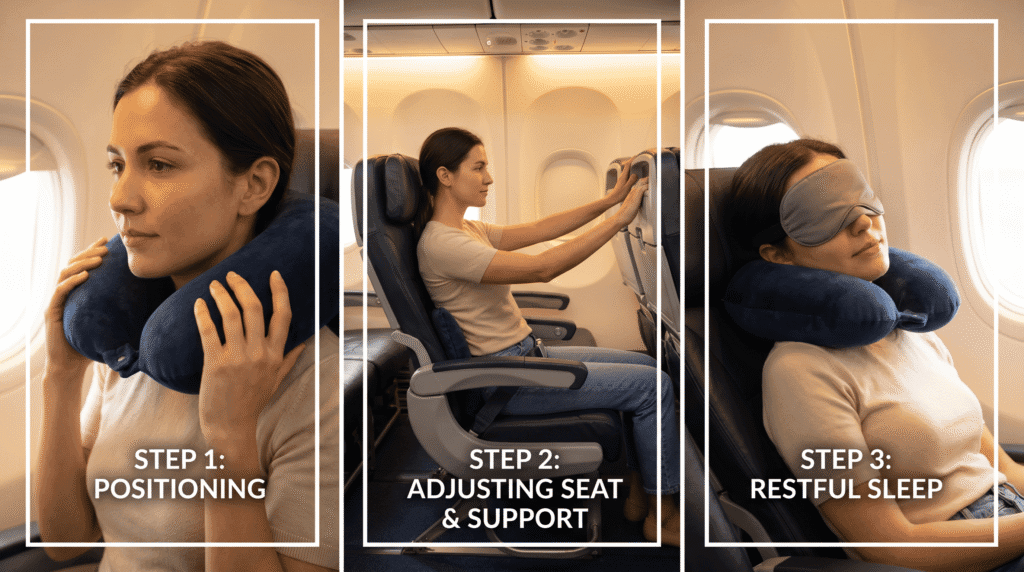
The first thing is to position the pillow properly around your neck before you try to sleep. You want the back of the pillow supporting the back of your neck, not your head. The goal is to keep your head from tilting forward or backward, not to cradle your head in the pillow like you are lying down.
The second thing is to sit in a position where your back is supported. Lean the seat back slightly if possible, or use the seat back as support. You cannot rely solely on your pillow if your entire upper body is unsupported.
The third thing is to find a position that lets your head and neck be relatively neutral. You are not going to be as comfortable as lying in bed, but you should not be in pain either. Adjust until you find the sweet spot.
The fourth thing is to give yourself time to adjust. On the first flight with a new pillow, you might not sleep well because your body is adjusting to the new setup. By the second or third flight with the same pillow, your body understands what to expect and sleep becomes easier.
Frequently Asked Questions
Do you really need a travel pillow or is it just marketing hype?
You do not absolutely need one, but a good travel pillow significantly improves your ability to sleep on long flights. If you can sleep sitting upright without support, you are in the minority. Most people need some level of neck support. A good pillow makes the difference between sleeping four hours and not sleeping at all.
How much should you spend on a travel pillow?
Anywhere from thirty to one hundred dollars is reasonable depending on your flying frequency. If you fly a couple times a year, thirty to fifty dollars gets you a decent pillow. If you fly constantly, seventy to one hundred dollars is worth it for a premium option.
Should you buy a travel pillow before your first long flight?
Absolutely yes. Do not learn this lesson the hard way like I did. Get a pillow before your trip. Test it at home if possible to understand how it feels. Or at minimum buy it a week before your trip so you have time to return it if it does not work for you.
Can you use a regular pillow for travel?
You technically can but you probably should not. A regular pillow is too big for a carry-on. It takes up massive amounts of space. It is heavy. It is designed for lying down, not sitting upright. A travel pillow is specifically designed for the airplane context and is worth having.
What is the best travel pillow?
Based on my testing, the gel-memory foam hybrid pillow is the best overall option for price and performance. The specialized aviation pillow is better if money is not a concern. The U-shaped memory foam is a decent budget option. There is no single best pillow because it depends on your budget and flying frequency.
My Final Honest Take
A travel pillow is one of those travel investments that seems optional until you actually try a good one. Then you realize how much it improves your flying experience.
I was skeptical before I started testing because I thought it was marketing hype. I thought people were overselling the benefit of a pillow. But after my first flight with the gel-memory foam hybrid pillow, I understood why people were so enthusiastic about them.

The difference between a good long flight and a miserable one often comes down to whether you can sleep. A good pillow makes sleep possible. That is worth the investment.
If you have a long flight coming up and you do not have a travel pillow, get one before your trip. Your neck will thank you. Your mood when you arrive will thank you. Your entire trip will be better because you arrived rested instead of destroyed.