
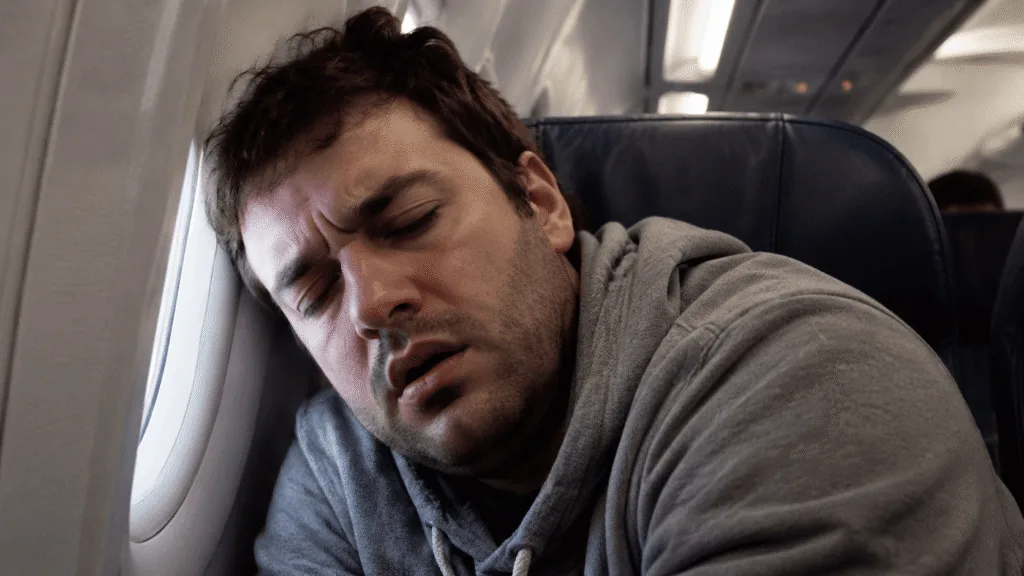
You just landed in Bangkok. You’re exhausted. You’ve been awake for almost 24 hours. But you’re also wired. Your body thinks it’s 3 AM back home but the sun is rising here and your brain is completely confused.
You try to sleep but can’t. You try to stay awake but your eyes are closing. You’re irritable. You’re confused. Everything feels surreal. This is jet lag, and it’s about to steal the first three days of your trip.
Most people accept jet lag as inevitable. They spend their first week in a fog, adjusting slowly, wasting time they paid good money to experience. Some people never fully adjust during a two-week trip.

Here’s what most people don’t know: you can almost completely eliminate jet lag in 72 hours if you know what you’re doing. Not reduce it. Eliminate it. You can land in Bangkok and sleep normally that first night. You can wake up and feel fine. You can actually enjoy your trip from day one instead of recovering.
This requires some strategy and some discipline. But it works. I’ve done it dozens of times. So have thousands of other travelers once they learned this system.
Why Jet Lag Happens and Why Most People Get It Wrong
Jet lag isn’t just about being tired. It’s about your circadian rhythm being completely out of sync with the local time.
Your body has an internal clock. This clock tells you when to sleep, when to eat, when to be alert. This clock is set by light exposure primarily, but also by meal timing, exercise, and routine. When you fly east (like from the US to Thailand), you cross many time zones quickly. Your internal clock is still on US time, but the sun is telling you it’s a completely different time.
Your body is confused. It’s releasing melatonin (the sleep hormone) at the wrong times. It’s releasing cortisol (the wake-up hormone) at the wrong times. Your stomach is asking for food at weird hours. Your sleep is terrible because your body thinks it should be awake.
Here’s what most people do wrong: they try to push through it. They stay awake all day and try to sleep at night. But their body is fighting them. They can’t sleep. They’re exhausted but wired. They lie in bed for hours. They get increasingly frustrated.
Or they do the opposite: they nap constantly. They take a long nap when they arrive. Then another nap in the afternoon. Then they can’t sleep at night. They’re back to being awake at weird hours.
Both approaches keep you jet-lagged for a full week or more.
The real solution is forcing your body to adjust quickly using light, sleep timing, and supplements. It’s not natural. Your body doesn’t want to do it. But you force it to happen in 72 hours instead of seven days.
The 72-Hour Jet Lag Protocol: Pre-Departure Phase
This starts before you even leave the US.
Three Days Before You Leave: Start Shifting Your Sleep Schedule
If you’re leaving on a Thursday, start adjusting on Monday.
You’re flying to Thailand, which is about 12 to 13 hours ahead of US time (depending on daylight saving and which part of Thailand). So if you normally sleep 10 PM to 6 AM, you need to shift that forward by 12 hours.
Here’s how: Go to bed 2 to 3 hours later than normal. Wake up 2 to 3 hours later than normal. So if you normally sleep 10 PM to 6 AM, sleep at 1 AM to 9 AM instead. Do this for three days.
This sounds extreme but here’s why it works. You’re pre-adjusting your body. By the time you land, your body is already partially on Thailand time. Instead of needing seven days to adjust, you need three.
Most people skip this step because it feels uncomfortable. They think it’s not worth the hassle. Then they spend the first week of their trip in a fog.
Your trip costs thousands of dollars. Spending three nights with a weird sleep schedule is worth it.
Two Days Before You Leave: Get Your Light Exposure Right
Light is the primary signal that tells your body what time it is.
Get bright light exposure in the evening and early night. This tells your body to stay awake. Go outside in the afternoon and evening. Sit by a window. Get as much natural light as possible. This shifts your circadian rhythm forward.
Avoid bright light in the early morning. If you normally wake up at 6 AM, avoid bright light until 9 AM or 10 AM. Use dimmer lights. Wear sunglasses if you have to.
This sounds counterintuitive (why avoid light in the morning?) but it works. You’re telling your body that morning hasn’t happened yet.
Day of Departure: Strategic Caffeine and No Sleep
The night before you leave, don’t sleep. Yes, really.
This sounds exhausting (because it is), but here’s the logic. You’re going to be on a plane for 16+ hours anyway. You’ll be uncomfortable and can’t sleep properly on the plane. So instead of trying to sleep on the plane and failing, just don’t sleep before you leave.
Stay up all night. Board your flight exhausted. Sleep on the plane. You’ll actually sleep because you’re properly tired, not just uncomfortably cramped.
Don’t use caffeine the day of departure. You’re already exhausted. Caffeine will keep you jittery and prevent you from sleeping on the plane.
The 72-Hour Jet Lag Protocol: During the Flight
Set Your Watch Immediately
As soon as you board, set your watch to Bangkok time. This sounds silly but it works psychologically. You’re now in Bangkok time mentally. You make decisions based on Bangkok time.
Sleep Strategy on the Plane
Sleep is crucial on the flight. You need at least 5 to 6 hours of real sleep.
Take a sleep aid. Melatonin (3 to 5 mg) works well. Or a prescription sleep aid if you have one. Take it 30 minutes before you want to sleep. Use earplugs and an eye mask. Wear comfortable clothes.
The goal is to sleep during the night hours in Bangkok time. If you’re on a flight that leaves in the evening US time and arrives in the morning Bangkok time, the plane flight covers the night hours. So the plane is dark, it’s the right time to sleep in Bangkok, and you should sleep.
If your flight timing is different, adjust. Sleep during the Bangkok night hours, even if it’s afternoon on the plane.
Most airlines dim the cabin lights to help you sleep. That’s when you sleep. When they turn lights back on, you should be waking up.
Hydration and No Alcohol
Drink water constantly. Dehydration makes jet lag worse. Your body needs water to function and adjust properly. Drink way more water than you think you need.
Skip alcohol. Yes, alcohol helps you sleep initially but it disrupts sleep quality. You’ll sleep but you’ll wake up at 3 AM and can’t get back to sleep. Your circadian rhythm adjustment needs quality sleep. Alcohol prevents that.
Same with excessive caffeine. One coffee is fine. Seven coffees is not.
Light Exposure on the Plane
When the sun comes up on the plane (even if it’s afternoon for you), get bright light exposure. Open the window shade. Let sunlight hit your face. This signals to your body that it’s daytime.
When they dim the cabin lights for the next night section, use your eye mask and sleep.
You’re using light to signal the correct time zone to your body.
The 72-Hour Jet Lag Protocol: First 24 Hours in Bangkok
Arrival Day: No Sleep, Lots of Activity
You land in Bangkok. You’re exhausted. Your instinct is to go to the hotel and sleep.
Don’t. This is the most important rule.
You landed in the morning Bangkok time. In Bangkok, it’s morning. So you need to be awake in the morning. If you sleep now, you’ll mess up your adjustment completely.
Go to your hotel. Drop your bag. Don’t sleep. Go out immediately. Get breakfast. Walk around. Expose yourself to bright sunlight.
This is hard. You’re exhausted. But you’re forcing your body to stay awake during Bangkok daytime so it adjusts to Bangkok time.
Stay awake all day. The goal is to be exhausted by evening Bangkok time so you can sleep at night.
Strategic Light Exposure
Get outside in bright sunlight as much as possible. This is the most powerful circadian rhythm adjustment tool. The sun tells your body “it’s daytime, you should be awake.”
Wear sunscreen but don’t wear sunglasses. Your eyes need to see the bright light. Sunglasses block the signal.
Spend at least 2 to 3 hours in direct sunlight during the day.
Activity and Movement
Exercise or walk a lot. Movement helps your body adjust. Your muscles are saying “we’re awake and active,” which reinforces the circadian signal.
Don’t nap. I don’t care how tired you are. No naps. Napping at the wrong time will destroy your adjustment.
Eating on Local Time
Eat breakfast, lunch, and dinner on Bangkok time, even if you’re not hungry. Meal timing is a secondary circadian rhythm signal. Eating on local time helps your body adjust.
You might not be hungry for breakfast because your body thinks it’s midnight. Eat anyway. A light breakfast is fine but eat something.
Evening: Prepare for Sleep
By evening Bangkok time, you should be exhausted. This is intentional.
Have dinner early (5 to 6 PM Bangkok time). This is earlier than you might normally eat but it helps your body settle into the Bangkok schedule.
Take a melatonin supplement (3 to 5 mg) around 9 PM Bangkok time. Go to bed around 10 PM.
You should sleep deeply because you’re genuinely exhausted. Your body has been awake for over 24 hours. You’ll sleep.
The 72-Hour Jet Lag Protocol: Days 2 and 3
Day 2: Normal Activity, Strict Sleep Schedule
Wake up at a normal Bangkok time (7 to 8 AM). Get bright light exposure immediately. Go outside. Eat breakfast.
Do normal activities all day. Explore, eat, walk around. Stay in bright light.
No naps. This is crucial. Napping will disrupt your adjustment.
In the evening, repeat the melatonin and early bedtime. Aim for 10 to 11 PM Bangkok time.
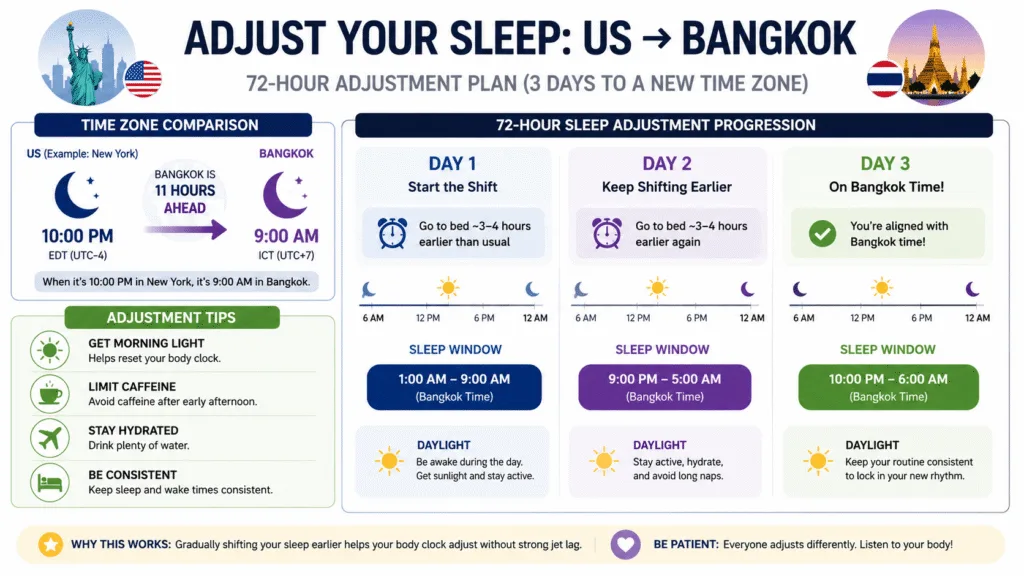
Day 3: The Final Push
Same routine. Wake up early. Bright light. Activity all day. No naps.
By day 3, your body should be largely adjusted. Your sleep should be normal. Your energy should be normal.
Why This Works in 72 Hours
You’re using multiple signals simultaneously: light exposure (the strongest signal), meal timing, activity timing, sleep schedule, and supplements. All of these are telling your body the same thing: you’re in Bangkok now.
Your body doesn’t have time to resist. By day three, your circadian rhythm has adjusted.
Products That Actually Help
Melatonin
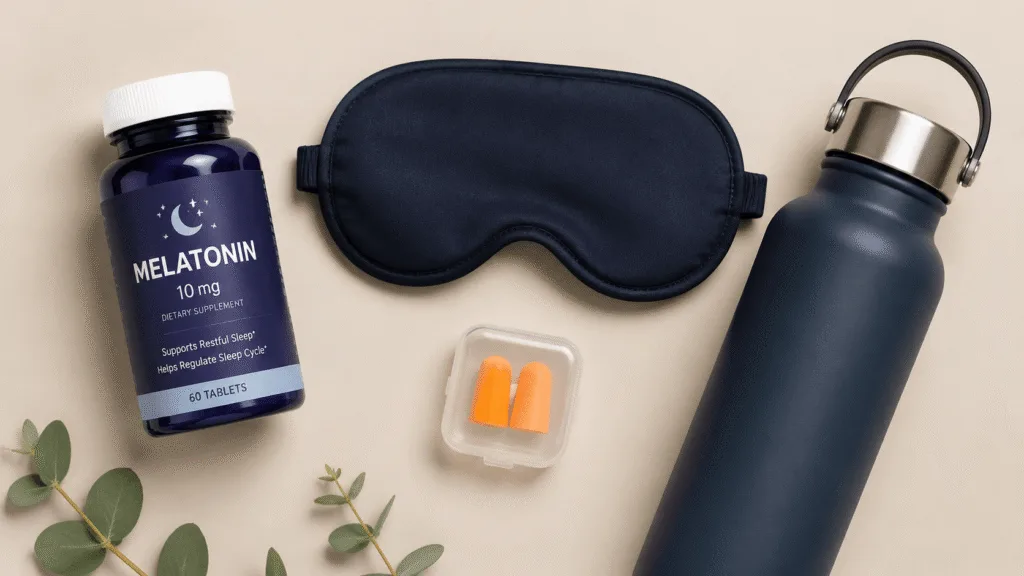
This is the supplement your body produces naturally to signal sleep time. Taking it at the right times helps your body adjust faster. 3 to 5 mg is the right dose. More doesn’t work better. Don’t take it during the day (it’ll make you groggy). Take it 30 minutes before your intended sleep time.
Eye Mask and Earplugs
These are cheap but crucial. A good eye mask blocks all light. Good earplugs block plane noise so you can sleep on the flight. Worth investing in quality versions.
Light Therapy Lamp (Optional but helps)
If you’re adjusting to an even more extreme time difference, a portable light therapy lamp can help. Use it in the morning on Bangkok time. It’s essentially artificial sunlight that signals your body it’s daytime.
Weighted Sleep Mask or Compression Socks
Some people find weighted items help them relax and sleep better. Not essential but can help if you’re a restless sleeper.
Water Bottle
A good reusable water bottle helps you stay hydrated on the flight and in Thailand. Hydration is crucial for jet lag adjustment.
Common Mistakes That Destroy Jet Lag Recovery
Don’t take long naps on arrival day. You’ll sleep at the wrong time and be awake all night.
Don’t try to sleep on the flight if you slept the night before departure. You need to be tired to sleep on the plane.
Don’t avoid bright light. Light is your most powerful tool. Don’t hide in your hotel room.
Don’t eat on US time. Eating when your body thinks it’s midnight confuses your circadian rhythm.
Don’t use heavy sleep medications. Melatonin is fine. Prescription sleep aids might leave you groggy for days.
Don’t skip the pre-departure adjustment. It’s uncomfortable but it cuts your jet lag recovery in half.
The Real Benefit
You landed Thursday morning. By Sunday morning, you’re completely adjusted. Your sleep is normal. Your energy is normal. You’re exploring like you’ve been there a week already.
Other tourists? They’re still in a fog. They’re sleeping at weird times. They’re exhausted. They’re wasting vacation time recovering.
You’re three days ahead of them because you did this protocol correctly.
That’s worth a few uncomfortable nights before you leave.