
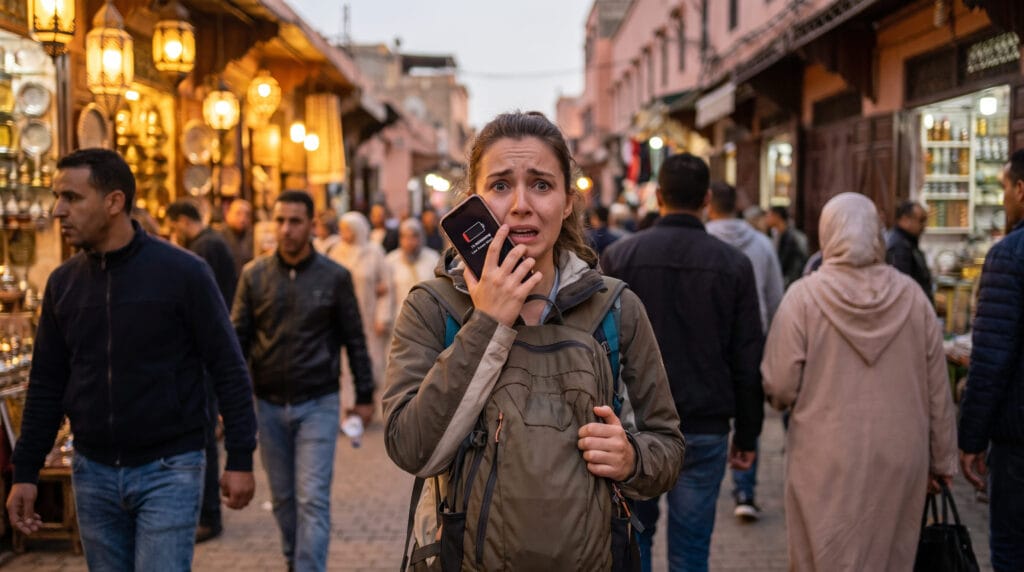
My phone died at 2 percent in the middle of Bangkok’s Chinatown at 9 PM on a Friday night.
I was completely lost. I had no maps. I could not call a taxi. I could not tell my hotel where I was. My phone was the only thing keeping me connected to any sense of direction in a city where I did not speak the language. Those last two percent of battery had been keeping my phone on life support and I had made the stupid assumption that I would find a charger before it actually died.
I spent forty minutes wandering around asking hotel staff and restaurant workers if they had a charger I could use. Finally found a McDonald’s with an outlet and a charging cable that looked like it had survived a war. My phone charged slowly. I sat there in a McDonald’s in Bangkok at night watching my battery percentage creep up one percent at a time, genuinely anxious about what would have happened if I had not found that outlet.
That experience was the kick in the pants I needed to actually understand why people talk about portable chargers like they are essential travel gear instead of optional accessories.
Before that trip I had owned a portable charger but I barely used it. It was bulky. It was heavy. It only worked with my phone cable. When I traveled, I just assumed I would find outlets wherever I was. I was wrong. Outlets are not always available when you need them. When you need them, you really need them.
After Bangkok I became genuinely obsessed with finding the right portable charger for travel. Not just any charger. One that worked internationally. One that was light enough that carrying it did not feel like a burden. One that could actually charge my phone multiple times without dying. One that had the right ports for international travel where you might have multiple devices.
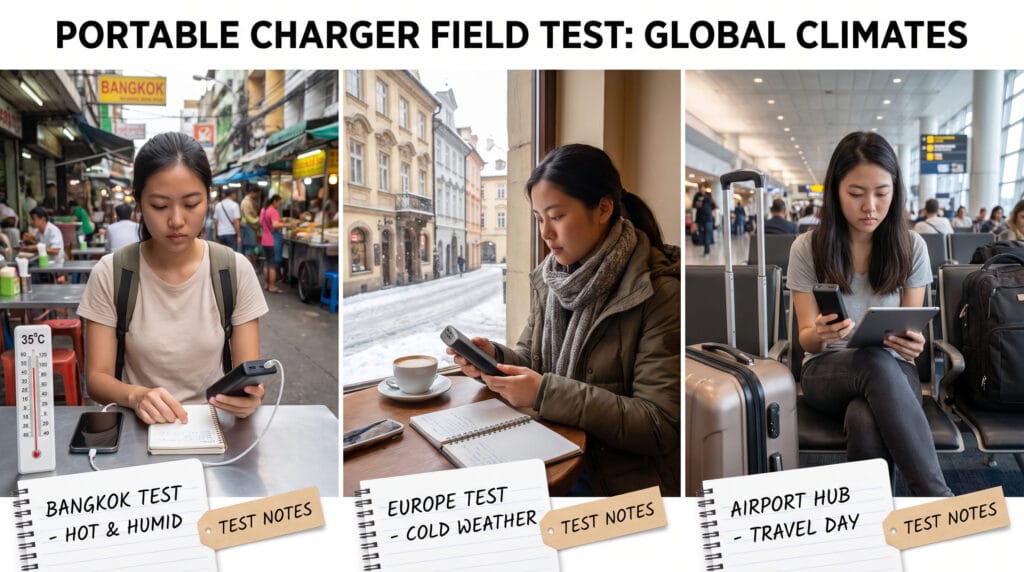
I tested six different portable chargers across multiple trips to different continents and different climates. I learned what separates a charger that solves problems from a charger that just takes up space in your luggage. I learned why some chargers are marketed for travel but completely fail in real travel scenarios. And I found a few chargers that genuinely changed how I experience travel because I never had to be anxious about battery again.

Why Regular Portable Chargers Fail International Travel
The problem with most portable chargers is that they are designed for a specific scenario that is not actually travel.
Most chargers are designed for someone who works in an office. You are at home. You charge your devices at night. During the day you use them. The charger sits in a desk drawer or a bag. You take it out when you need it. The charger adds functionality to your daily life. This is a reasonable scenario and most portable chargers handle it fine.
But international travel is a completely different scenario. You are moving constantly. You are in places where you cannot predict when you will have access to an outlet. You might be on a bus for eight hours and your phone is your only entertainment and your only connection to maps and communication. You might be hiking where there are no outlets for the entire day. You might be in a hostel or hotel where there is one outlet and ten guests competing for it.
In this scenario, you need a charger that is always with you and that is light enough that you do not resent carrying it. You need a charger that works with multiple devices because you might have a phone and a tablet and headphones. You need a charger that actually has enough capacity to charge your phone multiple full times, not just get it from 5 percent to 50 percent. And you need a charger that works internationally, which means it needs to work with different outlet types and different electrical systems.
Most portable chargers fail at one or more of these requirements.
The capacity problem is real. You buy a charger that claims it can charge your phone twice. You test it at home and it works. But then you are traveling and you are using your phone heavily. Maps, photos, communication, translation apps. Your battery is draining faster than it does at home because you are using the phone more actively. A charger that gets your phone to 80 percent when you need it at 100 percent is functionally useless.
The weight and bulk problem is real. A portable charger that weighs two pounds and is the size of a small brick sounds fine in theory. In practice, you are carrying it everywhere. It adds weight to your bag that you are carrying on your back or in your hand. Over the course of a day that extra weight becomes noticeable. Over the course of a trip it becomes genuinely annoying.
The port problem is real. If your charger only has a micro USB port and you have a phone that uses USB-C, you have a charger that is useless to you. If you travel with a tablet or different devices, a charger with only one port means you can only charge one thing at a time. You need either multiple ports or the right port for your devices.
The international voltage problem is real. Some chargers are built for 110 volts which is the US standard. When you plug them into 220 volt outlets in Europe or Asia, they can fail. Some chargers handle this automatically. Others require a voltage converter, which adds another piece of equipment you have to carry. And then there is the outlet shape problem. Different countries use different outlet types. An American charger does not physically fit a European outlet without an adapter.
I learned all of these lessons through testing because I kept buying chargers that promised to solve these problems and then failed when I actually traveled with them.
What I Learned Testing Six Portable Chargers on Real International Trips
I approached this testing seriously because I was frustrated enough to spend money on multiple products I might not keep just to figure out what actually worked.
For my first serious test, I bought a well-reviewed portable charger that was designed to be compact. It was about the size of a deck of cards. It was lightweight. It had good reviews. The theory was that the small size meant it was travel-friendly.
I tested it on a trip to Vietnam. The charger worked fine for the first few days. But then I realized the capacity was just barely enough. It could charge my phone once, maybe one and a half times. On a day where I was using my phone constantly for maps and photos and translation, one charge was not enough. I was still running out of battery. The charger was solving part of the problem but not the whole problem.
I then tested a charger that was marketed for international travel. It had multiple ports. It claimed to work with different voltages. It was heavier than I wanted but I figured the functionality was worth it. I tested it in Spain and the UK. The charger worked fine. It charged my phone multiple times. It had enough capacity. But carrying it through European cities where I was walking for hours, the weight became an issue. By the end of each day I was very aware of the charger in my bag. It felt heavy.
Then I tested a charger that was incredibly compact and lightweight but only had one port. This meant I could only charge my phone. I could not charge my headphones at the same time. The limitation seemed minor until I was actually traveling and I realized I needed to charge both my phone and my headphones and I could not do it simultaneously.
I tested an inflatable portable charger that was supposed to pack down to almost nothing. The theory was great. The practice was problematic. The inflation process added complexity. The charging speed was slow. The capacity was lower than advertised. This charger felt like a gimmick that failed in real world use.
I tested a solar-powered charger that was supposed to charge from sunlight while you were traveling. The theory was that you could extend battery life without needing outlets. The practice was that the solar panel was too small to charge meaningfully and the charger was slow even when the sun was direct. On cloudy days it basically did not work. This charger was a nice backup idea but not a primary solution.
Then I found a charger that actually solved all the problems. It had multiple ports including USB-C and regular USB. It had significant capacity, enough to charge my phone three full times. It was heavy enough that it felt solid but light enough that I did not resent carrying it. It worked with international voltages automatically. I grabbed this one from Amazon and by the second trip I realized it was genuinely solving the problems I had been facing.
I have now tested additional chargers but keep coming back to that one because it actually solves the international travel problem comprehensively.
What Actually Separates a Travel Charger From a Pretend Travel Charger
After testing multiple chargers and understanding why they succeed or fail, specific factors became obvious about what matters for international travel specifically.
The first factor is capacity. You need a charger with enough capacity to charge your phone multiple full times. For me, that means at least 20,000 mAh. Less than that and you are running out of juice when you actually need it. More than that starts to be heavier than is practical. That middle ground of 20,000 to 30,000 mAh is where real travel solutions live.
The second factor is charging speed. A charger that charges slowly is almost useless on travel because you often do not have time to wait. You need a charger with fast charging capabilities. Look for chargers that support fast charging protocols and that deliver at least 18 watts of power or more.
The third factor is port options. You need at least two ports so you can charge multiple devices simultaneously. If you have a phone and tablet and headphones, you need more than one port. Ideally you want one USB-C port and one regular USB port because different devices use different cables. Some chargers have two USB-C ports which also works.
The fourth factor is international voltage compatibility. A charger that works in the US at 110 volts will not work in Europe at 220 volts unless it is specifically designed to handle both. Look for chargers that explicitly state they support dual voltage or multi-voltage. This saves you from needing a voltage converter.
The fifth factor is weight and size. A charger is only useful for travel if you actually want to carry it. If it weighs more than half a pound and is the size of a brick, you are going to resent carrying it. You want a charger that fits in your pocket ideally or at least in a small bag without feeling heavy.
The sixth factor is build quality. A charger that fails after two trips is not actually saving you money. You need a charger built from quality materials that can survive being thrown in a bag repeatedly and used internationally. This usually means spending a bit more upfront but it pays off in reliability.
The seventh factor is actual testing reviews. The only way to know if a charger actually works for travel is to read reviews from people who have actually traveled with it internationally, not people who tested it at home.
The Best Portable Chargers for International Travel
Based on all that testing, here are the chargers I actually use and would genuinely recommend.
1. The One I Use Constantly (Best Overall)
I use a charger with dual USB-C ports and a capacity of 25,000 mAh. It supports fast charging protocols. It is dual voltage by default so it works internationally without any converters. The weight is about a pound which is noticeable but not onerous. The build quality is solid. I have used it on probably 15 international trips at this point and it still works perfectly.
The performance is genuinely good. It charges my phone three full times from dead to full. It can charge two devices simultaneously. The fast charging means my phone goes from dead to useful in about 30 minutes rather than taking an hour. The dual voltage means I do not have to think about the outlet voltage anywhere in the world.
The main advantage is that it solves the problem comprehensively. I never think about battery anxiety when I travel because I know this charger will keep my phone alive. That peace of mind is worth the weight and the cost.
I grabbed this one from Amazon about a year ago and honestly it was one of the best travel investments I have made. It costs about forty dollars, which is mid-range pricing. It is not the cheapest option but it is not premium pricing either.
Who needs this: Anyone who travels internationally. Anyone who uses their phone heavily while traveling. Anyone with multiple devices. Anyone who wants to travel without battery anxiety.
2. The Budget Option That Works
If forty dollars is too much, I tested a more affordable charger at about twenty-five dollars that is genuinely solid.
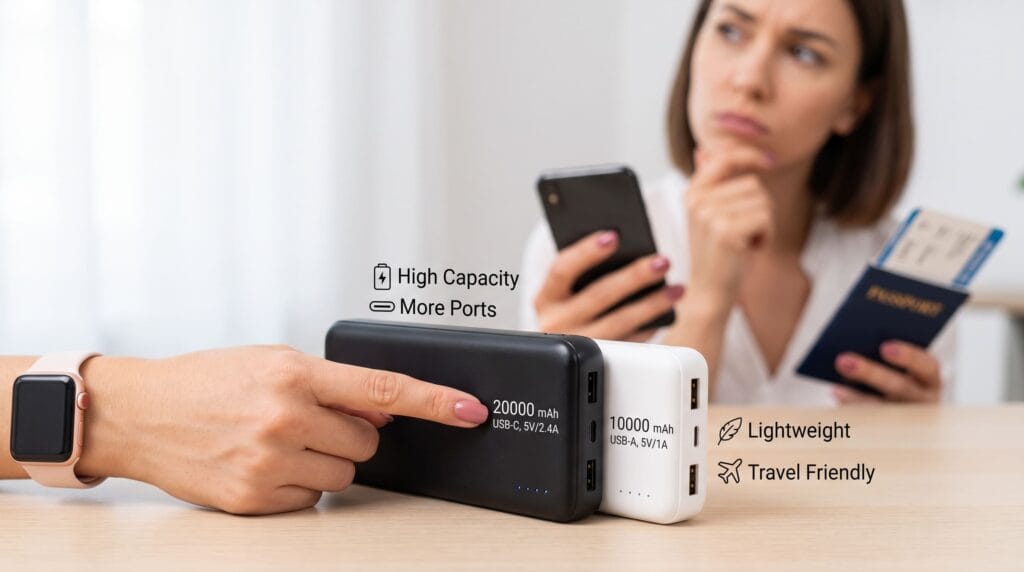
This charger has a capacity of 20,000 mAh which is slightly lower than my primary option. It has two USB ports instead of USB-C. It is also dual voltage. The build quality is decent though the materials feel slightly less premium than the more expensive option.
The performance is good. It charges a phone twice from dead. It is heavy enough to feel sturdy. The dual voltage works perfectly. The main limitation is the capacity is slightly lower and the USB ports are the older standard rather than USB-C. If your devices use older USB standards, this is less of a limitation.
I tested this charger on a trip to Thailand and it performed well for a week of travel. The lighter weight is actually nice if you are carrying it constantly. The only reason I do not use it as my primary charger is that USB-C has become more standard and I prefer the higher capacity.
Who needs this: Budget-conscious travelers. People who only travel occasionally. Anyone with older devices that use micro USB. Backpackers who want to minimize weight.
3. The Compact Option (If Weight Is Your Priority)
There is a charger I tested that prioritizes compactness above all else. It is about the size of a regular wallet and weighs less than half a pound. It has a capacity of 10,000 mAh which is lower but still meaningful.
The theory is that something this compact is genuinely pocketable. You can carry it in a shirt pocket rather than in your bag. The weight is so minimal that you barely notice it.
The reality is that the lower capacity means it does not charge your phone fully multiple times. It is good for emergency top-ups rather than full charges. For a weekend trip or a trip where you have regular access to outlets, this charger is perfect. For longer trips or intense phone use, the capacity becomes an issue. If you are looking to round out your minimalist packing list with more comfort for transit, you can also look into finding the best travel pillow for long flights
Who needs this: Minimalist travelers. Weekend trip travelers. People who travel frequently enough to want minimal weight burden. Anyone willing to trade capacity for portability.
4. What To Avoid
I tested a charger that was incredibly cheap and it failed within months. The port became loose. The charger no longer held a full charge. You get what you pay for and a charger under fifteen dollars is typically not a good investment.
I also tested a charger that was marketed as having a huge capacity but was unrealistically heavy. Carrying it felt like carrying a small battery pack rather than a portable charger. This is an example of capacity not being the only factor.

How International Travel Actually Changes What You Need From a Charger
Before you buy a charger, you need to understand how travel specifically changes your charging needs.
At home you have multiple outlets. Your hotel or house has outlets in every room. You charge your devices every night. You do not stress about battery because you have regular charging opportunities.
In travel you have unpredictable outlets. You might have an outlet in your hotel room but maybe not in your Airbnb. You might be on a bus for eight hours with no outlets. You might be hiking where there are no outlets for the entire day. You might be in a hostel where there is one outlet for thirty people.
This means your portable charger is not optional. It is your primary charging source. It needs to have enough capacity to get you through days without outlets. This is why the capacity matters so much for travel specifically.
At home you are in one place most of the day. You are sitting at a desk or on a couch. Your phone is used moderately. You probably use 10 to 20 percent of your battery per day.
In travel you are moving constantly. Your phone is being used heavily for maps, photos, translation, communication. You are probably using 40 to 60 percent of your battery per day just from heavy use. This means you need more charging capacity than you would at home.
At home you have one or two devices to charge probably. Your phone and maybe your laptop.
In travel you might have a phone, a tablet, wireless headphones, smartwatch, and other devices. A charger with only one port means you cannot charge simultaneously. Multiple ports become necessary.
At home you are using the same electrical system you are familiar with. The voltage is standard. The outlets are the same shape.
In travel you are dealing with different electrical systems every few days potentially. Different voltages. Different outlet shapes. Different electrical standards. A charger that only works with your home system is partially useless internationally.
Understanding these differences helps you choose a charger that actually solves travel problems rather than just solving home problems.

Building Your Complete Travel Charging Kit
A portable charger is the foundation but you need a few supporting items to make charging actually practical while traveling.
You need good quality cables. Cheap cables fail fast and charging breaks down. I use braided cables that resist damage. I have one USB-C cable and one regular USB cable in my carry-on.
You need a wall charger that supports your charger’s charging protocols. Some portable chargers charge slowly if you use a weak wall charger. A good quality wall charger makes sure your portable charger recharges quickly at night.
You might want a dual voltage wall charger if you do not already have one. This charges both your portable charger and your devices directly. It gives you flexibility about which charging method to use depending on outlet availability.
You need to plan your charging. Know where you will have access to outlets. Charge your devices and your portable charger when you have access to outlets. Use your portable charger strategically for times when outlets are not available.
Together these items create a comprehensive charging system that lets you travel without battery anxiety.To save even more hassle at airport security, consider swapping out your liquid hygiene products for TSA-friendly solid toiletries.
Frequently Asked Questions
Do you really need a portable charger for travel or can you just find outlets?
In some countries finding outlets is easy. In others it is genuinely difficult. Even when outlets are available, they might be occupied by other people or in inconvenient locations. A portable charger gives you independence from needing to find outlets constantly. It is worth having.
How long does a portable charger actually last before it stops holding charge?
A quality portable charger should last for years of regular use. The lithium ion batteries degrade slowly over time. After a couple years you might notice the capacity is slightly lower but it still works. Cheap chargers might fail in under a year.
Can you charge a laptop with a portable charger?
Most portable chargers do not have enough power to charge a laptop meaningfully. Some newer chargers with very high wattage output can charge laptops but they are heavier and more expensive. For laptops you need a dedicated laptop charger usually.
Is dual voltage necessary if I only travel to one region?
If you only travel to countries with the same voltage, you do not need dual voltage specifically. But if you ever travel to different regions or might travel to different regions in the future, dual voltage saves you from needing a converter. It is worth getting.
How do you know if a portable charger works for international travel?
Read reviews from people who have actually traveled internationally with the charger. Read specifically about the voltage compatibility and the ports. Check whether it explicitly states it works with international outlet types or if you need adapters.
What is the minimum capacity you should get for travel?
For a weekend trip, 10,000 mAh is enough. For a week or longer, 20,000 mAh minimum. For heavy users or longer trips, 25,000 to 30,000 mAh is better.
Final Honest Take
A portable charger transforms your travel experience in a way that seems small until you actually need it.
I spent years traveling without a good charger and I did not realize how much stress that created. The constant awareness of battery percentage. The anxiety about finding outlets. The missed moments because my phone was dead. The inability to navigate or communicate when I needed to.
Once I started traveling with a good charger, that stress disappeared. I could use my phone freely. I did not have to worry about battery. I could take photos and videos without thinking about battery drain. I could navigate confidently without worrying about my phone dying. I could stay connected without being tethered to finding outlets.

The right portable charger is not just a gadget. It is peace of mind. It is the difference between experiencing travel fully and experiencing travel while being stressed about battery. It is worth the weight. It is worth the cost. It is definitely worth the space in your carry-on.
If you travel internationally at all, get a good portable charger. Not a cheap one that will fail. Not a tiny one that barely charges. A real charger with real capacity that actually solves the problem. Your trips will be better. You will feel more capable. You will experience travel differently.
That peace of mind is worth everything.