Last updated: October 2026
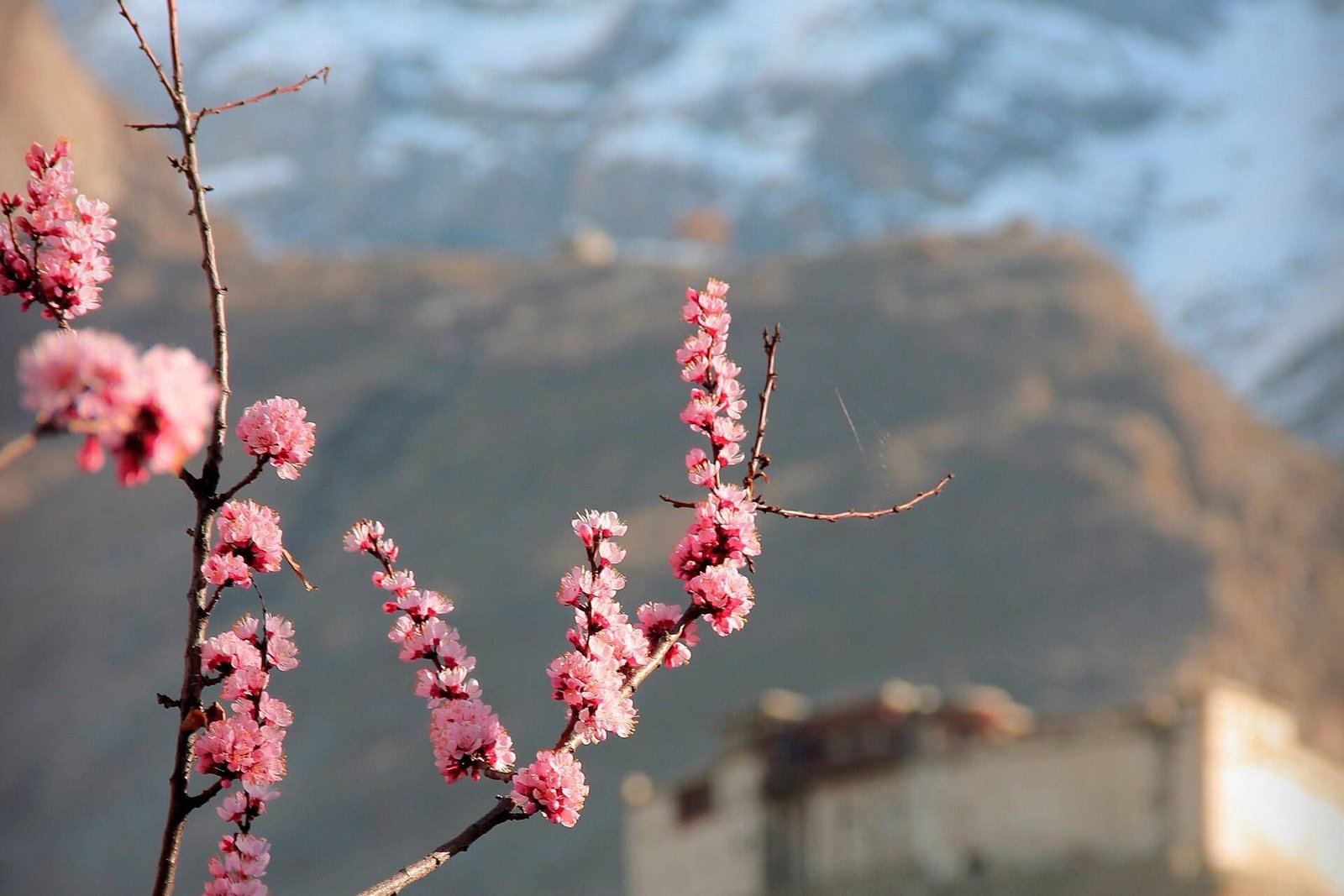
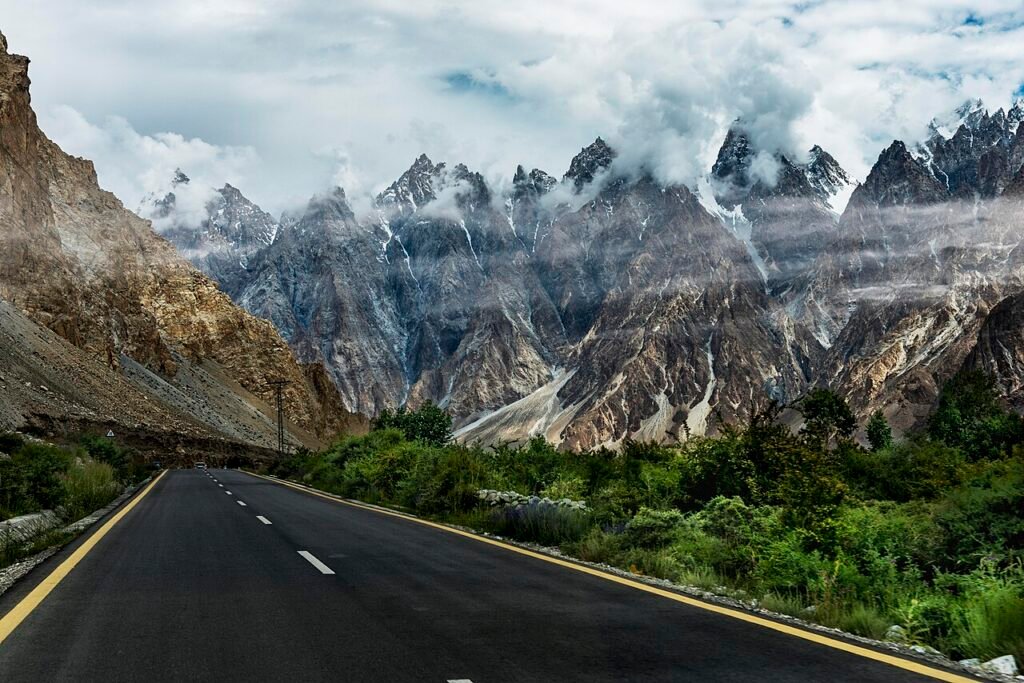
Breakfast in Karimabad, I was in a t-shirt, squinting at Rakaposhi through apricot blossom and strong sun. By two o’clock I was standing at the Khunjerab Pass, 4,693 metres up on the Chinese border, in a down jacket and gloves, with wind coming off the snowfields hard enough to lean on. Same day. Same valley system. Nobody had warned me that what to pack for northern Pakistan is not really a question about luggage — it is a question about altitude, and about how fast this landscape changes its mind.
That is the whole problem in one day: a road trip here can climb more than 2,000 vertical metres between lunch and tea. Valley floors bake. Passes bite. Guesthouse rooms at night are colder than the street at noon. The travellers who struggle in Gilgit-Baltistan are almost never the ones who packed too little — they are the ones who packed for one season and met four.
The answer is one layering system, adjusted by season, plus the handful of non-clothing things — cash, a local SIM, the right plug — that actually decide whether a trip runs smoothly. For the broader essentials inventory, pair it with our full essentials checklist for Gilgit-Baltistan, which covers the general kit this guide deliberately doesn’t repeat.
Disclosure: This article contains affiliate links to Amazon. If you buy through them, I earn a small commission at no extra cost to you — it helps keep this site running and the chai hot.
The Short Answer
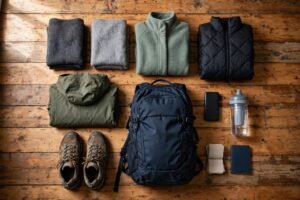
Pack one three-layer clothing system — a wicking base, an insulating mid, a windproof shell — and adjust its weight to your season, because northern Pakistan serves all four seasons inside a single day’s drive. Add broken-in walking shoes, more cash than feels reasonable, an SCOM SIM bought in Gilgit or Skardu, a Type C/D adapter, and a power bank. Leave the rest of the space in your bag empty: the bazaars will fill it better than you can.
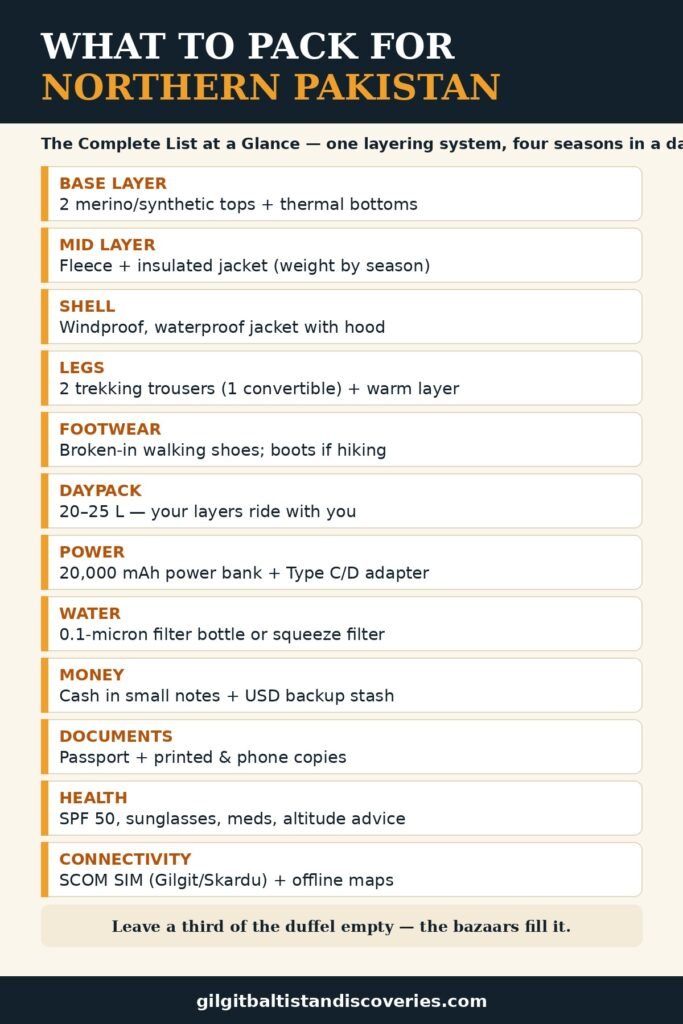
The Complete List at a Glance
| Category | Pack this | Why |
|---|---|---|
| Base layer | 2 merino or synthetic tops, 1 set of thermal bottoms | The engine of the whole system; cotton stays cold when wet |
| Mid layer | Fleece or light insulated jacket; down jacket weight set by season | Trapped air is your warmth, added and shed in minutes |
| Shell | Windproof, waterproof jacket with a hood | Pass wind, not temperature, is what actually bites |
| Legs | 2 trekking trousers (1 convertible), 1 warm layer for nights | Jeans are heavy, slow to dry, and cold when wet |
| Footwear | Sturdy walking shoes, broken in; boots only if hiking most days | 90% of this trip happens on roads, bazaars and village paths |
| Daypack | 20–25 L, rides in the vehicle with you | Your layers live here, not in the roof-racked main bag |
| Power | 20,000 mAh power bank + Type C/D adapter | Guesthouse sockets are few; load-shedding is real |
| Water | 0.1-micron filter bottle or squeeze filter | Tap water is not for visitors; bottled water adds up |
| Money | Cash in small notes + a USD backup stash | Working ATMs effectively stop at Gilgit and Skardu |
| Documents | Passport + printed and phone copies of passport and visa | Checkpoints on the KKH ask, often |
| Health | SPF 50, sunglasses, basic meds, any altitude medication your doctor approves | Sun at 3,000 m is not the sun you know |
| Connectivity | SCOM SIM (bought in Gilgit or Skardu) + offline maps | The only network that follows you into the valleys |
How Cold Does It Actually Get? The Four-Seasons Problem, in Numbers
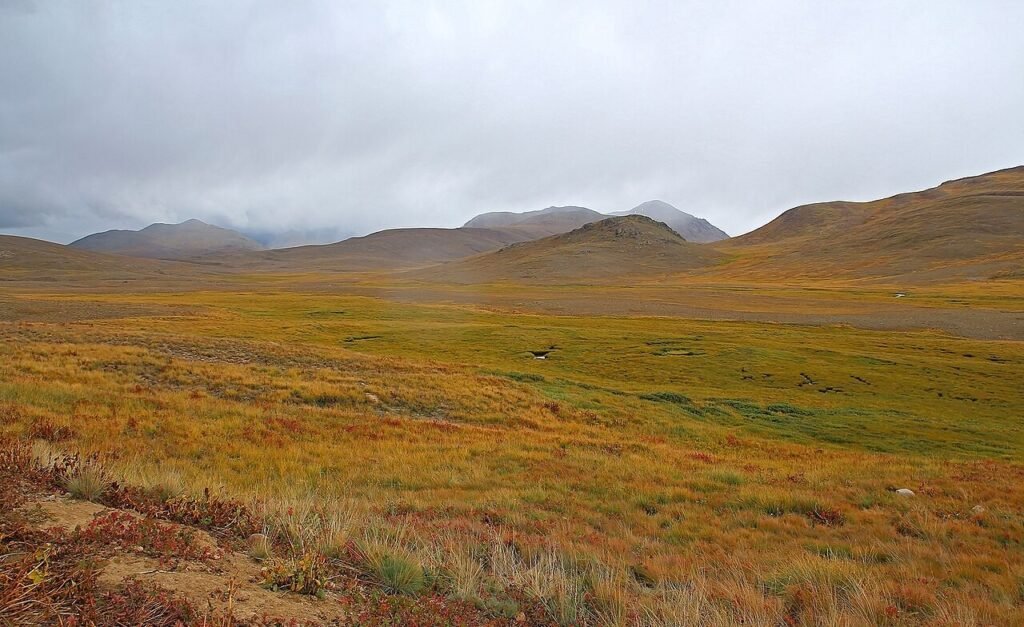
Air cools roughly 6 °C for every 1,000 metres you climb. Karimabad sits near 2,450 m; the Khunjerab day trip tops out at 4,693 m; Deosai’s plateau averages over 4,000 m. So a 28 °C afternoon in a Hunza orchard and a wind-chilled 5 °C at the pass are not bad luck — they are arithmetic. Pack for the arithmetic.
These are typical valley-town ranges (sources vary, and altitude overrides everything — treat them as planning bands, not promises):
| Season | Karimabad (Hunza) day / night | Skardu day / night | What changes in the system |
|---|---|---|---|
| Spring (Mar–May) | 12–22 °C / 2–9 °C | 14–24 °C / 3–10 °C | Standard system; blossom-season days are warm, passes still wintry — keep the down jacket mid-weight |
| Summer (Jun–Aug) | 23–30 °C / 13–18 °C | 27–34 °C / 15–20 °C | Lightest base layers; swap the heavy down for a light insulated jacket — you will still use it every evening and at every pass |
| Autumn (Sep–Nov) | 10–22 °C / −2–8 °C | 12–24 °C / 0–8 °C | The system earns its keep: golden days, freezing nights by late October — mid-weight down returns |
| Winter (Dec–Feb) | 0–7 °C / −12–−4 °C | −3–5 °C / −15–−7 °C | Full expedition logic: heavy down, insulated trousers, serious gloves; many high roads and services close |
If you are still deciding when to come, our month-by-month guide to the best time to visit Hunza Valley walks through each season’s trade-offs in detail.
The Layering System: Three Layers, Zero Regrets
Base layer: what touches your skin
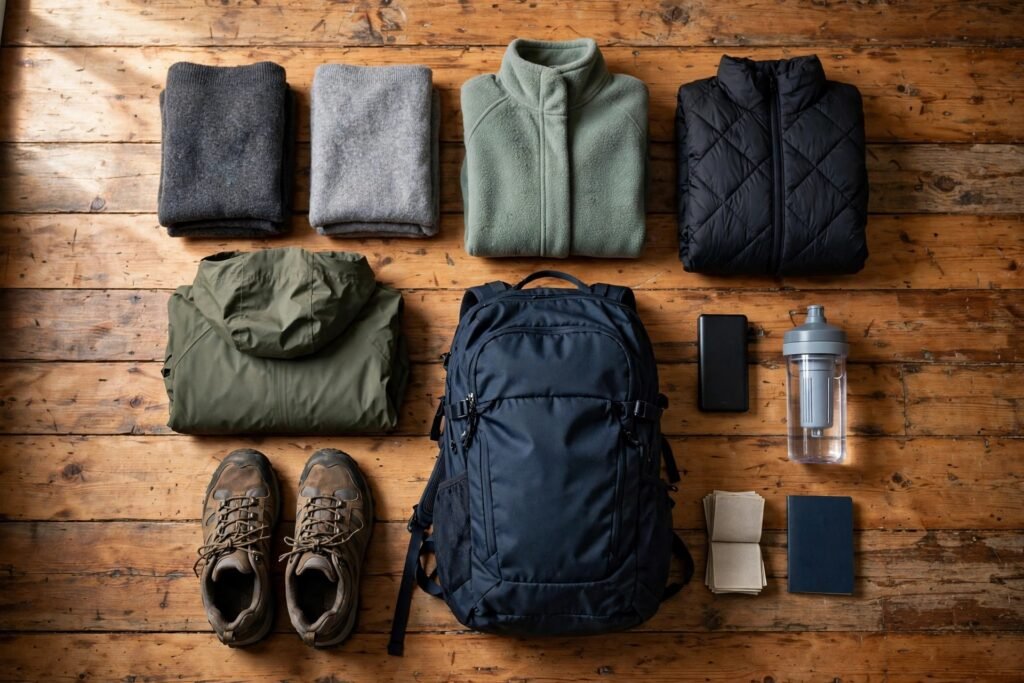
Choose merino wool or a technical synthetic, and understand why: both move sweat off your skin and keep insulating when damp. Merino smells better over a five-day road trip and regulates temperature beautifully; synthetics dry faster and cost less. Either works. What does not work is cotton. A cotton t-shirt soaked with sweat at 3,500 m, hit by pass wind, will chill you faster than wearing nothing extra at all — mountaineers call it the fabric that kills, and on a breezy viewpoint above the Karakoram Highway you will understand the nickname. Two tops, rotated, plus one set of thermal bottoms for nights and high days, is the whole base-layer wardrobe. A good starting point is a merino wool base layer set in a mid weight you can wear three seasons of the year.
Mid layer: the warmth you can shed
Your mid layer is trapped air: a fleece for active warmth, plus an insulated jacket whose weight is your one seasonal decision. In summer, a light packable down or synthetic jacket is enough — evenings in Karimabad drop into the teens and the passes still demand it. In spring and autumn, go mid-weight. In winter, this layer becomes a real expedition parka and the fleece stays on under it all day. Look for something that compresses into its own pocket, like the lightweight packable down jackets in the 300–400 g class — on a road trip, warmth you can’t pack small is warmth you’ll leave behind.
Shell: the layer that fights the wind
Most ‘cold’ moments in northern Pakistan are wind moments: the funnelled blast at the top of Babusar, the evening flow off a glacier, an open jeep ride to Fairy Meadows. A hooded, windproof and waterproof shell over your mid layer defeats all three. It needs sealed seams, a hood that cinches, and room to fit over your insulation without squeezing the air out of it — not an expedition price tag.
What Shoes Do You Actually Need?
One pair, chosen by itinerary, broken in before you come — that is the entire rule.
If your trip is the classic circuit — Karimabad and Altit, Attabad Lake, Nagar, Skardu town, Shigar, day walks to viewpoints — sturdy walking shoes or trail shoes with real tread are enough, and kinder to your feet over long bazaar-and-fort days than stiff boots. The ground is rocky and uneven, but it is paths, not technical terrain.
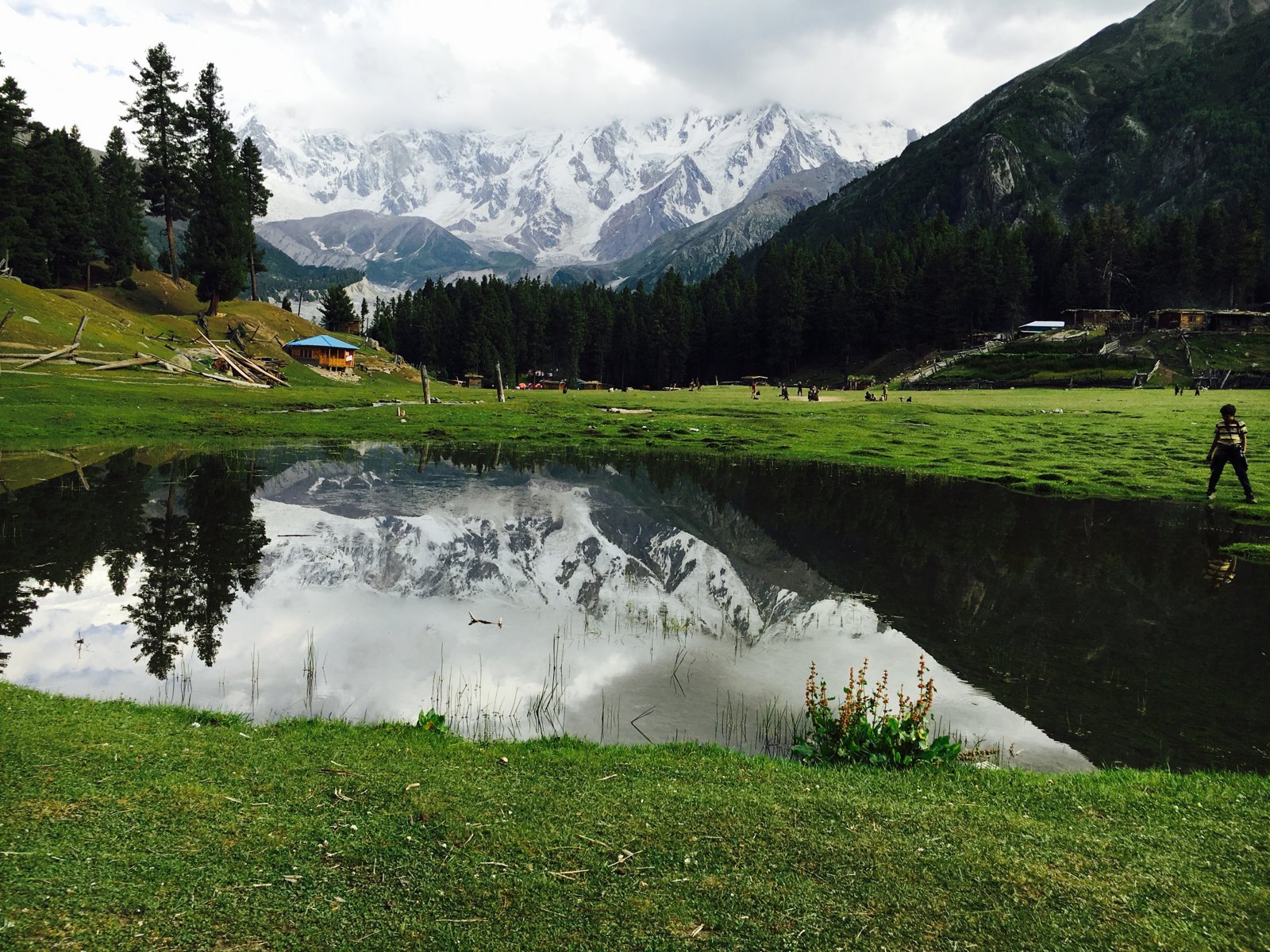
Boots earn their space when your days tilt toward hiking: the walk up to Fairy Meadows and on to Beyal Camp, the Rakaposhi base camp trail from Minapin, glacier viewpoints in Hopar. Then a waterproof mid boot with ankle support pays for its weight — the KEEN Targhee 3 is the class of boot I mean: not a mountaineering boot, just honest support and grip. Whichever you choose, wear it for at least two weeks at home first — new footwear and mountain paths is a combination with a guaranteed ending, and it is not a happy one. Add two merino sock pairs and light slip-ons for guesthouse evenings.
How Do You Pack It All? Bags, Cubes and the Mountain-Road Rule
Your main bag will ride on a roof rack, in a jeep’s open back, and up a flight of guesthouse stairs, so make it soft, tough and carryable: a duffel or soft-sided case beats a rigid suitcase on every mountain road. Our test of travel duffels that survive rough handling covers what actually lasts. Inside it, organisation is what keeps a ten-day trip sane — I use the cube system in our packing cubes guide for minimalist travel: one cube per layer, one for small things, one that slowly fills with laundry.
Two more pieces do quiet, essential work. A 20–25 L travel daypack rides inside the vehicle with you and carries the day’s layers, water and documents — because the jacket you need at the pass is useless zipped into a bag on the roof. And a set of waterproof dry bags inside the main duffel insures your warm layers against the classic Karakoram combination: an open vehicle, a river valley, and weather arriving from nowhere.
Documents and Money: The Cash Reality
Bring your passport — and bring copies like you mean it. The Karakoram Highway has checkpoints where foreign travellers register, sometimes a dozen or more on a long drive, and printed photocopies of your passport and visa (plus photos of both on your phone) turn each stop into a two-minute formality instead of a roadside negotiation. Keep a document wallet in your daypack, never in the roof bag.
Money is simpler and stricter: northern Pakistan runs on cash. Working ATMs effectively stop at Gilgit and Skardu — a machine exists in Karimabad, but travellers find it empty or offline often enough that no sensible plan depends on it, and beyond the towns there are none at all: not in Passu, not in Gulmit, not anywhere near Fairy Meadows. Foreign cards are unreliable even where machines exist. So withdraw or exchange a generous stack of rupees in Islamabad or Gilgit before you turn north, break it into small notes (a guesthouse owner in Hopar cannot change your Rs 5,000 note), and split it between two hiding places. A modest backup of clean US dollars rides along for true emergencies; dollars exchange easily in Gilgit if a plan collapses.
What Plugs, Power and Signal Can You Expect?
Pakistan uses Type C and Type D sockets at 230 V — the two-round-pin and the three-round-pin triangular patterns. British plugs (Type G) do not fit, and neither do American ones, so an adapter is not optional. Rather than another Amazon tab, start with our own tested roundup of travel adapters that work across countries — the universal model there handles both Pakistani socket types. The good news for UK travellers: at 230 V, your chargers need no voltage conversion, just the plug shape.
Power itself is the second problem. Valley guesthouses have few sockets and load-shedding is a fact of life, so a 20,000 mAh power bank is not a convenience here; it is your camera, torch and map insurance across long road days. I carry the Anker PowerCore 20,100 mAh — roughly four phone charges, and it has never once been the thing I regretted packing. A small rechargeable headlamp completes the kit: unlit village paths, midnight power cuts, and early starts for sunrise viewpoints all argue for one.
Signal follows a pattern most visitors get wrong. The national networks — Zong and Jazz — work respectably in Gilgit, Karimabad and Skardu, then thin out fast in the side valleys. The network that follows you into Upper Hunza, Ghizer and the remoter corners of Baltistan is SCOM, the regional operator, which topped the telecom regulator’s 2026 quality survey for Gilgit-Baltistan outright. Buy the SCOM SIM in Gilgit or Skardu (passport and visa copy required; use an official franchise, not a roadside seller), and download offline maps before you leave the last strong signal — Deosai and the high side valleys have honest, complete dead zones, and they are better enjoyed that way anyway.
Health, Sun and Altitude: The Quiet Section That Matters Most
The sun at altitude is a different substance. UV intensifies with every thousand metres, the air is dry enough to hide the burn until evening, and snowfields and the turquoise glare off Attabad Lake multiply it. SPF 50, reapplied; sunglasses you would actually wear all day; a brim or cap; lip balm with SPF. This is the least glamorous advice in this article and the kind travellers most often wish they had taken seriously.
Water: do not drink the tap water, however crystalline the streams look — glacial silt and village plumbing are separate issues, and both argue for filtering. A 0.1-micron filter like the Sawyer Squeeze turns any tap or stream into safe water for years of trips and quietly deletes a mountain of single-use plastic bottles from your journey.
Altitude deserves respect without drama. Most itineraries sleep between 2,000 and 2,500 m — high enough for poor sleep the first nights, low enough to adjust quickly. The real exposure comes on day trips: the Khunjerab Pass at 4,693 m is a climb of over 2,200 m from Karimabad in a few hours, and Deosai sleeps you above 4,000 m if you camp. Headache, nausea and unusual tiredness up there are information, not weakness: hydrate, take the day gently, and descend if symptoms build — the CDC’s guidance on travel to high altitudes is the clearest short brief on recognising altitude illness. Carry personal medications in hand luggage (valley pharmacies are basic), plus rehydration salts, plasters, painkillers, and something for a traveller’s stomach. Altitude medication is a conversation for your own doctor before the trip, not for a checklist.
How Should You Dress Out of Respect for Local Culture?
Gilgit-Baltistan is welcoming, relaxed and deeply hospitable — and also a conservative, majority-Muslim mountain society where modest dress reads as simple good manners. The practical version is undemanding: trousers or long skirts rather than shorts, shoulders covered, nothing skin-tight as your only layer in villages and bazaars. For women travellers, that usually means loose trousers or a long dress with a light shawl to hand — the shawl earns its place a dozen ways (mosque visits, sun, evening chill, a family’s courtyard tea). Karimabad’s tourist cafés are more relaxed than a Nagar village lane; read the place, mirror the women around you, and you will be met with the warmth this region is famous for. A dedicated women’s guide is coming; for now, the system above already packs modestly by design.
What Should You NOT Pack?
- A second big bag. Mountain vehicles, roof racks and guesthouse stairs tax every extra kilo; one duffel plus a daypack is the ceiling.
- A single-season outfit. A bag built only for summer — or only for winter — fails by the second pass. The system flexes; a fixed wardrobe doesn’t.
- Valuables you would grieve. Good jewellery, the irreplaceable watch, the laptop you don’t truly need. Leave them; the mountains are not impressed, and you will relax more.
- Jeans as your only trousers. Heavy, cold when wet, slow to dry in unheated rooms. One pair for towns if you love them — never the plan.
- A hairdryer and a ‘just in case’ pile. Valley wiring and your own back both vote no. If an item’s only job is soothing anxiety, it stays home.
Leave Space: What to Buy in the Bazaars Instead
The wisest line on this whole list is the empty third of your duffel. Northern Pakistan will fill it with things better than anything you flew in with: a genuine pashmina or heavy local wool shawl in Karimabad or Gilgit — warmer than the fleece it replaces, bought from the hands that made it. Woollen caps and socks in every bazaar. Walnuts, dried apricots and mulberries from the harvest valleys, sold by the kilo for a fraction of home prices. Buy your warm layer here, wear it through the coldest week of your trip, and take it home as the souvenir that actually gets used.
Frequently Asked Questions
How much cash should I carry in northern Pakistan?
Carry more than feels comfortable — enough rupees for your full time north of Gilgit, withdrawn or exchanged before you leave Islamabad or Gilgit. ATMs effectively stop at Gilgit and Skardu, foreign cards are unreliable, and guesthouses, drivers and cafés are cash businesses. Split the stack, keep small notes handy, and hold a small USD backup for emergencies.
What shoes are best for a Hunza and Skardu road trip?
Sturdy, broken-in walking or trail shoes cover almost everything: forts, bazaars, village paths and lake viewpoints. Step up to waterproof hiking boots with ankle support only if your itinerary is hike-heavy — Fairy Meadows, the Rakaposhi base camp trail, glacier viewpoints. Never bring new footwear; two weeks of home wear first is the rule.
Do I need a down jacket in northern Pakistan in summer?
Yes — a light one. Valley towns reach the high 20s °C by day, but evenings drop into the teens, and every high point on the route (Khunjerab at 4,693 m, Deosai above 4,000 m, Babusar Top) can sit near freezing with wind, in any month. A packable insulated jacket is the single most-used item in most travellers’ bags.
What adapter do I need for Pakistan?
Pakistan uses Type C and Type D sockets at 230 V, so bring a universal adapter that covers both — neither US nor UK plugs fit directly. UK chargers need only the plug shape, not a voltage converter, since Pakistan runs at 230 V like the UK. Pair the adapter with a power bank; valley sockets are scarce.
Can I do laundry, or buy gear locally if I forget something?
Yes to both, within limits. Guesthouses and town laundries in Gilgit, Karimabad and Skardu wash clothes cheaply, though drying takes longer in the cold months. Bazaars stock warm layers, shawls, gloves and basic outdoor kit easily; branded technical gear and specific footwear are scarce, so technical items — boots, filters, power banks — should come with you.
Packing Is a Way of Paying Attention
Every traveller I have watched fall in love with these mountains packed, in the end, the same way: lightly, warmly, and with room left over. Dress for the pass, not the café. Carry cash like the ATMs have already failed, because one of them has. Buy the shawl in the bazaar instead of flying it in. Do that, and when the day swings from blossom to snowfield and back again before dinner, you will not be thinking about your bag at all — which is exactly what a good packing list is for.
Going deeper? If your trip grows from road trip into real trekking, the K2 base camp trek packing list is this system’s expedition-grade big sibling — same philosophy, colder numbers.