Last updated: October 2026
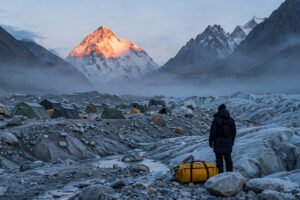
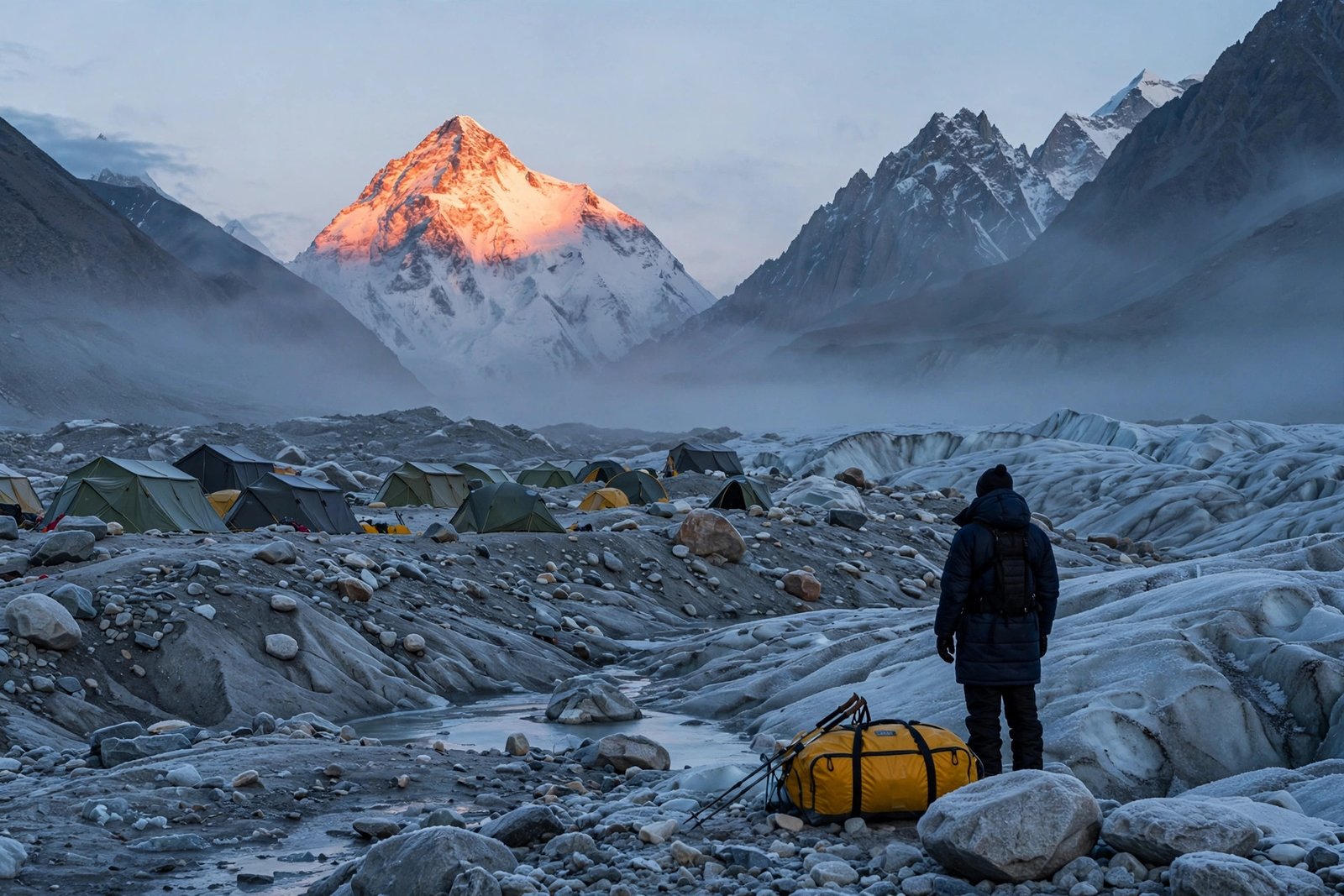
There is a moment, about four days into the walk up the Baltoro Glacier, when the scale of the place stops being scenery and becomes a physical fact. The ice complains under your boots. The moraine shifts. Somewhere ahead, hidden behind Gasherbrum IV’s shoulder, is the second-highest mountain on Earth — and the only weather forecast that matters is the one written on your own skin.
Nobody tells you this part in Skardu, where the packing happens in warm hotel rooms and everything feels theoretical. Out here, your gear list is not a shopping exercise. It is the difference between standing at Concordia at dawn, watching K2 turn the colour of struck copper, and sitting in a tent at Goro II wondering why you came.
I have read a lot of K2 base camp trek packing lists. Most of them read like they were written by someone who never left the airport. This one is written the other way: from the glacier backwards. Here is everything you actually need, why you need it, and the specific pieces I would put in the duffel.
Disclosure: This article contains affiliate links to Amazon. If you buy through them, I earn a small commission at no extra cost to you — it helps keep this site running and the chai hot.
Table of Contents
ToggleThe Short Answer
Your personal duffel must stay at or under 15 kg — a porter carries it, and loads are regulated. From Askole, the trek takes 6–7 days to Concordia (4,600 m) and K2 base camp at roughly 5,000 m, where nights fall to −10 °C or colder even in July and August. The non-negotiables: a 0 °F (−18 °C) sleeping bag, an expedition-weight down parka, broken-in waterproof boots, Category 4 glacier glasses, a water filter, and a 20,000 mAh power bank. The full list, with the reasoning and the specific gear, is below.
The Complete List at a Glance
| Category | Pack this |
|---|---|
| Duffel | 90–100 L expedition duffel with lockable zips — 15 kg max, packed |
| Sleeping bag | 0 °F (−18 °C) down bag, 800 fill power, mummy cut with draft collar |
| Insulation | Box-wall expedition down parka with a big insulated hood |
| Boots | Stiff, waterproof trekking boots, broken in for at least a month |
| Traction | Strap-on ice cleats for icy morning moraine |
| Poles | One pair of trekking poles, carbon or cork grip, with snow baskets |
| Eye protection | Category 4 glacier glasses with side shields, plus a retainer strap |
| Light | Rechargeable headlamp, around 500 lumens, red mode, IP67 waterproofing |
| Power | 20,000 mAh power bank, plus a universal adapter (Pakistan: Type C/D plugs, 230 V) |
| Water | 0.1-micron squeeze filter, plus a bandana as a silt pre-filter |
| Sun | SPF 50 sunblock and SPF lip balm |
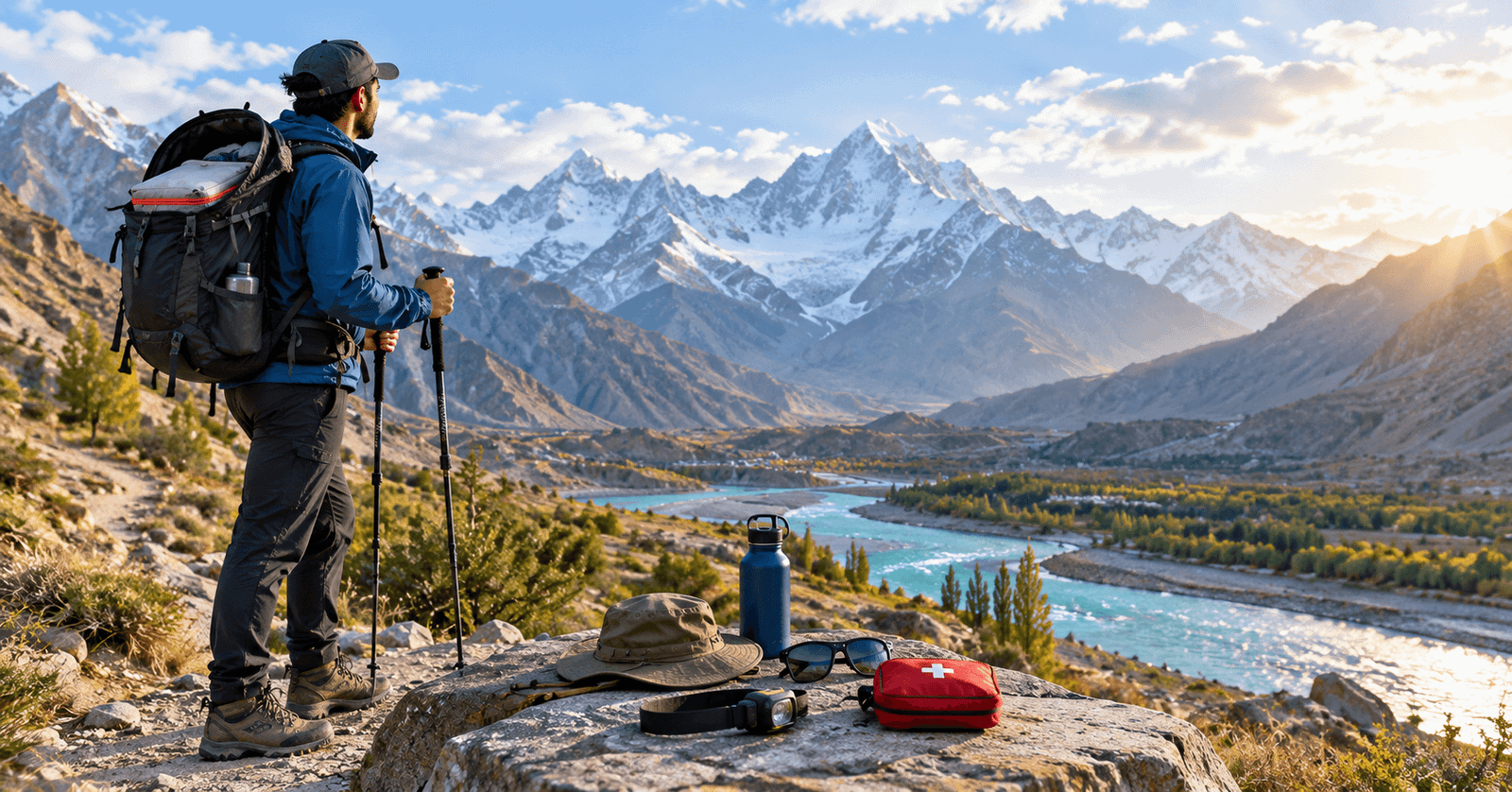
| Health | Electrolytes, doctor-approved altitude medication, a real first aid kit |
| Small essentials | Pee bottle, two buffs, liner gloves plus mitts, hand warmers, paper journal |
If your trip also includes valley time — Skardu town, jeep roads, lower trails — note that this list is deliberately glacier-specific; our general packing list for Gilgit-Baltistan covers the rest of the region.
What Conditions Are You Packing For?
The logistics shape the list. From Skardu, a jeep grinds for six or seven hours to Askole, the last village, where the road simply gives up. After that, everything moves on two legs — yours, and a porter’s. Most operators ask you to keep your personal duffel to around 15 kg. That single number should discipline every decision you make.
The walk itself takes most people six to seven days to Concordia (4,600 m), where the Baltoro and Godwin-Austen glaciers collide in an amphitheatre of giants: K2, Broad Peak, Gasherbrum IV. (The Baltoro runs 63 km end to end — one of the longest glaciers on Earth outside the polar regions.) K2 base camp itself sits near 5,000 m. Even in the peak months of July and August, nights at Concordia and above can fall to −10 °C or colder, and the Karakoram does not care what the calendar says. Snow in July is not an anomaly. It is a personality trait.
Altitude is the quiet variable in all of this. Acute mountain sickness (AMS) — the mildest form of altitude illness — can start above roughly 2,500 m, and the trek sleeps above 4,000 m for days. The CDC’s guidance on travel to high altitudes recommends gaining no more than about 500 m of sleeping elevation per day once you are above 3,000 m, and taking medicines to prevent AMS only after talking to your doctor. The itinerary’s slow days are not padding. They are the mechanism that gets you there.
So: pack for deep cold, brutal sun, silty water, zero electricity, and a hard weight limit. In that order. And pack for the glacier’s sake as well as yours — everything you carry onto the Baltoro has to come back off it. The Leave No Trace seven principles were written for exactly this kind of fragile place: pack it in, pack it out, and leave the ice as you found it.
Which Duffel Bag Can Survive the Baltoro?
Everything you own for two weeks gets strapped to a porter’s back, dragged across moraine — the gravel, rock, and rubble the glacier carries on its surface — and occasionally dropped in glacial dust. A suitcase will die. A trekking backpack is the wrong shape. What you want is a bombproof expedition duffel in the 90–100 litre range, with lockable zips and fabric that treats abrasion as a rumour.
The classic for a reason is THE NORTH FACE Base Camp Duffel – Large (95L). You’ve seen these on every expedition from Denali to the Khumbu — the laminated ballistics fabric survives being hauled over rock, and the backpack straps matter more than you’d think for the Skardu-to-Askole shuffle. Mine has been rained on, sat on, and used as a windbreak. It looks terrible and works perfectly, which is the correct relationship to have with a duffel. If you want the wider field compared before you buy, we tested the main contenders in our guide to how to choose a travel duffel that survives rough handling.
One honest limitation: the Base Camp Duffel is not light when empty, and it has no frame or hip belt, so it carries comfortably only for short hauls, not for a day’s walk. If your operator issues expedition duffels as part of the package — many do — skip this purchase entirely and put the money toward your sleeping bag instead.
What Sleeping Bag Rating Do You Need at 5,000 m?
Sleep is where altitude is won or lost. At Concordia, in a tent on ice, a bag rated to 0 °F (−18 °C) is not overkill — it is the baseline. Look for high-loft down (800 fill power if you can), a proper mummy cut with a draft collar, and hydrophobic treatment, because tent condensation is real even in a desert of ice. Fill power, in plain terms, measures how much a given weight of down expands: the higher the number, the more warmth you carry per gram — and grams are rationed by that 15 kg limit.
The bag I’d point most people to is the Hyke & Byke Eolus 0 °F — 800 fill power goose down, roughly three pounds, and priced like the company forgot what Western Mountaineering charges. Check the current listing and sizes here: 0 °F down sleeping bags on Amazon.
Its honest limitation: temperature ratings are not standardised across brands, and budget bags tend to rate optimistically. If you sleep cold, treat the Eolus’s 0 °F rating as your floor, not your safety margin — and budget for a warmer bag or accept some character-building nights. The shell fabric is also less burly than premium brands, so it earns a stuff sack and a little respect around camp.
Two hard-won details. First, sleep in your base layers, not your day clothes — damp clothing in the bag steals warmth all night. Second, throw tomorrow’s base layer and your boot liners (if removable) into the foot of the bag. Future you, at 5 a.m., will be grateful in a way that is difficult to overstate.
How Warm Does Your Down Jacket Need to Be?
You do not walk in this jacket. Walking, your layers and your own engine keep you warm. The expedition parka is for the other sixteen hours: cooking light fading over the Trango Towers, dinner in a mess tent that traps no heat at all, and the 4 a.m. start toward base camp when the cold has a texture, like glass.
What you want is a box-wall (not stitch-through) down parka with serious fill. The difference matters: stitch-through construction pinches the insulation to nothing at every seam, printing cold lines across your torso, while box-wall baffles sew the down into three-dimensional chambers with no compressed seams. Look for the class of jacket made by Rab’s Neutrino Pro or Fjällräven’s Expedition line: 800 fill power, a big insulated hood, and room to go over everything else you own. Browse current options here: expedition down parkas on Amazon.
A confession: the first time I did this trek, I brought a mid-weight “three-season” down jacket because it packed smaller. At Concordia I wore every item of clothing I owned, simultaneously, and still negotiated with the cold like a debtor. Buy the big jacket. Wear it on the plane if you have to. The only people who can consider skipping it are those whose itinerary turns around at Concordia without sleeping higher — and even they are gambling their dawn views on a mild night.
What Boots Work Best on Moraine and Glacier Ice?
The Baltoro is not a trail so much as a negotiation with rubble — days of walking on moraine that ranges from gravel to refrigerator-sized blocks, with glacier ice underneath. You need a stiff, supportive, waterproof trekking boot with a real shank and ankle support. You do not need a full mountaineering boot unless you’re continuing onto technical ground; the trek to base camp is a walk, albeit the hardest walk most people ever do.
A proven, wide-fitting option is the KEEN Men’s Targhee 3 Mid Waterproof Hiking Boot — KEEN’s roomy toe box is a genuine blessing at altitude, where feet swell, and the waterproof leather shrugs off glacial streams. Its honest limitation: the Targhee is a hiking boot, not a rigid mountaineering boot, so the sole flexes — comfortable over long walking days, but with less edging precision on steep, hard ice. For the standard trek to base camp, that is the right trade. If your itinerary adds a technical crossing such as the Gondogoro La (5,585 m), step up to a stiffer boot instead. On a tighter budget, the NORTIV 8 Men’s Mid Waterproof Hiking Boots are the value pick a lot of trekkers quietly swear by — with the caveat that the waterproofing and sole compound age faster than the KEEN’s. Treat it as a one-big-trek boot, priced accordingly, and it will not disappoint you.
Whatever you choose: break them in for a month before you fly. The Baltoro is a terrible place to discover a hot spot, because there is no version of this trek that gets shorter.
One more thing for your feet — the upper Baltoro and the walk into base camp can involve hard, icy sections, especially in the morning. A set of strap-on traction spikes weighs almost nothing and can save your dignity, or your ankle: Cimkiz crampon-style ice cleats with 19 stainless steel spikes. They are not technical crampons, and they don’t pretend to be. For icy moraine, that’s exactly the point.
Do You Need Trekking Poles on the Baltoro?
By day five, descending from Urdukas to Goro across loose moraine, poles stop being an accessory and become a philosophy. They take measurable load off your knees, they turn river crossings from gambles into walks, and on the glacier they are two extra points of contact with a world that is always slightly moving.
Carbon fibre keeps the swing weight low over eight-hour days. The BISINNA Carbon Fiber Trekking Poles — flip locks, folding design, about 460 g for the pair — are the ones I’d pack. One trade-off to know: carbon shafts can snap under a sideways load where aluminium would bend, so plant them vertically on moraine rather than levering off them. If you prefer a cork grip (genuinely nicer with sweaty or frozen hands, and it moulds to you over a long trek), the TREKOLOGY Trek-Z Cork Grip Trekking Poles fold down to a ridiculous 15 inches for the flight home.
Bring the snow baskets. On glacier sections you’ll be glad you did, and they weigh less than the regret.
What Sunglasses Prevent Snow Blindness at 5,000 m?
Snow blindness — photokeratitis, a sunburn of the cornea — is not a metaphor. Ultraviolet light at 5,000 m, reflected off kilometres of ice, can burn your eyes in hours, and the pain arrives in the night, like sand ground into them. Ordinary sunglasses — Category 3, the kind you’d wear driving — are not enough up here.
You want Category 4 lenses with side shields: the darkest standard lens category, letting through only about 3–8% of visible light, in proper glacier glasses. The design hasn’t changed in a century because it doesn’t need to. The Julbo Vermont Classic, with its round lenses and leather side shields, is the same silhouette Terray’s generation wore in these mountains — when you order, choose the Spectron 4 lens option for full glacier protection. One limitation to plan around: Category 4 lenses are too dark for driving, and illegal for it in many countries, so these are glacier-only glasses — pack your ordinary sunglasses separately for Skardu and the jeep road. And add a retainer strap. The Baltoro has claimed more sunglasses than any river in Pakistan, probably, and it is always hungry.
What Headlamp Do You Need for Alpine Starts?
Days on the Baltoro start before the first one does. Alpine starts toward base camp, midnight trips across frozen camp ground, reading in the tent while the wind works the flysheet — a headlamp is not optional equipment; it is how the trek is scheduled.
The BLACK DIAMOND Storm 500-R is built for exactly this: 500 lumens when you need to pick a line across the ice, a red mode that preserves night vision (and tent-mates’ tempers), IP67 waterproofing for the weather you will eventually get, and a rechargeable battery with an honest meter on it. The flip side of rechargeable is the one weakness: when it dies, it dies — there are no spare cells to swap in at 5,000 m, so make a habit of topping it up from your power bank each evening. Learn its lock mode before you go, so it doesn’t spend its battery illuminating the inside of your duffel at 30,000 feet over Turkmenistan.
How Do You Keep Everything Charged with No Electricity?
Between Askole and Concordia there is no electricity you can use. Solar panels sound romantic and underperform in Karakoram weather; what works is capacity, carried in. A 20,000 mAh power bank will keep a phone (your camera, your book, your lifeline to the weather forecast in Skardu) alive for the whole trek if you’re disciplined about it.
Charging starts before the glacier, though. Pakistan’s wall sockets are Type C and Type D, running at 230 V, so most North American plugs — and plenty of others — need an adapter for the Skardu hotel nights at either end of the trek. If you travel beyond Pakistan too, it is worth choosing one adapter that handles everywhere; here is which travel power adapter actually works across countries.
The Anker PowerCore 20,100mAh is the unglamorous, reliable standard — enough for four to five phone charges, tough enough for duffel life. The honest trade-off is weight: a 20,000 mAh bank is one of the heaviest single items in your daypack. If you carry only a sparingly used phone and a headlamp, a 10,000 mAh bank covers the trek at half the weight. If you want the wider field compared properly — capacity against real-world drain — see the portable charger guide for long international trips. Two cold-weather rules either way: sleep with the power bank in your sleeping bag, because lithium batteries lose charge fast at −10 °C, and keep your phone on airplane mode with the screen dim. The mountain will provide plenty to look at.
Can You Drink the Water on the Baltoro?
Your cook team will boil water, and mostly that system works. But “mostly” is a word that has ruined many treks — one bad litre can cost you the walk to base camp, and glacial water near camps carries everything the camps put into it. A personal filter is cheap insurance and weighs about three ounces.
The backpacking standard is the Sawyer Products SP129 Squeeze Water Filtration System: screw it onto a bottle or pouch, squeeze, drink. It filters bacteria and protozoa down to 0.1 microns and is rated for a frankly absurd 100,000 gallons. (It does not remove viruses — rarely the concern in glacial meltwater, where bacteria and protozoa are the realistic threat.) One caution: let glacial meltwater settle before filtering, or the silt will clog the filter and slow your flow — a bandana over the bottle mouth works as a pre-filter. And sleep with the filter in your bag on cold nights; a frozen filter membrane is a dead filter.
What Small Items Make the Biggest Difference?
A short list, earned the hard way:
- Sunblock, SPF 50, and lip balm with SPF. The burn at altitude comes from above and below. Nostril sunburn is real and I will not discuss it further.
- A wide-mouth pee bottle for the tent. Marked. Distinctly. You will thank me at 3 a.m. in a storm.
- Electrolytes and altitude medication, discussed with your doctor before you go — Diamox (acetazolamide) is a conversation, not a souvenir.
- Two buffs/neck gaiters. One for sun, one for dust on the jeep road. The Karakorum Highway dust gets everywhere, including your soul.
- Hand warmers and liner gloves inside proper insulated gloves. Mitts for base camp day.
- A journal. Not your phone. Paper. Some things should be written down at the speed of thought, not the speed of a dying battery.
Your medical kit deserves more than a bullet point on someone else’s list — what actually gets used at altitude is its own subject, and we have written it up properly in our guide to building a proper travel first aid kit.
Frequently Asked Questions
How cold does it actually get at K2 base camp? In peak season (late June to August), sunny glacier days can reach 10 °C, but nights at Concordia (4,600 m) and K2 base camp (about 5,000 m) regularly fall to −10 °C, with colder snaps possible in any month. Pack a 0 °F (−18 °C) sleeping bag and an expedition-weight down parka.
How much weight can I bring? Porters carry the duffel, right? Porters carry your main duffel between camps, but loads are regulated and most operators cap personal gear at about 15 kg per trekker. Weigh your packed duffel at home before you fly. Anything over the cap means extra porter fees — or leaving gear behind in Skardu, where doing without hurts the most.
Do I need mountaineering boots for the K2 base camp trek? No. The route to K2 base camp is non-technical: moraine, glacier ice, and camp trails. A stiff, waterproof, well-broken-in trekking boot plus strap-on ice cleats for icy mornings is the right setup. Reserve full mountaineering boots for itineraries that climb beyond base camp, such as the Gondogoro La crossing.
Can I drink the water on the Baltoro? Only after treatment. Camps provide boiled water; run it through a 0.1-micron filter such as the Sawyer Squeeze anyway, and let silty glacial water settle before filtering so it does not clog. Never drink directly from streams near camps — the water looks pristine and is not.
What is the single most common packing mistake? A sleeping bag rated too light for −10 °C nights — followed closely by boots that are not broken in. Cold and blisters end more Baltoro treks than weather does. Both mistakes are decided at home, weeks ahead, in the boring discipline of preparation — which is, in the end, what this entire list is for.
A Last Word, from Concordia
On my last morning at Concordia, I woke before the light and stood outside the tent in my big parka, headlamp off, watching the sky go the colour of a held breath. K2 does not perform. It simply is — enormous, indifferent, and more beautiful than the photographs, which is something photographs are supposed to prevent you from saying.
Everything on this list exists to buy you that moment: warm enough, rested enough, healthy enough to stand there and pay attention. Pack like it matters, because on the Baltoro, it is the only thing that does.
See you out there.