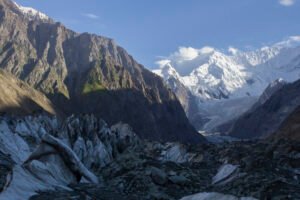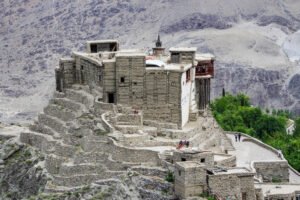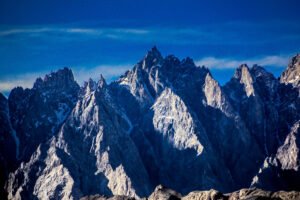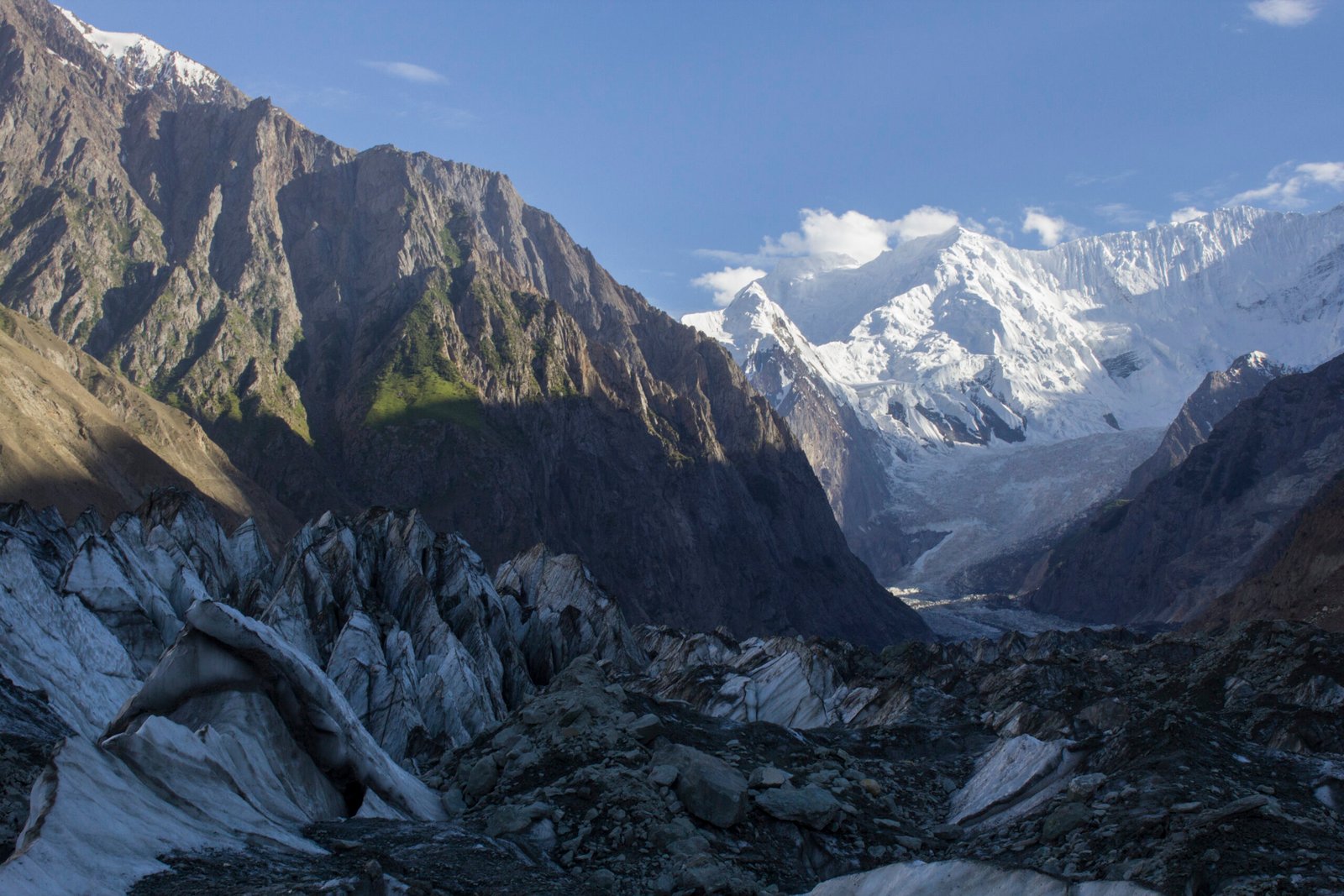
I have watched travellers get this question wrong in both directions. Some arrive in February expecting the Hunza of the postcards and find a valley shut down by snow, its hotels closed and its road a gamble. Others write off July entirely because someone told them “monsoon,” and miss the greenest Deosai and the wildest polo match on earth. Gilgit-Baltistan does not have one best time. It has four different regions, each peaking at a different moment, and the right answer depends entirely on what kind of traveller you are.
This guide is the map. It gives you the whole region month by month, the window for each valley in a few lines, and then hands you to the detailed guides where you need depth: our Hunza timing post for the valley that most people actually plan around, and our autumn colour calendar for the golden weeks.
Short Answer
The best overall window for a first trip to Gilgit-Baltistan is mid-May to mid-October, when the Karakoram Highway is fully open, the valleys are accessible, and every region is in play. Inside that window, the best month depends on you:
- Trekkers: June to September — high passes open, trails clear, and the big routes (K2 Base Camp, Fairy Meadows, Rakaposhi) are at their best.
- Sightseers and photographers: late September to late October — stable skies, harvest gold, and the autumn colour peak across Hunza, Nagar, Skardu and Khaplu.
- Blossom chasers: late March to late April — apricot and cherry blossom sweeping up the valleys, starting in Karimabad and reaching Upper Hunza weeks later.
- Budget travellers: May or November — shoulder-season prices, thinner crowds, and (in May) almost everything open; in November, only the low valleys.
- Winter adventurers: December to February — snow, frozen lakes and empty valleys, but only if you accept flight cancellations, closed high routes and limited services.
The honest rule underneath all of it: altitude decides everything. A valley town at 2,400 metres and a pass at 4,700 metres are in different seasons on the same day. Plan by elevation, not by calendar alone.
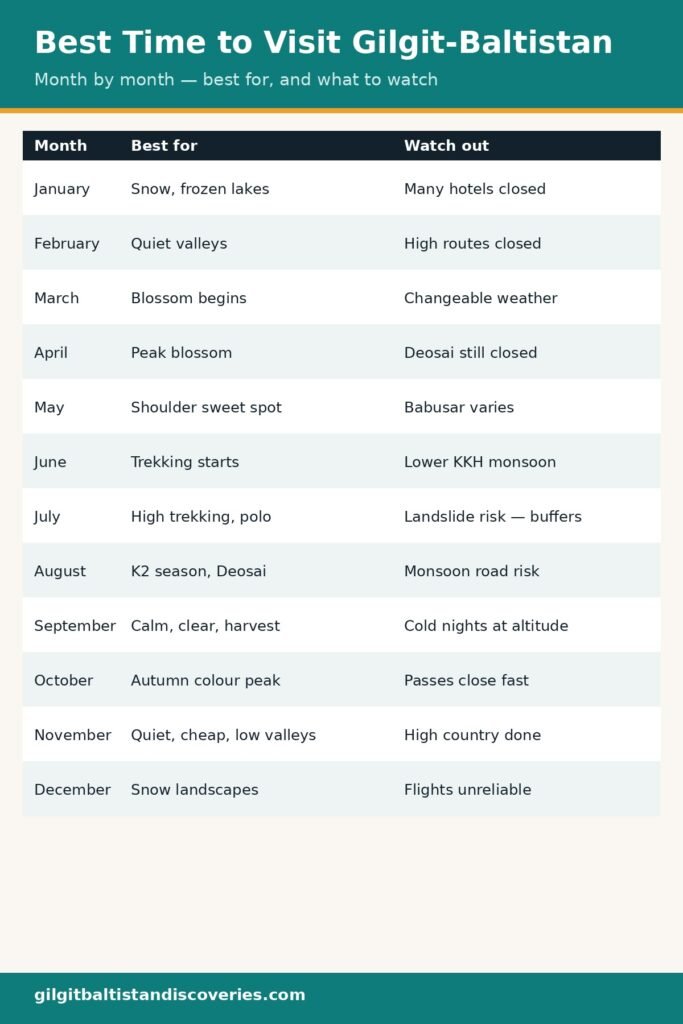
The Year at a Glance: Month by Month
| Month | Weather (valley towns, typical) | Access | What’s good | Watch out |
|---|---|---|---|---|
| January | Coldest month; Skardu nights commonly below −10°C, days below freezing | KKH open via Chilas; high routes closed; flights weather-dependent | Snow scenery, frozen lakes, empty valleys, winter photography | Many hotels closed; Babusar and Deosai shut; flight cancellations common |
| February | Still cold; first early blossoms at the lowest elevations | As January | Quiet valleys; earliest blossom hints in places like Chunda Valley late in the month | Cold, limited services, high routes closed |
| March | Transitional; changeable — rain or late snow possible | KKH open; high passes still closed | Blossom begins in Karimabad late in the month; spring light returns | Unpredictable weather; don’t plan high treks yet |
| April | Mild days, cool nights; blossom season across Hunza and several Skardu-area valleys | Most low-to-mid valleys accessible | Peak blossom — the region’s prettiest weeks; comfortable sightseeing | Deosai and Minimarg still closed; some trails snowbound |
| May | Warming fast; green valleys, long days | Almost everything except Deosai open; Babusar typically opens late May | Shoulder-season sweet spot: open roads, lower prices, fewer crowds | Deosai usually not yet open; Babusar opening date varies by year |
| June | Warm days, cool nights; summer begins | Deosai road generally opens; Khunjerab fully accessible | Trekking season starts; Ginani harvest festival in Hunza (~21 June); wildflowers begin | Monsoon influence begins on lower KKH sections; check road advisories |
| July | Warmest month; historically the region’s wettest | All routes open, including Shandur Pass | High trekking at its best; Shandur Polo Festival (usually 7–9 July); Deosai green | Highest monsoon-related road risk of the year — landslides on the lower KKH; build in buffer days |
| August | Warm; Deosai at its greenest | All routes open | K2 Base Camp season; Deosai wildflowers and wildlife; summer festivals | Still monsoon-influenced; same road-check advice as July |
| September | Cooling; generally more stable than July–August | All routes open; Deosai open | A local guides’ favourite: calmer, less crowded, clear light; harvest begins; Silk Road Festival season in Hunza (Sep–Oct) | Nights turn cold at altitude; pack layers |
| October | Cool days, cold nights; peak autumn colour | Deosai closes by the last week most years; Babusar closes with snow (it shut on 11 October 2026) | Autumn colour peak — Gulmit and Passu ~mid-October, Karimabad late October; photography at its best | Pass closures arrive fast; check Babusar and Deosai status before you go |
| November | Cold sets in; high valleys begin snowing over | KKH via Chilas remains the lifeline; high routes closing or closed | Quiet, cheap, low-altitude visits; late autumn colour in the lowest valleys early in the month | Most high attractions closed; services thinning out |
| December | Winter conditions established | KKH open via Chilas, weather permitting; Khunjerab officially year-round but snow-disrupted | Snow landscapes; the year’s quietest month | Road closures possible at higher elevations; flights unreliable |
Temperature figures are typical planning bands for valley towns, not promises — altitude overrides them everywhere. A pass 2,000 metres above your hotel can be 12°C colder on the same afternoon.
The Four Seasons, Honestly
Spring (March–May): blossom, then green
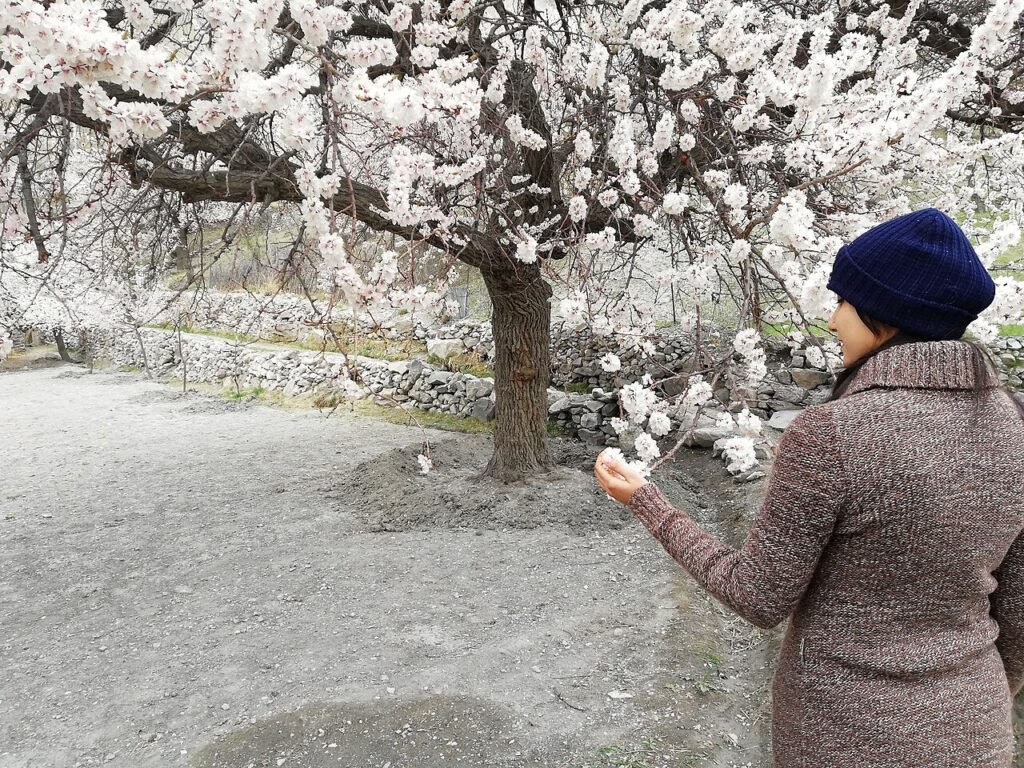
Spring arrives from the bottom up. The first apricot and cherry blossoms open in the lowest valleys in March, and the wave climbs: Karimabad in late March to early April, Upper Hunza in mid-to-late April. This is the gentlest season in the region — mild days, uncrowded roads, and villages waking up after winter. It is also the least predictable: a late snowfall can still dust the valleys in March, and the high country stays shut. Come in spring for blossom and culture, not for high passes.
For the full valley-by-valley blossom breakdown, our detailed guide to the best time to visit Hunza Valley tracks the bloom as it moves up the valley — it is the single most useful timing page on this site.
Summer (June–August): the trekking season — and the monsoon caveat
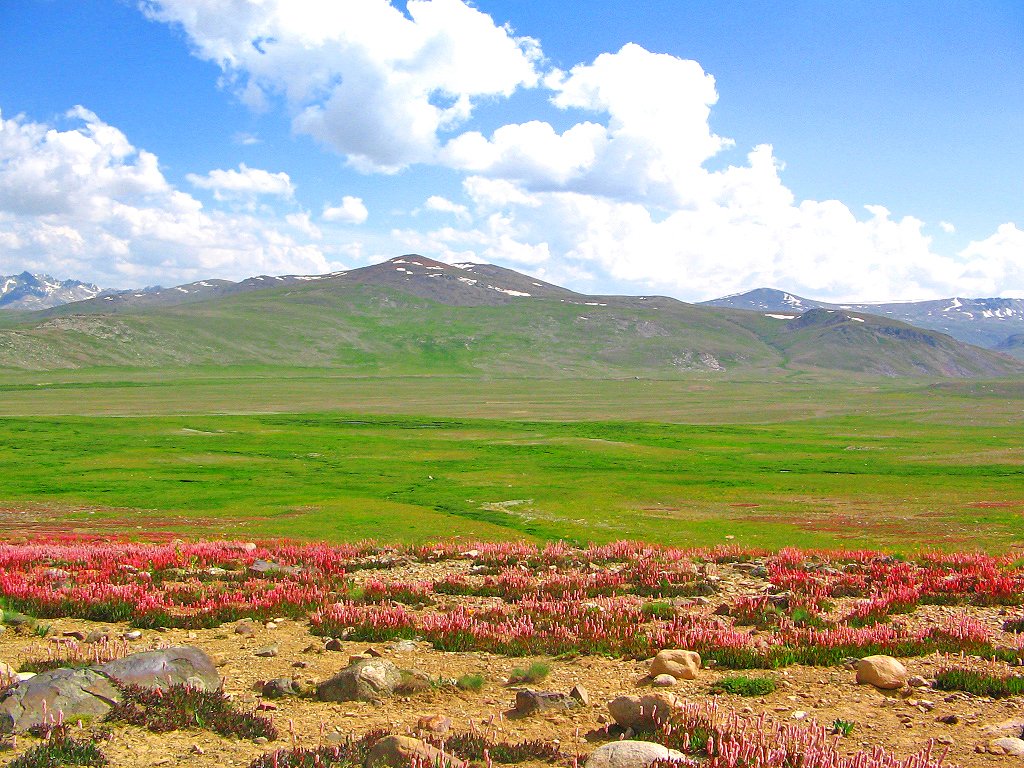
June to September is when Gilgit-Baltistan fully opens. Deosai’s road generally opens in June, the high treks clear, and the region runs at full capacity. This is the only window for K2 Base Camp, Snow Lake, and the high passes, and it holds the year’s biggest festivals.
The caveat is the monsoon — and it needs stating precisely, because it is widely misunderstood. Gilgit-Baltistan itself sits in a rain shadow and gets far less rain than the rest of Pakistan. The risk is not rain on your hotel; it is landslides on the lower Karakoram Highway, between Besham and Chilas, where monsoon rain loosens slopes. July is historically the wettest month and carries the highest road risk of the year. The fix is boring and effective: build in one or two buffer days, check road conditions before you set out, and don’t schedule a tight flight connection for the day after a long road journey. Travellers with buffer time routinely call July and August their best trips; travellers without it are the ones who get stuck.
Autumn (September–November): the photographer’s season
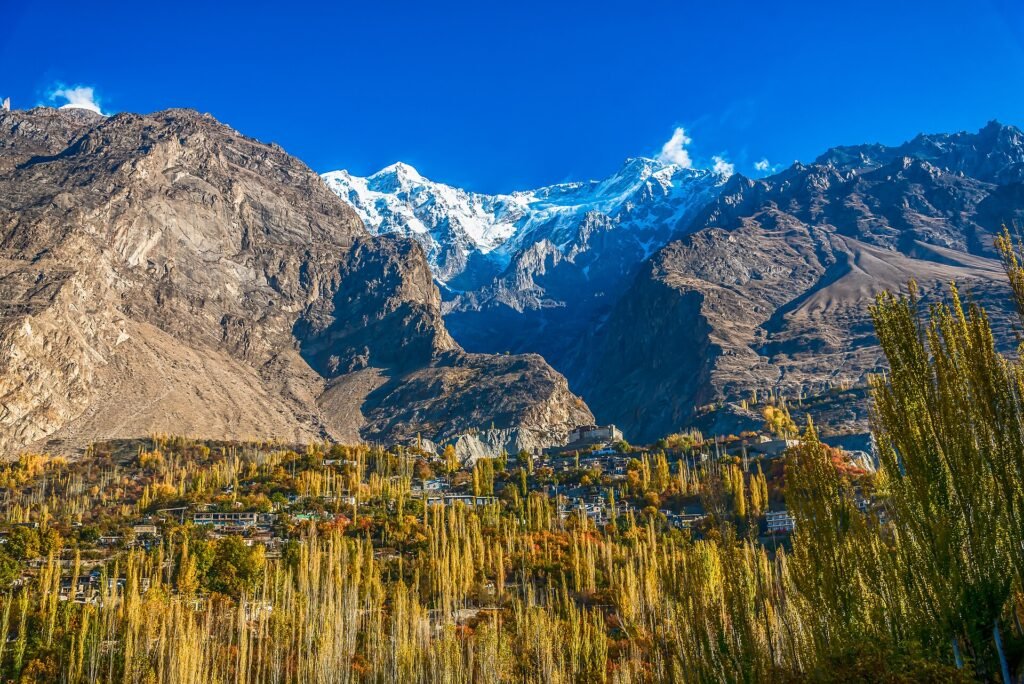
Ask a local guide for their favourite month and many will say September or October. The monsoon influence fades, the skies clear, the crowds thin, and then the colour arrives: Ghizer and Phander first in late September, central and Upper Hunza through October (Gulmit and Passu peaking around mid-October, Karimabad late in the month), Nagar and Khaplu running into early November, and the whole show fading by mid-November. October is also harvest season — walnuts, apples, sea buckthorn and dried fruit — which makes the villages feel more alive, not less.
The catch is that autumn ends abruptly at altitude. Deosai typically closes by the last week of October, and Babusar shuts with the first heavy snow — it closed on 11 October 2026. If your trip runs into late October, plan your high passes early in the itinerary, not late.
Our autumn colour calendar for Gilgit-Baltistan gives the week-by-week peak for every valley, plus the harvest season most guides ignore.
Winter (December–February): beautiful, and only for the prepared
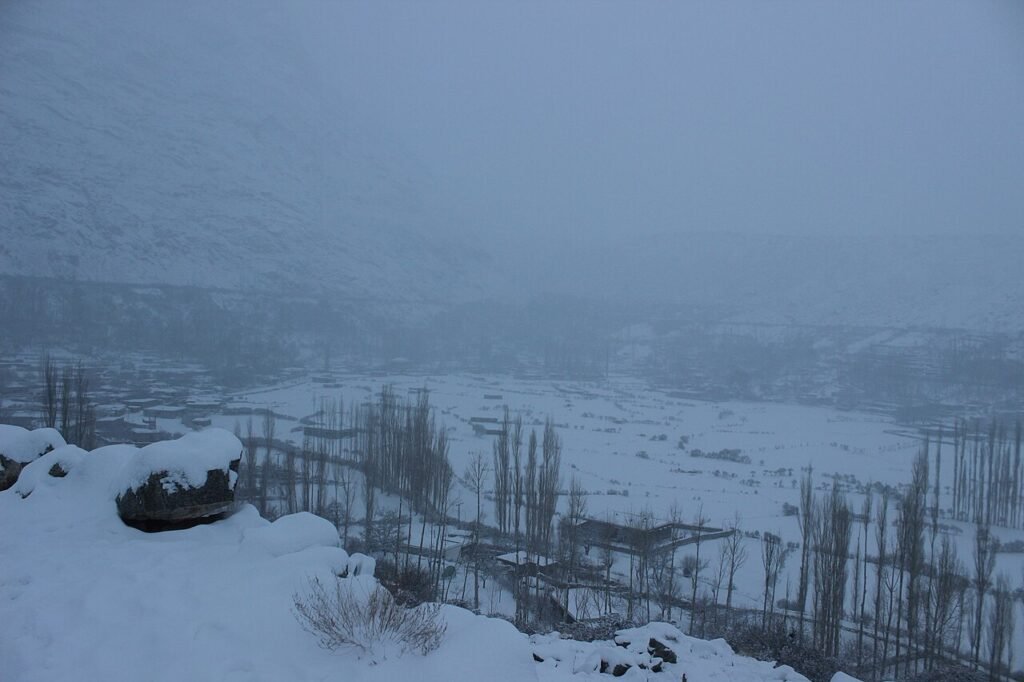
Winter in Gilgit-Baltistan is not a normal holiday. Skardu nights fall well below −10°C, many hotels close, flights to Gilgit and Skardu cancel in bad weather, and the high routes — Babusar, Deosai, the upper valleys — are shut. What you get in return is the region at its emptiest and most dramatic: snow, frozen lakes, and a local life that summer visitors never see. The Karakoram Highway via Chilas stays open as the lifeline, and Khunjerab Pass is officially open year-round since December 2024, though its high section is snow-disrupted in practice. Winter works for photographers and hardy travellers with flexible plans. It does not work for tight itineraries.
Best Windows by Region
Hunza Valley — late March to late April for blossom; mid-to-late October for autumn. The valley most people plan around, and the one with the sharpest timing: blossom starts in Karimabad in late March to early April and reaches Upper Hunza in mid-to-late April; autumn peaks in Gulmit and Passu around mid-October and in Karimabad late in the month, fading by mid-November. Summer (June–September) is warm, green and fully open. Full detail lives in our Hunza timing guide (linked in the spring section above).
Skardu and Baltistan — April to October for sightseeing; June to September for the high country. Skardu town and the Shigar and Khaplu valleys are accessible for most of the year, but the experiences that define Baltistan — Deosai, the high lakes, the K2 trailheads — belong to summer. Autumn colour runs into early November in Khaplu, but by then the plateau is closed and services are thinning.
Nagar Valley — April to early November. Nagar tracks Hunza closely but peaks slightly later in autumn: colour runs late October into the first week of November, and the valley’s treks (Rakaposhi Base Camp, Rush Lake) are summer propositions. Spring blossom mirrors Hunza’s, a week or so behind.
Deosai Plateau — mid-June to late October, and not a day more. The plateau’s season is the shortest in the region: the road generally opens in mid-June, wildflowers and wildlife peak in July and August, and the road closes with snow, typically by the last week of October. Overnight camping on the plateau has been banned since September 2025, so Deosai is a day trip from Skardu — plan it in the middle of your Skardu stay, not at either end, so a bad-weather day doesn’t cost you the trip.
Khunjerab Pass — May to October for a reliable crossing. Officially open year-round since December 2024, but the high section is snow-disrupted in winter and spring, and the crossing is only a pleasure in the warmer months. Pair it with a Hunza trip in late spring or early autumn, when the road is reliable and the light is kind.
Festivals Worth Timing a Trip Around
Festival dates in the mountains move — always confirm the current year’s dates with your guesthouse or operator before booking around one. Three are worth the effort:
- Ginani (Hunza, around 21 June): the summer-solstice harvest festival, marking the wheat and barley harvest with prayers, music, dancing and feasting. It is a community observance first and a tourist event second — ask locally whether visitors are welcome at a particular village celebration.
- Shandur Polo Festival (Shandur Pass, usually 7–9 July): freestyle polo between Gilgit and Chitral on the world’s highest polo ground, at 3,700 metres, with a camping village, folk music and dancing. The most spectacular — and most logistically demanding — event in the region; book transport and camping well ahead.
- Silk Road Festival (Karimabad and Gulmit, September–October): crafts, folk music and mountain cuisine in Hunza’s two great villages, timed for the autumn season when the valleys are at their most photogenic.
When NOT to Go
- Don’t plan high treks or Deosai outside June–September. The passes will be closed, and no amount of optimism reopens them.
- Don’t fly in on a tight schedule in winter. Gilgit and Skardu flights cancel in bad weather with no compensation pattern you can rely on — keep a spare day at the end of any winter trip.
- Don’t drive the lower KKH in heavy rain in July or August without a buffer day. Landslides clear in hours most of the time, but “most of the time” is not a plan.
- Don’t assume Babusar is open. It is a seasonal shortcut, not a year-round road — it closed on 11 October 2026, and its reopening each year depends on snow clearance, usually around June.
- Don’t visit in November expecting summer. November is a quiet, cheap, low-valley month — lovely on its own terms, but the high country is done for the year.
What to Pack Changes With the Month
The single biggest packing mistake in Gilgit-Baltistan is dressing for the valley town and forgetting the pass. Even in July, a 4,000-metre viewpoint is cold and windy; even in October, a sunny Karimabad afternoon is warm. The system that works year-round is layers — base, insulation, shell — adjusted by season, which is exactly what our guide to what to pack for northern Pakistan builds out, including its season-adjustment table. If you are heading to Fairy Meadows, note that the jeep-and-hike logistics change with the season too — our Fairy Meadows logistics guide covers the road and trail reality.
Frequently Asked Questions
What is the single best month to visit Gilgit-Baltistan?
For a first trip that mixes sightseeing, easy walks and photography, September: stable weather after the monsoon, thinning crowds, harvest season beginning, and autumn colour starting in the higher valleys. For trekking specifically, July and August are better.
What is the best month for Hunza specifically?
April for blossom (Karimabad late March to early April, Upper Hunza mid-to-late April) or October for autumn colour (Gulmit and Passu around mid-October, Karimabad late October). Both beat the summer crowds, and both are covered in depth in our Hunza timing guide.
Can I visit Gilgit-Baltistan in winter?
Yes, with the right expectations. The KKH via Chilas stays open, Hunza and Skardu towns are reachable, and the snow scenery is superb — but flights cancel, many hotels close, and Deosai, Babusar and the high treks are shut. Winter suits flexible photographers, not fixed itineraries.
Is the monsoon a reason to avoid July and August?
Not on its own. Gilgit-Baltistan is a rain shadow and sees far less rain than the rest of Pakistan; the real risk is landslides on the lower KKH during heavy rain. With one or two buffer days and daily road checks, July and August are excellent — they are also the only months for the highest treks and the Shandur Polo Festival.
What is the cheapest month to visit?
May and November. May is the better bet: almost everything is open, prices are still shoulder-season, and the valleys are green and uncrowded. November is cheaper still but limited to low-valley sightseeing, with most high attractions closed.
The Bottom Line
If you remember one thing, make it this: there is no bad month in Gilgit-Baltistan, only a wrong month for a particular plan. Trekkers need June to September. Blossom chasers need late March to late April. Photographers need October. And everyone needs to respect altitude — the pass above your hotel is always in a different season.
Pick your traveller type, pick your month from the table, then go deep: Hunza timing, the autumn colour calendar, and the packing guide linked above will do the rest.
Last updated: October 2026