Short Answer
Gilgit-Baltistan’s festivals follow the farming year, not a fixed tourist calendar. The bookable anchors are Nauroz on 21 March, spring blossom from mid-March to late April, the Ginani harvest thanksgiving around 21 June, and Shandur Polo in June or July. Shandur is the date you must never assume: it traditionally ran from 7 to 9 July, but recent editions moved earlier, into June. For every other festival here, treat the month as reliable and confirm the exact day locally before you travel.
At a Glance
| Festival | Typical time | Where | Best for |
|---|---|---|---|
| Nauroz (Navroz) | 21 March | Region-wide | Spring new year, family celebrations, polo |
| Jashn-e-Baharan (spring blossom) | Mid-March to late April | Hunza and Nagar valleys | Blossom photography, village walks |
| Takhum Rezi (Bo / Bee Ganik) | March | Ghizer District | Sowing rituals, a quiet local festival |
| Ginani (Ganoni / Strublah) | Around 21 June | Hunza, Nagar, Gilgit, Baltistan | Harvest thanksgiving, food, music |
| Shandur Polo Festival | June–July; dates shift yearly | Shandur Pass, Ghizer–Chitral border | Freestyle polo, camping, folk culture |
| Babusar Polo Festival | August | Babusar Pass, Diamer District | High-altitude polo without Shandur’s crowds |
| GB Independence Day and Jashn-e-Azadi polo | 1 November | Region-wide, main events in Gilgit | Parades, cultural performances, polo |
| Nasalo | Late November to December | Gilgit, Nagar, Ghizer, Bagrote | Winter preparation traditions |
| May Fung | 21 December | Baltistan | Winter-solstice torchlight |
| Sevendays Winter Feast | January | Naltar Valley | Winter sports and cultural stalls |
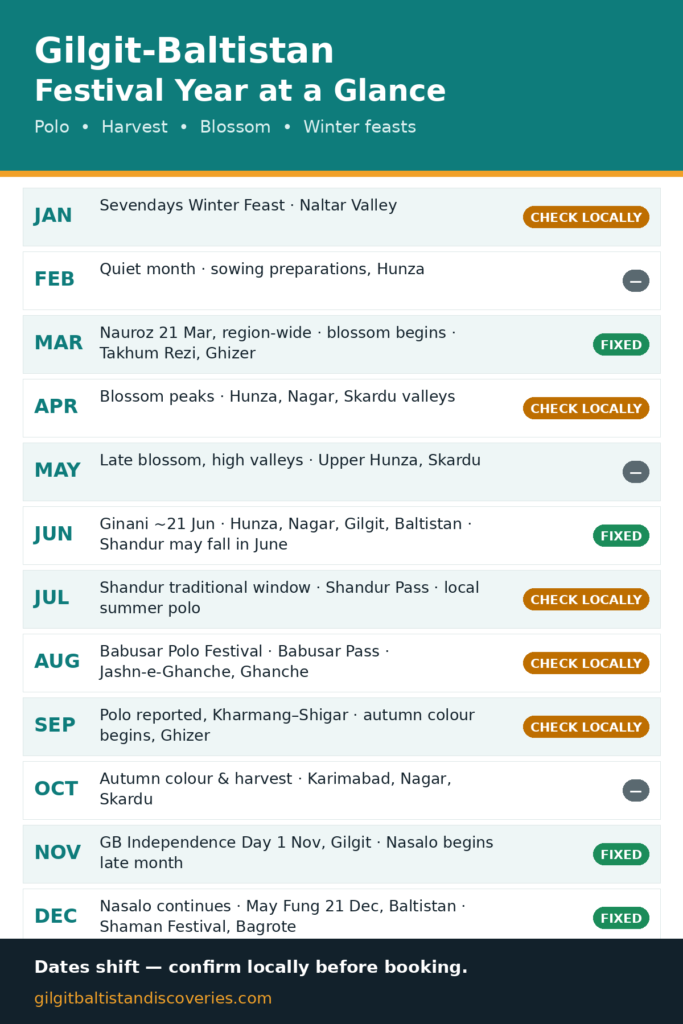
What is the Gilgit-Baltistan festival calendar, month by month?
This calendar has two kinds of entries: festivals tied to the sun, which barely move, and festivals set by people, which move every year. Nauroz (21 March, the spring equinox), Ginani (around 21 June, the summer solstice) and May Fung (21 December, the winter solstice) belong to the first group. Shandur, Babusar and the smaller district polo tournaments belong to the second — their dates are announced closer to the event, so this guide gives you the season and tells you to check locally, rather than printing a date that may be wrong.
Gilgit-Baltistan is not one valley with one culture: Shina, Balti, Burushaski, Khowar and Wakhi are all spoken across the region, and a festival can carry a different name in the next valley. Ginani in Hunza and Nagar is Ganoni in Gilgit and Strublah in Baltistan. Plan by valley, not just by date.
| Month | What is happening | Where to base yourself |
|---|---|---|
| January | Sevendays Winter Feast; winter sports at Naltar | Gilgit, then Naltar Valley |
| February | Quiet month; sowing preparations in Hunza | Karimabad, Hunza District |
| March | Nauroz on 21 March; Takhum Rezi; blossom begins | Gilgit, Karimabad, Ghizer |
| April | Blossom season peaks in Hunza, Nagar and Skardu valleys | Karimabad, Skardu |
| May | Late blossom in high valleys; fields green up | Upper Hunza, Skardu |
| June | Ginani around 21 June; Shandur may fall in June | Karimabad, then Shandur via Ghizer |
| July | Shandur’s traditional window; local summer polo | Shandur Pass, Gilgit |
| August | Babusar Polo Festival; Jashn-e-Ghanche listed in August | Babusar Pass, Ghanche |
| September | Reported polo in Kharmang–Shigar; autumn colour begins in Ghizer | Skardu, Shigar |
| October | Autumn colour and harvest weeks across the valleys | Karimabad, Nagar, Skardu |
| November | GB Independence Day on 1 November; Nasalo begins late in the month | Gilgit, Bagrote Valley |
| December | Nasalo continues; Shaman Festival in Bagrote; May Fung on 21 December | Gilgit, Baltistan |
What happens at Nauroz, the spring new year?
Nauroz, also spelled Navroz, is celebrated on 21 March across Gilgit-Baltistan, marking the spring equinox and the Persian New Year. It is an official public holiday in the region, with celebrations recorded in Gilgit, Hunza, Nagar, Ghizer, Astore, Skardu, Shigar, Kharmang and Ghanche districts. Families wear new clothes, prepare traditional dishes, share food with relatives and neighbours, and children visit neighbouring houses to exchange greetings.
The local customs are what make it worth travelling for. In Baltistan, the signature tradition is egg-fighting: painted eggs are struck together until one cracks. In Hunza District and Nagar District — separate districts, on opposite sides of the Hunza River — families gather for Chi Chi, a village-wide sharing of dried fruit and homemade sweets, sometimes centred on a newborn child dressed in new clothes. Freestyle polo and poetry gatherings are also part of the day, and a traditional polo tournament typically opens in Skardu the day before Nauroz itself.
Nauroz is a community and family occasion before it is a tourist event. At public celebrations you will be welcomed; if invited into a home, accept tea and food graciously and ask before photographing people.
When is the spring blossom festival, and where should I see it?
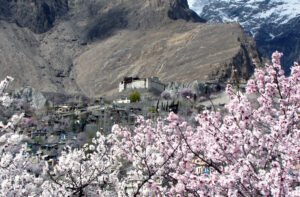
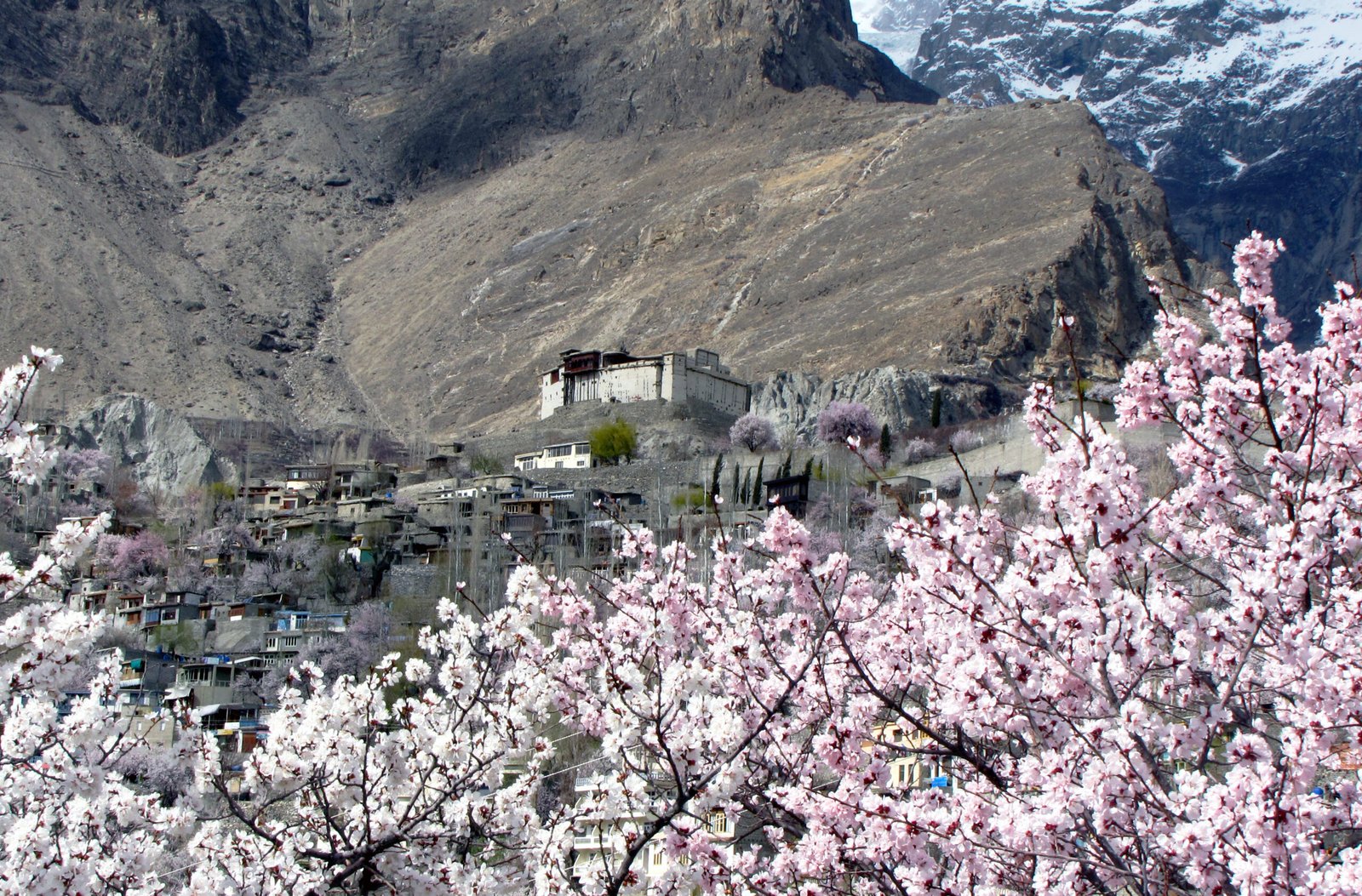
Jashn-e-Baharan, the spring blossom festival, is less a single ceremony than a season: roughly mid-March through late April, timed to the apricot and cherry blossom in Hunza and Nagar valleys. Orchards flower valley by valley, so the “peak” moves. Lower valleys bloom first, from late March; Karimabad and upper Hunza peak around mid-April; Skardu and Shigar follow into late April. Bloom shifts by a week or two each year with snowfall and spring temperatures, so no guide can name your exact week — guesthouses in Karimabad are the best real-time source.
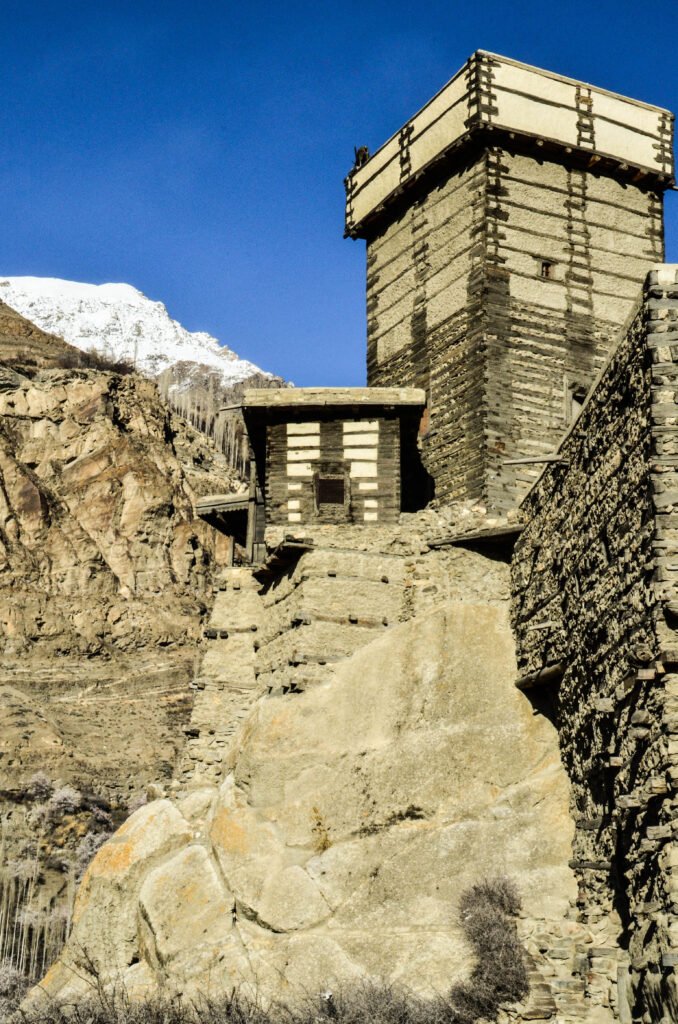
The classic bases are Karimabad for Baltit and Altit forts above blossom terraces, and the villages of Altit and Ganish for walking among the trees rather than above them. Duikar, the Eagle’s Nest ridge above Karimabad, gives the wide view over the whole blossoming valley. For the full valley picture, see our Beautiful Places to Visit in Hunza.
March also brings Takhum Rezi in Ghizer District, known locally as Bo or Bee Ganik. It marks the start of the sowing season, with horse racing, tug-of-war, traditional dance and a torch-lit procession. It is a community observance rather than a publicised tourist event, so ask at your guesthouse about current timing, which varies by valley and year.
What is Ginani, the harvest festival?
Ginani is Hunza and Nagar’s summer-solstice harvest festival, celebrated around 21 June, when the wheat and barley crops have ripened enough to survive the season — historically a moment of real relief in valleys that once faced famine risk. Before 1974, when Hunza was still a princely state, rituals were performed at Baltit Fort in front of the ruling family. Today, villagers gather at central community grounds, offer prayers for prosperity, and share the traditional festival dish, Dirum Pitti, made with freshly harvested grain.
The same celebration goes by different names across the region: Ganoni in Gilgit, Strublah in Baltistan, and Chineer among Wakhi communities in Upper Hunza. Experience it through a local contact or guesthouse: observe quietly, try the food when offered, and never interrupt prayers or photograph rituals without asking first.
When is the Shandur Polo Festival, really?
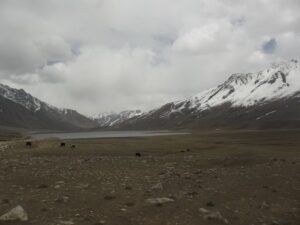
This is the question that needs the most care, because the famous date is no longer reliable. Shandur Polo Festival is played at the Shandur Polo Ground on Shandur Pass, at about 3,700 metres, between teams from Gilgit-Baltistan and Chitral under freestyle rules — fast, physical, and played without the modern rulebook. The ground is widely described as the world’s highest polo ground, the pass itself sits at about 3,800 metres, and the festival also includes folk music, dancing and a camping village set up on the pass. The tournament was organised in its modern form in the 1930s by British political agent Colonel Evelyn Hey Cobb.
The traditional dates were 7 to 9 July, with the final on 9 July. But recent editions have shifted earlier: 2025 ran from 20 to 22 June, and 2026 was held from 11 to 13 June, with Gilgit-Baltistan winning the 2026 final. So for any future year: dates announced closer to the event — check locally with the Gilgit-Baltistan tourism department before booking flights, transport or camping. Do not build a non-refundable trip around 7–9 July.
Practical notes: arrive a day early to acclimatise at 3,700 metres, pack warm camping gear because nights drop near freezing even in June and July, carry cash because there are no ATMs near the venue, and expect weak mobile signal — a local SIM and offline maps help. A portable charger is worth its weight across a multi-day camp; for example, the Anker PowerCore portable charger covers phone and camera top-ups. Reach the pass from Gilgit through Ghizer Valley or from the Chitral side, with an experienced local driver.
What other polo festivals are there besides Shandur?
Polo is the region’s everyday sport, not just a Shandur spectacle, and smaller tournaments run all summer. The best known after Shandur is the Babusar Polo Festival at Babusar Pass in Diamer District, at 4,173 metres. It has been held in August since 2007, with historic editions running from 6 to 8 August, and features folk music, dancing, tent-pegging, tug of war and a camping village alongside the matches. Because recent editions are less consistently publicised than Shandur’s, confirm whether it is running in your year before travelling — dates announced closer to the event, check locally.
Local summer polo also takes place through July and August in Astore, Ghizer and Gupis, and polo is reported in the Kharmang and Shigar valleys in September. These are informal, community-scale events: smaller than Shandur, but genuinely welcoming to visitors who show up. Around Nauroz, freestyle polo is played in many districts, and on GB Independence Day, 1 November, a Jashn-e-Azadi civil polo tournament is organised in Gilgit alongside flag hoisting, parades and cultural performances marking the 1947 Gilgit rebellion and accession to Pakistan.
What happens in autumn and winter?
Autumn is harvest season rather than a single named festival, and it is worth planning around in its own right. From late September into early November the orchard valleys turn gold valley by valley — Ghizer first, then central Hunza in mid-to-late October, with Nagar, Skardu and Khaplu peaking last, from late October into the first week of November. Walnuts are knocked down with long poles, apricots and apples are picked and dried, and the colour you photograph is a working crop being stored against winter. Our Autumn in Gilgit-Baltistan guide gives the valley-by-valley peak windows.
Winter brings the region’s oldest and quietest festivals. Nasalo, from late November into December in Gilgit, Nagar, Ghizer and Bagrote Valley (Bagrote’s observance is typically documented around 13–21 December), marks preparation for winter: animals are slaughtered, meat is processed into dried sausages called warki or ghittey to last the cold months, and the day opens with prayers before turning to music and dance. May Fung, on 21 December in Balti communities, marks the winter solstice with torches and lanterns lit after dusk. Bagrote Valley also hosts a Shaman Festival in December, organised by the GB tourism department since 2008, and Naltar Valley hosts the Sevendays Winter Feast in January. Do not expect published schedules for winter events; ask locally, and accept that some ceremonies are not open to visitors.
How should I plan a festival trip?
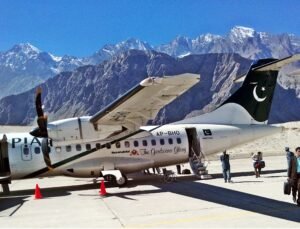
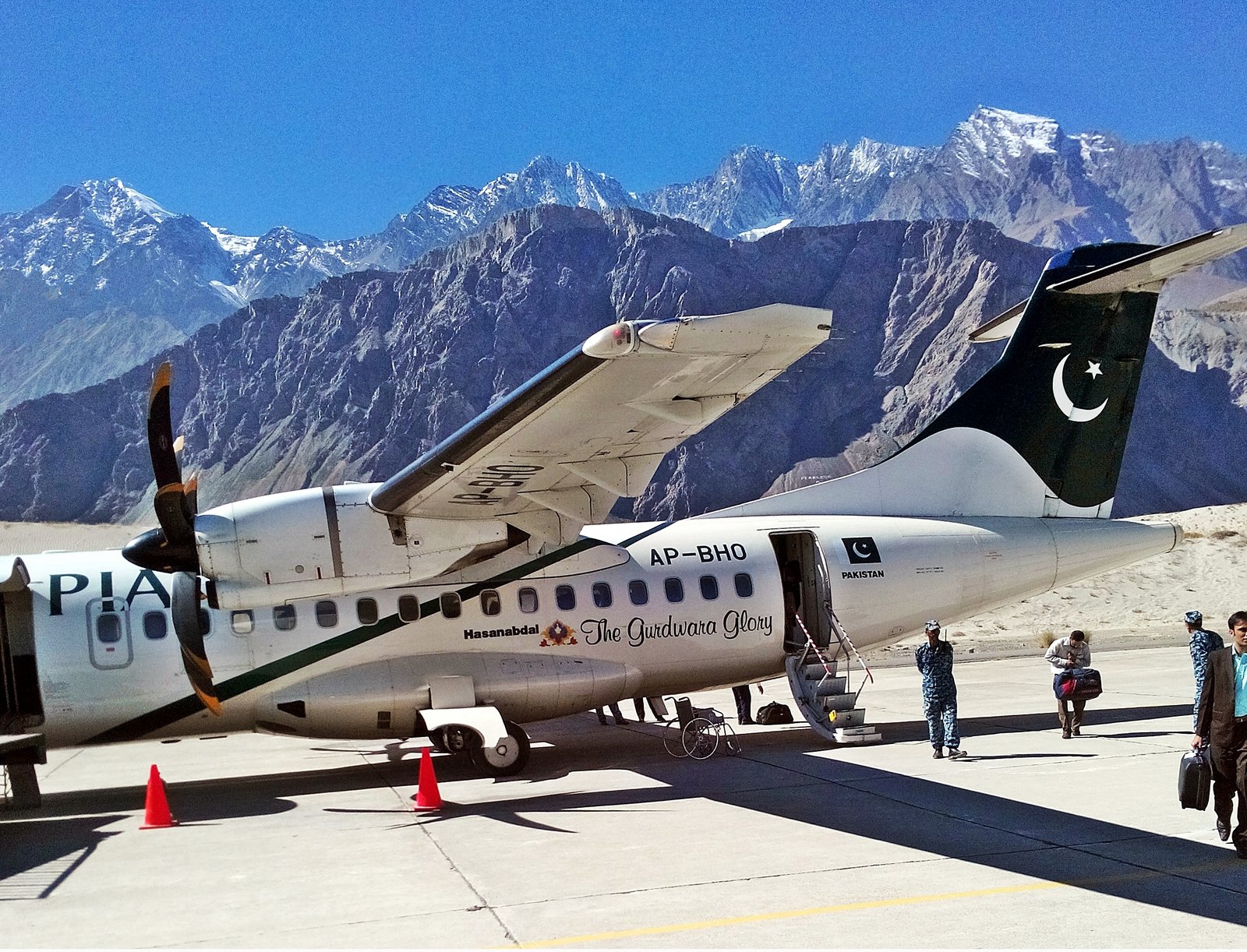
Start with the season, not a single date. If you want one big event, pick Shandur and build buffer days around it for weather, road delays and flight cancellations, which are common rather than rare on Gilgit and Skardu routes. If you want colour and culture with less risk, pick blossom season or autumn, when the valleys themselves are the event and a shifted date costs you nothing.
Book rooms early for Shandur week and for Karimabad in blossom season. Carry cash, a local SIM, warm layers even in summer, and a basic first-aid kit. Tell your guesthouse where you are going each day, especially for high passes. This site is run by a Gilgit-Baltistan local team — when you book, you are dealing with people from these valleys.
| Trip type | Go when | Base | Watch out for |
|---|---|---|---|
| First festival trip | June–July (Shandur season) | Gilgit, then camp at Shandur | Altitude, cold nights, shifting dates |
| Photography trip | Mid-March to late April | Karimabad, Hunza District | Bloom shifts by 1–2 weeks yearly |
| Harvest and culture trip | Around 21 June (Ginani) | Karimabad or Nagar villages | Village ceremonies need a local host |
| Autumn trip | Mid-October to early November | Karimabad, Nagar, Skardu | High passes close with first snow |
| Winter culture trip | Late November to January | Gilgit, Naltar | Short days, cold, few published schedules |
Frequently Asked Questions
When is the Shandur Polo Festival?
Shandur traditionally ran from 7 to 9 July, but recent editions have moved earlier — June 20–22 in 2025 and June 11–13 in 2026. Treat July as the historical window, not a promise. Always confirm the current year’s dates with the Gilgit-Baltistan tourism department before booking travel or accommodation.
What is the Ginani festival?
Ginani is Hunza and Nagar’s summer-solstice harvest thanksgiving, celebrated around 21 June when the wheat and barley crops have ripened enough to survive the season. The same celebration is called Ganoni in Gilgit and Strublah in Baltistan. Villagers share prayers, music, dance and the traditional dish Dirum Pitti with neighbours.
Can visitors attend village festivals in Gilgit-Baltistan?
Yes, visitors are generally welcomed, especially at public events such as Shandur, Babusar and Nauroz celebrations in towns. Smaller village ceremonies are community gatherings first and tourist events second. Ask your guesthouse or a local host first, dress modestly, ask before photographing people or rituals, and accept offered tea graciously.
Which festival should I plan a trip around?
For a first trip, choose Shandur if you love sport and high-altitude camping, or the spring blossom season from mid-March to late April if you prefer gentle village walks and photography. Both reward early planning: Shandur needs camping gear and acclimatisation, while blossom weeks fill guesthouses in Karimabad quickly.
Do Gilgit-Baltistan festivals have fixed dates I can book a year ahead?
Only a few do. Nauroz falls on 21 March and Ginani around 21 June because both follow the sun, while GB Independence Day is fixed on 1 November. Most other festivals — including Shandur — are announced closer to the event, so book flexible travel and confirm dates locally before finalising plans.
Last updated: 29 October 2026