Last updated: 31 October 2026
Short Answer
For trekking at 4,000 to 5,000 m in Pakistan — K2 base camp, Gondogoro La, Rush Lake, the high passes — buy a hooded down jacket with high fill power, enough fill weight to be genuinely warm at rest in camp, and a fit that layers over a fleece without compressing the down. Fill power tells you how much loft a given weight of down gives; fill weight tells you how much down is actually in the jacket. A jacket with high fill power but very little fill is a light jacket, not a warm one — and at 5,000 m, in camp after sunset, that distinction matters. No single jacket suits every season: a summer base-camp jacket and a winter expedition jacket are different tools, and this guide explains how to tell them apart before you buy.
What do fill power and fill weight actually mean?
These two numbers are the whole buying decision, and they are routinely confused — sometimes deliberately, in marketing.
| Term | What it means | What to look for |
|---|---|---|
| Fill power | How much space 1 ounce of down fills, measured in cubic inches (e.g. 800) | Higher = more loft per gram = warmer for the same weight, and more compressible |
| Fill weight | How much down is actually in the jacket, in grams | Higher = more insulation in total, regardless of fill power |
| Total warmth | Fill power × fill weight, in practice | A 800-fill jacket with 100 g of fill is warm; an 800-fill jacket with 50 g is a light layer |
A useful rule: for high-altitude trekking in Pakistan, look for fill power of 700 to 900 and a fill weight that puts the jacket firmly in the “warm at rest” category — typically 150 g or more of down for a men’s medium, depending on the design. A jacket marketed as “800-fill” with no fill weight stated is hiding the more important number. Ask for it, or choose a jacket that states it.
Down quality also matters: goose down generally lofts better than duck down at the same fill power, and responsibly sourced down (RDS-certified) is the standard to look for. Neither changes the basic arithmetic above — fill power and fill weight together decide warmth.
How warm does a jacket need to be at 4,000–5,000 m?
Temperature ratings on down jackets are not standardised the way sleeping-bag ratings are, so treat any single “rated to −20°C” claim with suspicion. Think instead in terms of use:
| Situation | What you need |
|---|---|
| Walking uphill in sunshine at 4,000 m | A light insulated layer or a fleece — you generate heat while moving |
| Sitting in camp at 4,500 m after sunset | A genuinely warm hooded down jacket, over a fleece, with a hood up |
| A high pass at dawn, in wind, at 5,000 m+ | That same jacket, plus a windproof shell over it, gloves and a warm hat |
| Winter trekking or expedition use above 5,000 m | A heavier expedition-weight jacket, not a standard trekking down jacket |
The critical insight is that you buy a down jacket for the coldest hour of the day, not the average hour. You will spend most of the walking day too warm in it — that is normal, and it is why the jacket lives in your pack until camp. A jacket that feels “just right” in a heated shop is almost certainly too light for a 5,000 m evening.

What about wet conditions, shells and fit?
Down and water are a bad combination: wet down loses loft and warmth, and dries slowly. Most good trekking down jackets now use hydrophobic-treated down and a water-resistant outer fabric, which helps in light snow and drizzle — but it does not make a down jacket a rain jacket. In wet conditions, wear a waterproof shell over the down jacket, and never rely on down alone in sustained rain. If your trek is in the monsoon shoulder or you expect wet snow, consider a synthetic insulated jacket instead: it is heavier and bulkier for the same warmth, but it keeps insulating when wet.
Fit is the second most common buying mistake after fill weight. A down jacket must fit over everything you will wear under it — base layer plus fleece — without compressing the down, because compressed down does not insulate. At the same time, it must not be so loose that cold air pumps in and out at the hem and cuffs. Check these points:
- With a fleece on, you can zip the jacket fully without the down feeling flat across the chest.
- The hood fits over a warm hat and adjusts snugly around the face, without pulling the jacket up at the back.
- The hem sits below your waist and adjusts, and the cuffs seal at the wrist over glove liners.
- You can raise your arms overhead without the jacket riding up and exposing your waist.
Weight and pack size are the third consideration. A good 800-fill jacket packs to roughly the size of a 1-litre bottle and weighs roughly 400 to 600 g. If a jacket is much heavier than that for the same warmth, you are carrying weight you do not need; if it is much lighter, check the fill weight — you may be buying a lighter jacket than you think.
How do I choose between down and synthetic?
| Factor | Down | Synthetic |
|---|---|---|
| Warmth for weight | Best — nothing matches down for loft per gram | Good, but heavier and bulkier for the same warmth |
| When wet | Loses warmth, dries slowly | Keeps much of its warmth, dries faster |
| Pack size | Compresses smallest | Bulkier in the pack |
| Durability | Long-lived if kept dry and uncompressed in storage | Loses loft faster over years of compression |
| Cost | Higher for high fill power | Usually cheaper |
For dry, cold, high-altitude trekking in Pakistan — the classic Karakoram conditions — down wins. For wet, lower, shoulder-season trekking where rain is likely, synthetic is the safer choice. Many experienced trekkers own one of each and choose by forecast, not by habit.
What should I actually buy? A decision checklist
Use this checklist in the shop or on the product page, in order:
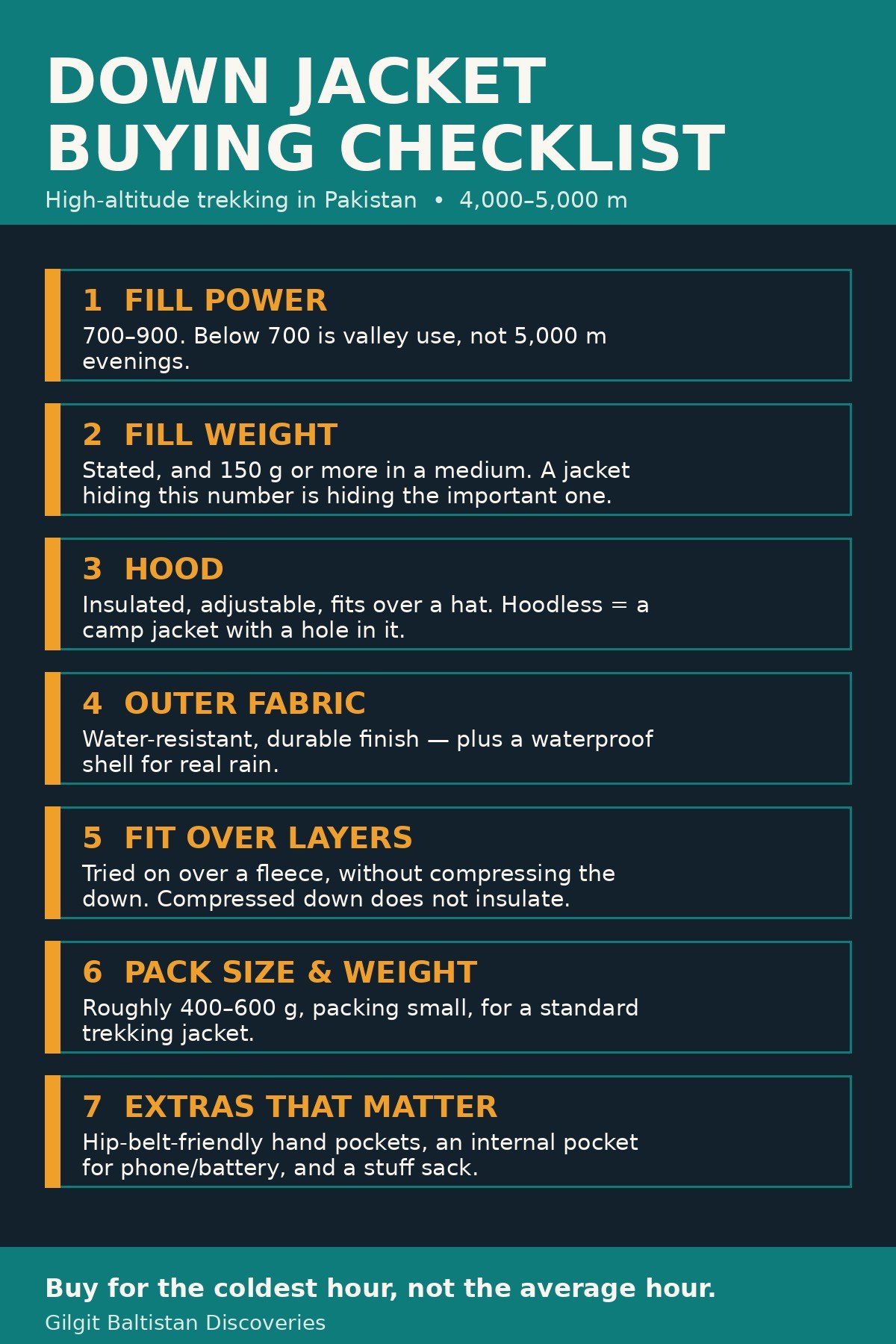
- Fill power: 700–900. Below 700 is fine for valley use, not for 5,000 m evenings.
- Fill weight: stated, and enough to be warm at rest — look for 150 g or more of down in a medium, and be suspicious of any jacket that hides this number.
- Hood: insulated, adjustable, fits over a hat. A hoodless down jacket is a camp jacket with a hole in it.
- Outer fabric: water-resistant, with a durable finish — and a waterproof shell to go over it in real rain.
- Fit over layers: tried on over a fleece, without compressing the down.
- Pack size and weight: roughly 400–600 g, packing small, for a standard trekking jacket.
- Extras that matter: two hand pockets that work with a pack hip belt, an internal pocket for a phone or battery (cold kills batteries — keep them warm inside the jacket), and a stuff sack.
No specific product ASIN is claimed in this guide, and no price is quoted: prices change, and a stale price misleads more than no price. Use a tagged search to compare current options — down jackets for trekking on Amazon — and judge every option against the checklist above, not against its marketing headline.
Related guides
For the wider kit picture, see our K2 Base Camp Trek Packing List and What to Pack for Northern Pakistan, and read Altitude Sickness in Gilgit-Baltistan before a high trek.
Frequently asked questions
Q: What fill power is best for high-altitude trekking in Pakistan? A: Look for 700 to 900 fill power, combined with enough fill weight — typically 150 g or more of down in a medium jacket — to be warm at rest in camp at 4,000 to 5,000 m. Fill power alone does not decide warmth: a high-fill-power jacket with very little fill is a light jacket, not a warm one.
Q: Is a down jacket warm enough for K2 base camp? A: Yes, if it is a genuinely warm hooded down jacket chosen for evenings in camp, not just for walking. At K2 base camp altitudes, you need the jacket most when you stop moving — in camp after sunset and on high passes at dawn — so buy for the coldest hour of the day, not the average.
Q: Should I buy down or synthetic for trekking in Pakistan? A: Down for dry, cold, high-altitude trekking, where its warmth-for-weight is unbeatable. Synthetic for wet, lower, shoulder-season trekking where rain is likely, because synthetic insulation keeps working when wet while down loses loft. Many experienced trekkers own one of each and choose by forecast.
Q: How should a down jacket fit for trekking? A: It must fit over a base layer and a fleece without compressing the down, since compressed down does not insulate. The hood should fit over a warm hat, the hem should sit below the waist and adjust, and you should be able to raise your arms without the jacket riding up and exposing your waist.
Q: Can I wear a down jacket in the rain? A: Not on its own. Hydrophobic-treated down and a water-resistant outer help in light snow and drizzle, but a down jacket is not a rain jacket. In sustained rain, wear a waterproof shell over the down jacket, and never rely on down alone in wet conditions.