Last updated: October 2026
The short answer: You have three real ways to travel from Islamabad to Gilgit-Baltistan. Fly — about 1 hour to Gilgit or Skardu, the fastest option but weather-dependent. Go by road on the Karakoram Highway (KKH) — roughly 600 km to Gilgit, 12–18 hours by car or 16–20 hours by bus, open all year via Besham. Or take the seasonal Babusar Pass route — about 530 km to Gilgit, open only in summer, and the most scenic drive in Pakistan. There is no train — the railway ends far south of the mountains. Most first-time visitors fly one way and drive the other, so they get the aerial view of Nanga Parbat and the KKH.

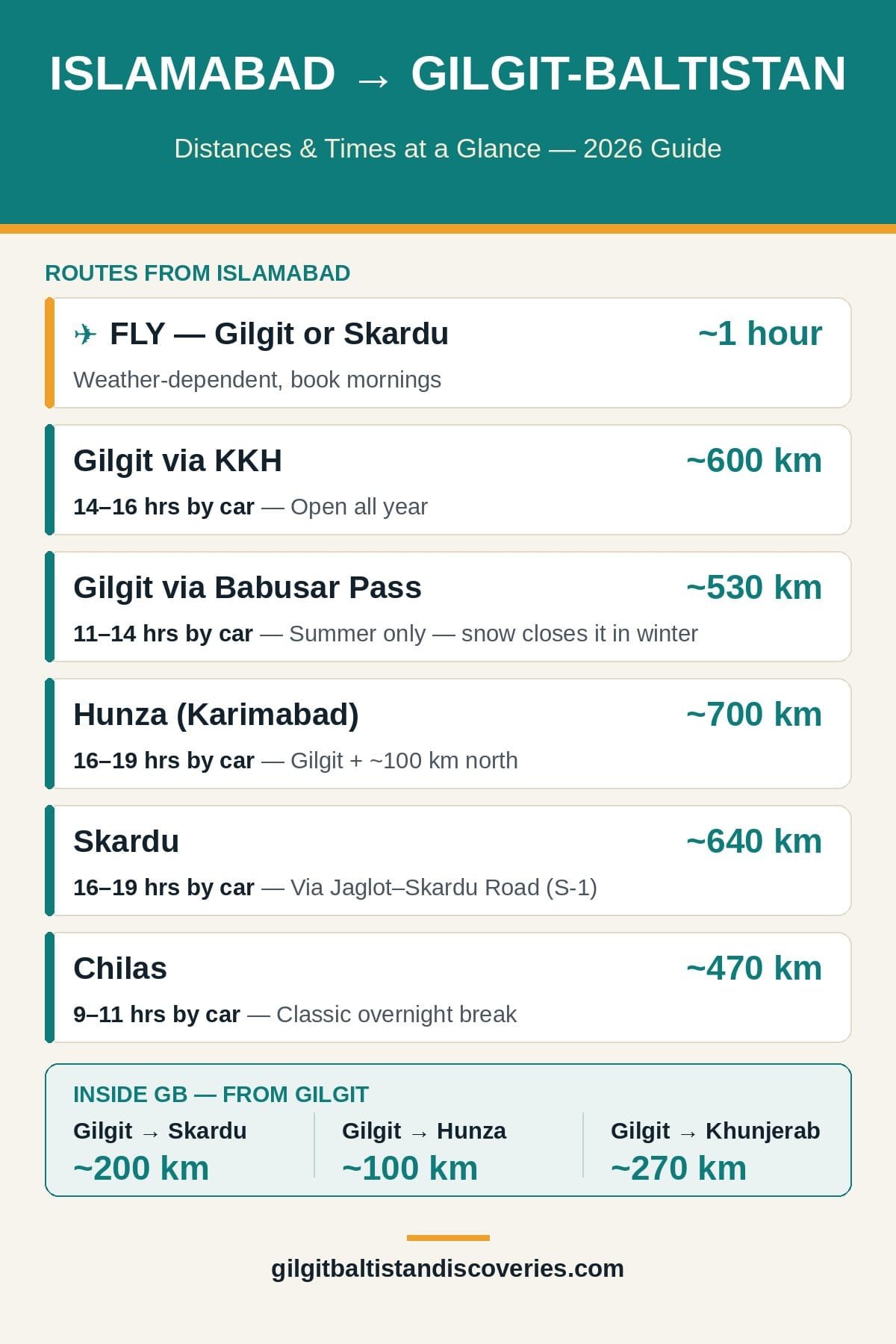
Islamabad to Gilgit-Baltistan: distances and travel times at a glance
| Route | Distance (approx.) | By car | By bus | Notes |
|---|---|---|---|---|
| Islamabad → Gilgit (via KKH / Besham) | ~600 km | 14–16 hrs | 16–20 hrs | Open all year; the reliable route |
| Islamabad → Gilgit (via Babusar Pass) | ~530 km | 11–14 hrs | 13–16 hrs | Seasonal — roughly late May/June to October, snow closes it in winter |
| Islamabad → Hunza, Karimabad (via KKH) | ~700 km | 16–19 hrs | 18–22 hrs | Gilgit, then ~100 km further north on the KKH |
| Islamabad → Skardu (via KKH + Jaglot–Skardu Road S-1) | ~640 km | 16–19 hrs | 18–22 hrs | Branches off the KKH at Jaglot |
| Islamabad → Chilas (via KKH / Besham) | ~470 km | 9–11 hrs | 10–13 hrs | Common overnight break point |
| Islamabad → Chilas (via Babusar) | ~400 km | 8–10 hrs | — | Seasonal, as above |
| Islamabad → Gilgit by air | ~300 km (air) | — | — | Flight ~55 min–1 hr 15 min, weather-dependent |
| Islamabad → Skardu by air | ~318 km (air) | — | — | Flight ~1 hr–1 hr 15 min, weather-dependent |
Distances vary a little by measuring point and detours; times are driving time in normal conditions. Landslides, roadworks and weather can add hours — always check conditions before you leave (see Safety, below).
Distances inside Gilgit-Baltistan (the legs everyone asks about)
| Leg | Distance (approx.) | Drive time |
|---|---|---|
| Gilgit → Skardu | ~200 km | 4.5–6 hrs |
| Gilgit → Hunza (Karimabad) | ~100 km | 2–3 hrs |
| Gilgit → Chilas | ~130 km | 2.5–3.5 hrs |
| Chilas → Raikot Bridge (Fairy Meadows turn-off) | ~55 km | 1–1.5 hrs |
| Gilgit → Khunjerab Pass (China border) | ~270 km | 5–7 hrs |
| Skardu Airport → Shangrila Resort (Lower Kachura) | ~35 km from Skardu city | 45–60 min from the city |
Which option should you choose?
| If you… | Choose | Why |
|---|---|---|
| Have limited days | Fly to Gilgit or Skardu | An hour in the air vs. two days of road travel in each direction |
| Are on a budget | NATCO or Faisal Movers bus | The cheapest seat into the mountains, with the KKH as your window view |
| Want the classic road trip | Drive via Babusar (summer) or KKH | The journey is the experience — build in an overnight at Chilas or Besham |
| Are travelling as a family/group | Private car with a local driver | Door-to-door, photo stops when you want, no night driving on mountain roads |
| Are heading to Skardu first | Fly or drive to Skardu directly | Going via Gilgit adds a ~200 km sideways leg |
1. By air: Islamabad to Gilgit and Skardu flights
Flying is the fastest way into Gilgit-Baltistan — when the weather plays along.
- Islamabad → Gilgit (GIL): Pakistan International Airlines (PIA) operates the route with smaller ATR aircraft. Scheduled flight time is roughly 55 minutes to 1 hour 15 minutes. Services are limited (typically one to two rotations a day) and are strictly weather-dependent — Gilgit’s mountain valley approach requires clear visibility, so cancellations and long delays are a normal part of flying this route, especially in winter.
- Islamabad → Skardu (KDU): A busier route, served by PIA, Airblue and AirSial with Airbus A320-family jets. Flight time is about 1 hour to 1 hour 15 minutes, and on a clear day the flight passes close to Nanga Parbat — ask for a window seat. Skardu also handles larger aircraft, so it is somewhat less weather-fragile than Gilgit, but delays still happen.
- Prices: One-way fares move a lot with season and how early you book. As a 2026 guide, expect roughly PKR 20,000–45,000 one-way on these routes, with peak summer and holiday flights at the top of that range. The old advice still holds: book as early as you can, prefer the morning departures (visibility is usually best early), keep the fare refundable or changeable if your plans are tight, and never book a same-day international connection after a Gilgit or Skardu flight — leave a buffer day in Islamabad.
Going on to Hunza after landing in Gilgit? Karimabad is ~100 km (2–3 hours) north on the KKH — shared vans and taxis wait at the airport. For Skardu arrivals, most hotels arrange airport pickups; the drive to Shangrila and Lower Kachura takes under an hour from the city.
2. By bus: NATCO, Faisal Movers and coasters
The bus is the budget classic, and the KKH scenery is free.
- Operators: NATCO (Northern Areas Transport Corporation, the government carrier) is the long-standing main operator from the Rawalpindi/Islamabad terminals (Pir Wadhai / Faizabad side) to Gilgit, Hunza (Aliabad), Skardu, Chilas and Astore. Faisal Movers and other private companies also run northern routes — check current departures at the terminal or on booking apps, as schedules change by season.
- Journey times: Islamabad/Rawalpindi → Gilgit about 16–20 hours; → Skardu about 18–22 hours. Most long-haul departures leave in the afternoon/evening and drive through the night — many travellers prefer a daytime departure or breaking the journey at Chilas so they actually see the KKH.
- Fares (2026 guide): roughly PKR 3,800–6,500 depending on route and bus class (standard coach vs. executive) — Gilgit sits at the lower end, Skardu and Hunza higher. Fares change with fuel prices, so confirm the live fare when you book.
- Practical tips: Book 2–3 days ahead in peak season (June–September). Carry your CNIC (Pakistanis) or passport with visa copies (foreign visitors) — there are multiple checkpoints on the KKH and having documents ready speeds everything up. Pack snacks, water and a warm layer in your hand luggage; the bus stops for meals, but mountain weather turns cold even in summer.
3. Private car or shared taxi with a driver

For families and small groups, a private car with an experienced local driver is usually the best balance of comfort, flexibility and safety.
- Times: Islamabad → Gilgit in about 12–16 hours via the KKH (less via Babusar in summer) — plan it as one very long day or, better, two easy days with a night in Besham or Chilas. Anyone quoting you 6–7 hours for this journey is wrong; do not plan around it.
- Why a driver, not just a car: Local drivers know which stretches are landslide-prone, where the fuel stations are, and when not to drive. You also get photo stops at the Rakaposhi viewpoint, the junction of three mountain ranges near Jaglot, and the Nanga Parbat viewpoint.
- Costs: Hiring is negotiated per vehicle and itinerary (vehicle type, route, number of days, whether fuel and tolls are included). Get the full figure in writing before you leave Islamabad, and confirm whether the driver’s food and lodging on overnight stops are included. Shared Hiace vans between Islamabad/Rawalpindi and Gilgit are the cheaper middle option if you’re travelling light.
Prefer someone to arrange the whole thing — car, driver, hotels and stops? That’s exactly what our team does: start with Plan My Trip.
4. Driving yourself

Self-driving the KKH is a genuine adventure — and a serious undertaking.
- The two routes: The KKH via Besham (M-15 Hazara Motorway → Mansehra → Besham → Dasu → Chilas → Raikot → Gilgit) is open year-round. The Babusar route (Mansehra → Naran → Babusar Top, 4,173 m → Chilas) is shorter and far more scenic, but seasonal — it opens once the snow is cleared, usually late May or June, and closes again around October/November. Note: Babusar is on the N-15, not the KKH; the KKH’s own highest point is Khunjerab Pass (4,693 m) at the China border.
- Vehicle: The KKH is paved, but expect rough patches, roadworks and landslide debris, especially between Besham and Chilas. A well-serviced car with good ground clearance is the minimum; a 4×4 is more comfortable but not required for Gilgit or Hunza in summer. Service the car before you go, carry a full-size spare, and fill up at every major town — Besham, Chilas and Jaglot are your reliable fuel points.
- Rules of the road up here: Never drive the mountain sections at night. Start early, take breaks, download offline maps (mobile coverage is patchy; SCoM has the widest footprint inside Gilgit-Baltistan), and check the day’s road status before departing — conditions change fast in monsoon (July–August) and winter.
5. By train — there isn’t one
There is no train service to Gilgit-Baltistan, and no railway line runs into the mountains. The nearest railheads are Rawalpindi and Havelian (the end of the branch line north from Rawalpindi, near the start of the KKH corridor). If you’re arriving in Pakistan by train, plan to continue from Rawalpindi/Islamabad by air or road using the options above.
Ticket prices at a glance (2026 guide prices — verify before booking)
| Option | Indicative cost (one way, per person unless stated) |
|---|---|
| Flight Islamabad → Gilgit or Skardu | ~PKR 20,000–45,000 |
| NATCO / coach bus → Gilgit | ~PKR 3,800–5,500 |
| NATCO / coach bus → Skardu or Hunza | ~PKR 4,600–6,500 |
| Shared Hiace van → Gilgit | Between bus and private-car prices; confirm at the terminal |
| Private car with driver → Gilgit | Per vehicle, negotiated — confirm fuel, tolls and driver costs in writing |
Prices are indicative ranges checked in October 2026 against airline and bus-booking listings. They change with fuel prices, season and availability — always confirm the live fare for your date before you rely on it.

Road status, safety and smart planning

- Check before you go: Road closures from landslides or snow are the #1 cause of ruined itineraries. Check the National Highway Authority (NHA) updates and recent traveller reports the day before any KKH drive, and keep one flexible day in your plan.
- Altitude: Gilgit town sits at ~1,500 m and Karimabad (Hunza) at ~2,400 m — most people feel fine, but take the first day easy, hydrate, and don’t rush straight up to Khunjerab (4,693 m) on day one.
- Best time for the road journey: May to October for Babusar and the clearest mountain views; the KKH via Besham runs all year, but winter adds snow delays and summer monsoon adds landslide risk. For season-by-season detail, see our month-by-month guide to the best time to visit Hunza Valley and what each season brings.
- Documents: Pakistanis — carry your CNIC. Foreign visitors — carry your passport and keep copies of your visa; you’ll show them at KKH checkpoints. No special permit is needed for standard tourist areas of Gilgit-Baltistan, but border-adjacent and restricted areas have their own rules — check locally before detouring.
- Packing: Even in summer, temperatures drop sharply with altitude. Our K2 Base Camp Trek Packing List covers serious trekking gear, and the general Gilgit-Baltistan packing list covers a normal road trip.

When you arrive: where most travellers go next
- Gilgit — break the journey, visit Kargah Buddha, and use the city as your hub. Continue with our District Nagar guide across the river, or head north.
- Hunza — Karimabad, Baltit Fort, Attabad Lake and the road to Khunjerab. Start with the District Hunza guide.
- Fairy Meadows — the turn-off is at Raikot Bridge on the KKH, about an hour before Gilgit. Our Fairy Meadows hiking track guide covers the jeep track and the hike up.
- Skardu — from Jaglot, the S-1 follows the Indus to Skardu; from the airport it’s a short hop to the city and Shangrila. See Skardu Airport to Shangrila Resort.
- Chilas — more than a stopover: ancient rock carvings and the gateway to Fairy Meadows. See our Chilas travel guide.
- Hungry after the road? Start with the 26 famous dishes of Gilgit-Baltistan.

Frequently Asked Questions
What is the distance from Islamabad to Gilgit?
About 600 km by road via the Karakoram Highway (through Besham and Chilas), or roughly 530 km via the seasonal Babusar Pass route. By air the distance is about 300 km and the flight takes around an hour.
How long does it take to travel from Islamabad to Gilgit-Baltistan?
By air, about 1 hour to Gilgit or Skardu. By road, 12–16 hours by private car to Gilgit via the KKH in normal conditions, and 16–20 hours by bus. Add 2–3 hours more for Hunza, and plan Skardu at 16–22 hours by road.
What is the fastest way to get from Islamabad to Gilgit-Baltistan?
Flying. PIA flies Islamabad–Gilgit (about 55 minutes to 1 hour 15 minutes), and PIA, Airblue and AirSial fly Islamabad–Skardu in about 1 hour to 1 hour 15 minutes. Mountain weather can delay or cancel flights, so morning departures and a buffer day are wise.
What is the cheapest way to travel from Islamabad to Gilgit-Baltistan?
A NATCO or intercity coach bus from Rawalpindi/Islamabad — roughly PKR 3,800–6,500 depending on route and class in 2026. It’s the longest option (16–22 hours) but the Karakoram Highway scenery comes free.
Is there a train from Islamabad to Gilgit-Baltistan?
No. No railway reaches Gilgit-Baltistan. The nearest stations are Rawalpindi and Havelian; from there you continue by air or road.
Gilgit to Skardu: what is the distance and time?
About 200 km on the Jaglot–Skardu Road (S-1) along the Indus, taking roughly 4.5–6 hours by car. There is no direct flight between Gilgit and Skardu.
Is it safe to drive from Islamabad to Gilgit-Baltistan?
Thousands of travellers drive the KKH every year. The main risks are mountain hazards — landslides, rockfall, weather and fatigue — not the route itself. Drive only in daylight, check NHA road status before leaving, use an experienced driver or a well-serviced vehicle, and keep a flexible day in your itinerary.
When is the Babusar Pass route open?
Usually from late May or June, once snow is cleared, until around October or November. Outside that window, use the year-round KKH route via Besham. Always confirm the pass status locally before relying on it.
Do foreign visitors need a permit for Gilgit-Baltistan?
No special permit is needed for the standard tourist areas. You do need your passport and visa, and you will pass checkpoints on the KKH where documents are checked — carry copies to speed things up. Some border-adjacent areas have extra restrictions.