Last updated: October 2026
Most travellers cross into Hunza, tick off the forts, and drive home past Nagar without stopping. I have never understood it. Nagar is the wilder twin across the Hunza River — the home side of Rakaposhi, where the mountain doesn’t pose at a distance but fills half the sky. This is the valley of glacier treks that start from village lanes, of meadows with no signboards, of chapshuro eaten where the truck drivers eat.
I was born into this landscape’s stories and have spent years walking its trails as a local guide and tour operator, so this Nagar Valley travel guide is written from the ground, not from a desk. These are the things to do in Nagar Valley that I send my own friends to — grouped by how you’ll actually experience them.
If you want the companion map of sights, our guide to the best places to visit in Nagar Valley covers the places themselves; this page is about what to do when you get there.
Disclosure: this guide contains one affiliate link; if you buy through it we may earn a small commission at no cost to you.
The Short Answer
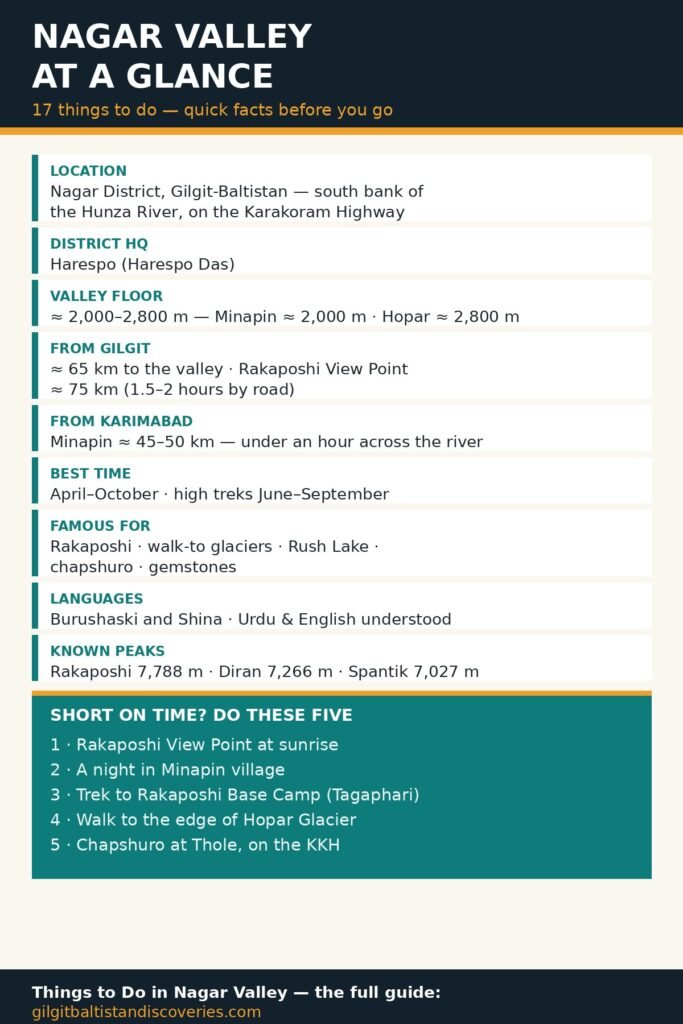
Short on time? Do these five: stand at Rakaposhi View Point at sunrise, sleep a night in Minapin village, trek to Rakaposhi Base Camp (Tagaphari), walk to the edge of Hopar Glacier, and eat chapshuro at Thole on the Karakoram Highway. The best time to visit Nagar Valley is April to October — blossom in April, high treks from June to September, autumn colour in October. Give the valley 2–3 days minimum; trekkers should plan 4–6.
Nagar Valley at a Glance
| Quick fact | Detail |
|---|---|
| Location | Nagar District, Gilgit-Baltistan — south bank of the Hunza River, directly across from Hunza on the Karakoram Highway (KKH) |
| District headquarters | Harespo (Harespo Das) |
| Valley-floor altitude | Roughly 2,000–2,800 m (Minapin ≈ 2,000 m; Hopar ≈ 2,800 m) |
| Distance from Gilgit | ≈ 65 km to the valley; Rakaposhi View Point (Ghulmet) ≈ 75 km, about 1.5–2 hours by road |
| Distance from Karimabad (Hunza) | Minapin ≈ 45–50 km, under an hour across the river |
| Best time to visit | April–October (high treks June–September) |
| Famous for | Rakaposhi, glaciers you can walk to, Rush Lake, chapshuro, gemstones |
| Languages | Burushaski and Shina (a little Domaaki survives around Chalt); Urdu and English widely understood |
| Known peaks | Rakaposhi 7,788 m · Diran 7,266 m · Spantik (Golden Peak) 7,027 m |
Viewpoints and Villages: The Nagar You Can Reach by Road
1. Rakaposhi View Point and Zero Point, Ghulmet
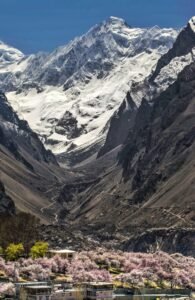
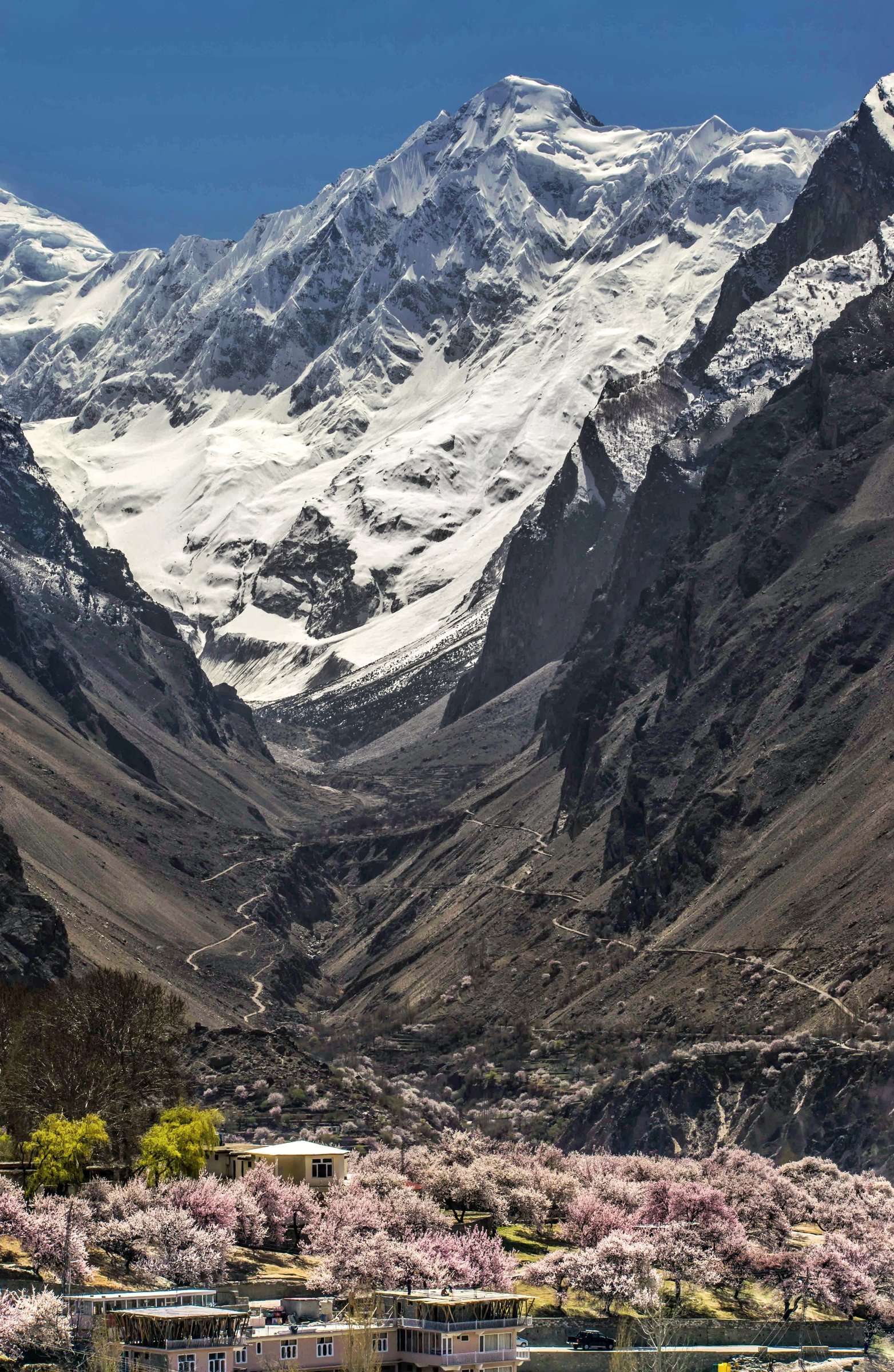
This is where almost every Nagar story starts: a bend on the Karakoram Highway at Ghulmet, about 75 km from Gilgit, where Rakaposhi stops traffic. The viewpoint — locally the Zero Point of Rakaposhi, the closest roadside view of the mountain — looks straight up a wall that rises some 5,900 metres in barely 11 km from the river, the greatest uninterrupted rise of any peak on Earth. Cafés and hotels line the glacier-fed stream, and shops sell Gilgit-Baltistan caps, stones and jewellery. A zipline billed as the longest in Gilgit-Baltistan now runs here, with sky cycling alongside. Insider tip: don’t do the 20-minute photo stop — sleep by the stream and be out at sunrise, before the clouds build.

2. Minapin Village — The Trekkers’ Front Porch
Four kilometres off the highway above Pissan, at roughly 2,000 m, Minapin is the village I tell every trekker to sleep in. Family-run guesthouses — the Diran Guest House is the old favourite — sit among cherry and apricot orchards, and the owners double as the valley’s trekking fixers, arranging guides, porters and camp food over dinner. You wake to Rakaposhi and Diran floating over green fields, and the base-camp trail starts at the village edge. Insider tip: arrive by afternoon, sort your loads and acclimatise here rather than rushing up the trail the same day.

3. Gappa Valley and Shani Peak, Above Chalt
Down in lower Nagar, near the old town of Chalt, a jeep track climbs from the KKH check post into Gappa — a bowl of juniper forest, springs and grassland (May to October) that still feels undiscovered. I have been twice, in 2018 and 2019, and stayed two nights; day-trippers who bounce up and down in an afternoon miss the point entirely. From the meadow, an hour’s steep climb reaches Shani Peak, whose panorama sweeps from Rakaposhi across half the district. Serious trekkers can continue on the multi-day route over towards Naltar, but that is guide-only country. Insider tip: sleep in Gappa and walk up Shani at dawn, when the light hits Rakaposhi first.
4. Shahshabaran, Ghulmet — The Princes’ Polo Ground
Above Rakaposhi View Point, a steep two-to-three-hour walk climbs to Shahshabaran, a high grassland where, in the princely era, the Mir of Nagar came up to watch polo — donkey polo, by the old accounts. The horses are gone; today it is summer pasture, reserved for livestock and the occasional camper. What you get for the climb is a balcony view west over Nagar’s villages and across the river to Karimabad and Aliabad. A second route drops in over the ridge from Talugotum, so you can walk up one way and down the other. Best season: May to September. Insider tip: there are no shops and no water sellers up here — carry everything.
5. Daman-e-Koh Miacher — The Roof of Hunza and Nagar
Every Hunza traveller knows Duikar’s Eagle’s Nest. Miacher is Nagar’s answer, and almost nobody goes. A 4×4 track climbs for about an hour to Daman-e-Koh, a shoulder above Miacher village, and suddenly both valleys are laid out below you like a map — every village of Nagar on one side, Hunza on the other, the river stitching them together. Best time: a clear morning, or sunset if your driver is happy on the track after dark. Insider tip: Miacher pairs naturally with Minapin in one day — viewpoint in the morning, Minapin by afternoon.
6. Pissan Cricket Stadium — The Prettiest Ground in Cricket?
In Pissan village, about an hour’s drive up from the highway, a natural amphitheatre of grass serves as a cricket stadium, with the Pissan Glacier hanging behind the bowler’s arm. Local tournaments are held here every year, and if your visit coincides with one, you are in for the most scenic day’s cricket on the planet. There are no hotels or cafés at the ground, so treat it as a self-catered day trip: bring food, water and a picnic blanket. Insider tip: ask in Minapin or Pissan bazaar about tournament dates before you go — the locals will happily fold a visiting spectator into the day.

7. Mamubar Meadows and Sumayar — Camping Opposite Hunza
Sumayar, facing Aliabad and Karimabad across the river, gives you the mirror image of the famous Hunza panorama — except you’re looking at Hunza, with Nagar’s own green shoulders around you. The Mamubar camping meadow here is road-accessible, and locals cook traditional food for visitors. Sumayar is also gemstone country: the Chumar Bakhoor mines in the hills above produce aquamarine, fluorite and quartz. Insider tip: if you want to buy gemstones, buy from sellers in Sumayar itself rather than at highway mark-ups — and camp at Mamubar for sunset over the Hunza side.
8. Talugotum Hill Station and Waterfall, Qasimabad
Terraced step-meadows, a high waterfall, and Rakaposhi close enough to feel personal: Talugotum, above Qasimabad, is the valley’s quiet hill station. I stayed overnight here once during the COVID lockdown, and the silence up there is something I still think about. Most visitors day-trip it, which is a mistake — the meadows change character completely in the evening. The waterfall runs strongest on late-spring and early-summer meltwater, and a ridge path connects over to Shahshabaran for strong walkers. Best season: May to September. Insider tip: stand close enough to the falls to feel the spray; the cold is part of the fun.
Treks and Base Camps: Nagar on Foot
9. Hapakun Meadows — The Meadow Before the Mountain
Half a day’s walk above Minapin (two to four hours, depending on pace and loads), the trail through pine forest opens onto Hapakun, a lush meadow at about 2,800 m that serves as the first camp on the Rakaposhi base camp trek. There is one camp hotel here, whose owner can organise guides and meal plans for the climb ahead — arrange it through your Minapin hotel before you set out. I have camped two nights at Hapakun and would happily return for the meadow alone: stream water, grazing horses, Rakaposhi turning pink above the trees. Best season: June to September. Insider tip: even if base camp isn’t your goal, Hapakun as an overnight walk is one of the finest short hikes in Gilgit-Baltistan.
10. Rakaposhi Base Camp Trek — Tagaphari
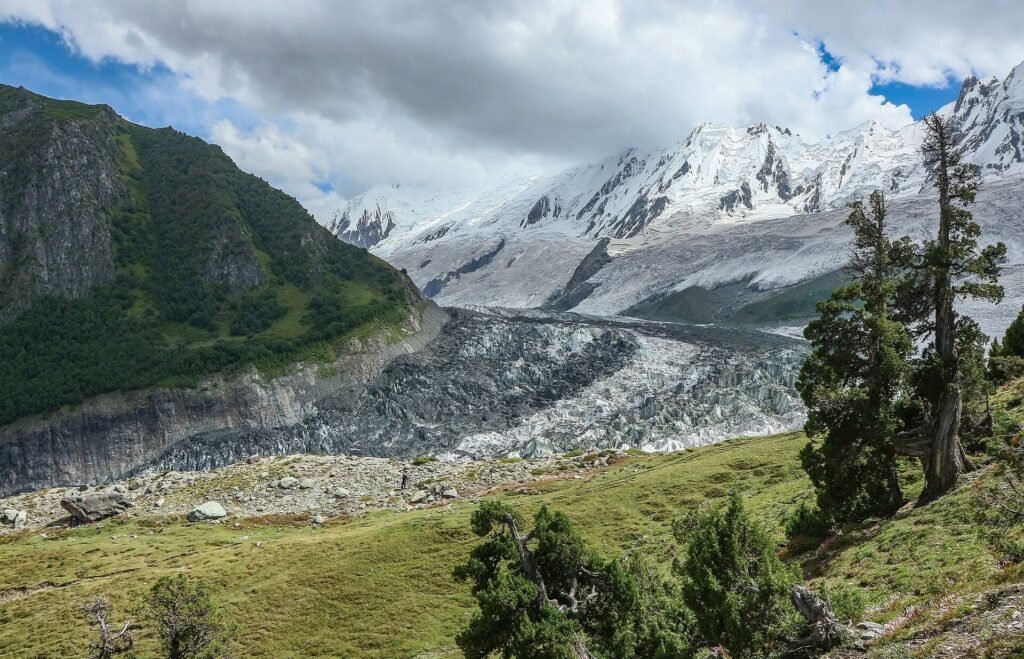
From Hapakun the trail climbs another two to three hours to Tagaphari, at about 3,300 m — the base camp of Rakaposhi from the Nagar side, and the emotional summit of this whole guide. You stand on moraine between the Minapin Glacier, Diran’s white pyramid and Rakaposhi’s north wall. By Karakoram standards this is an easy-to-moderate trek — a fit walker can go Minapin to base camp and back in a very long day, but two days with a Hapakun night is the civilised way. Porters and guides are easily arranged in Minapin, and a pair of trekking poles genuinely earns its keep on the steep forest trail. Best season: June to September.
11. Diran Base Camp — For Those Who Keep Walking
Diran (7,266 m) is Rakaposhi’s gentler-looking sister, and her base camp is where the Minapin trail gets serious. From Tagaphari you follow the Minapin Glacier for around three hours — moraine, white ice, and the constant low soundtrack of the glacier shifting — before climbing to Diran Base Camp. When I crossed, we could hear the ice cracking under the afternoon sun, and we strayed off the line three times; that is why a local guide is not optional here. Best season: June to September. Insider tip: start the glacier crossing early, while the surface is frozen hard and the walking is honest.
12. Rush Lake — One of the Highest Lakes on Earth
At 4,694 m, Rush Lake is one of the highest alpine lakes in the world, and getting there is Nagar’s classic expedition trek. From Hopar you cross the Bualtar Glacier, climb beside the Barpu Glacier through high camps, and reach the lake in three to four days; allow five to six days round trip. The reward is a shoreline panorama of Spantik, Malubiting, Miar Peak and Ultar Sar, with almost no one else in it. This is serious altitude — you gain roughly 1,900 m from Hopar — so acclimatise in the valley first and go with a guide and porters. Best season: July to September. Insider tip: fit walkers add the scramble up Rush Peak (5,098 m) above the lake for the full 360-degree Karakoram survey.

Bonus for Experienced Trekkers: Hispar Valley and the Snow Lake Traverse
East of Nagar Khas, a jeep road runs up the Hispar valley to Hispar village, the last settlement before one of the great ice journeys on Earth. The 49 km Hispar Glacier climbs to Hispar La (5,128 m), where it joins the Biafo Glacier to form the longest glacial system outside the polar regions — a roughly 100 km ice highway that once linked the kingdoms of Nagar and Baltistan, with the vast basin of Snow Lake at its heart. The full traverse takes two weeks or more, crosses crevasse country in a restricted zone, and is only done with a licensed operator and permits, in a July–August window. Insider tip: otherwise, drive to Hispar village and walk to the glacier’s snout as a day trip.
Glaciers and Lakes: Nagar’s Ice Country
13. Hopar Valley and Hopar Glacier
Ten kilometres from Nagar Khas, the bowl-shaped Hopar (also spelled Hopper) valley is one of the oldest settlements in the region and the valley’s second great base. From the village you can walk right to the edge of the Hopar (Bualtar) Glacier, a fast-moving river of grey ice — few places in the Karakoram let you stand this close to a glacier this easily. Hopar is also the trailhead for Rush Lake and for the two-to-three-day walk to Spantik base camp. Hotels and cafés have grown up along the approach in recent years. Our complete Hopar Glacier tour plan has the day-by-day detail. Best season: May to October. Insider tip: stay for sunset, when Spantik above the valley earns its other name — the Golden Peak.

14. Minapin Glacier — Walking on a Moving River
The Minapin Glacier fills the amphitheatre between Rakaposhi and Diran, and you meet it on every version of the base-camp trek: as the view from Tagaphari, and as the highway to Diran Base Camp. Up close it is a world of white ice, deep crevasses and meltwater streams that rearrange themselves every season. On a warm afternoon you can hear it — groans, cracks, the odd distant boom of an icefall settling. Walk on it only with a local guide who knows the current safe line: the surface you crossed in June is not the surface that’s there in August. Best season: June to September. Insider tip: the finest free viewpoint is Tagaphari at dawn, when the glacier lies in shadow and both peaks catch first light.
15. Kacheli Lake — The Lake Beyond the Lake District
Kacheli Lake, at around 3,500 m, is the answer for trekkers who found Tagaphari too easy. The route continues past Diran Base Camp and climbs a further two hours uphill to a still, rarely visited alpine lake under the big peaks. I have done the whole arc — Hapakun to base camp, across the glacier, up to Kacheli and back — in one very long nine-hour day, and my legs filed a formal complaint; the sane version camps at Diran Base Camp and day-hikes to the lake with a light pack. You will almost certainly have it entirely to yourself. Best season: July to September. Insider tip: because almost nobody comes here, carry everything — there is no camp infrastructure beyond Diran.
Culture and Food: The Nagar You Taste and Hear
16. Royal Palace Garden and Nagar Khas
Nagar Khas was for centuries the capital of a princely state that stood toe-to-toe with Hunza — the two kingdoms fought wars, played polo against each other, and divided a river between them. The Royal Palace Garden preserves that era: palace buildings of mud and timber, and collections of antique weapons and jewellery from the Mir’s court. Visits need prior permission, arranged through a local guide, and are worth the small effort. The town itself is the valley’s main bazaar, and nearby Nilt, right on the highway, is where Nagar’s fighters famously held up the British in the Anglo-Brusho war of 1891. For the full background, see our district Nagar overview. Insider tip: ask your hotel or guide to arrange permission a day ahead, not on the morning itself.
17. Chapshuro Food Street, Thole
Every traveller on the Karakoram Highway passes Thole bridge, and every local knows why you stop: stall after stall selling chapshuro, the minced-meat, onion and spice stuffed flatbread that is Gilgit-Baltistan’s definitive snack and Nagar’s pride. Each stall has its own hand with the seasoning, so the correct technique is comparative — one here, one two stalls down. It is cheap, filling and eaten scalding hot, ideally standing up with the river noise below you. Insider tip: eat where the truck drivers park — they have done the research for you.

How to Reach Nagar Valley
By air + road (fastest): Fly Islamabad to Gilgit (about an hour, weather-dependent — keep a buffer day), then drive the Karakoram Highway north. The valley begins around 65 km from Gilgit; Rakaposhi View Point is 75 km (1.5–2 hours), Minapin about 90 km, and Nagar Khas around 105 km. Buses and private hires run from Gilgit.
By road from Islamabad: The KKH via Besham and Chilas runs year-round and takes roughly 14–16 hours to Gilgit; in summer (about June to October) the route over Babusar Pass is shorter and prettier. Either way, Nagar is on the highway itself — no separate mountain road to find.
From Hunza: Nagar is the valley across the river, not a detour. From Karimabad, Minapin is under an hour’s drive. A Hunza-based day trip is entirely feasible for the viewpoints and Hopar — but you’ll understand the valley better with nights in it.
Getting around inside the valley: The KKH villages (Ghulmet, Thole, the Pissan turn-off, Nilt, Nagar Khas) are served by local transport and hires. Hopar, Hispar, Minapin and Miacher need side roads — hire a local car or 4×4 by the day, and pack for four seasons in a day using our Gilgit-Baltistan packing checklist.
Best Time to Visit Nagar Valley
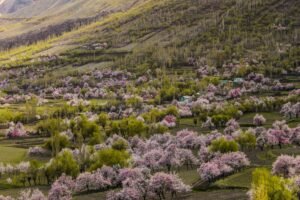
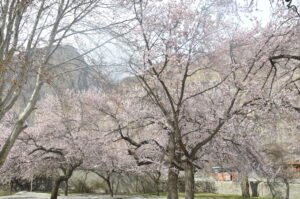
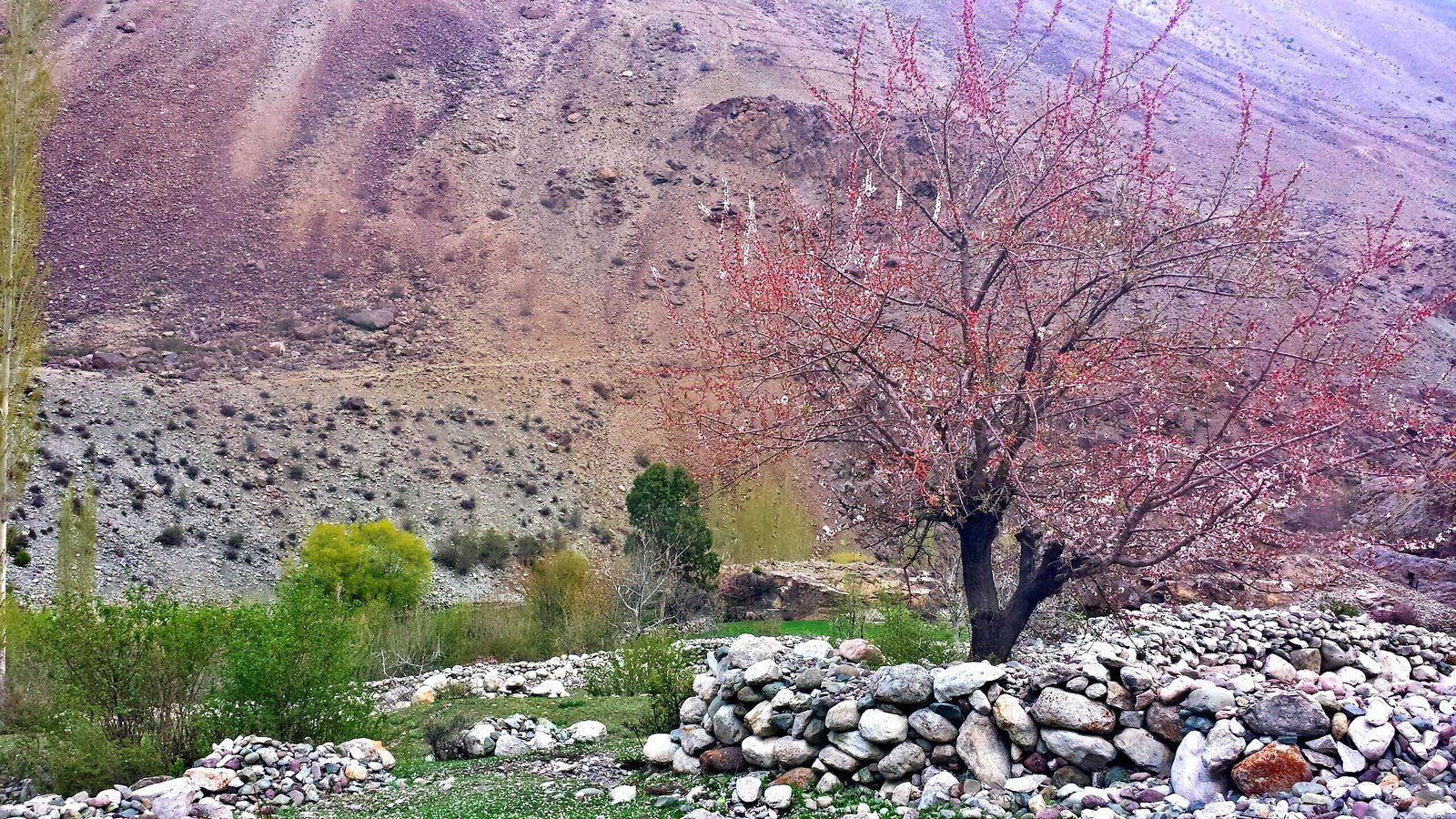
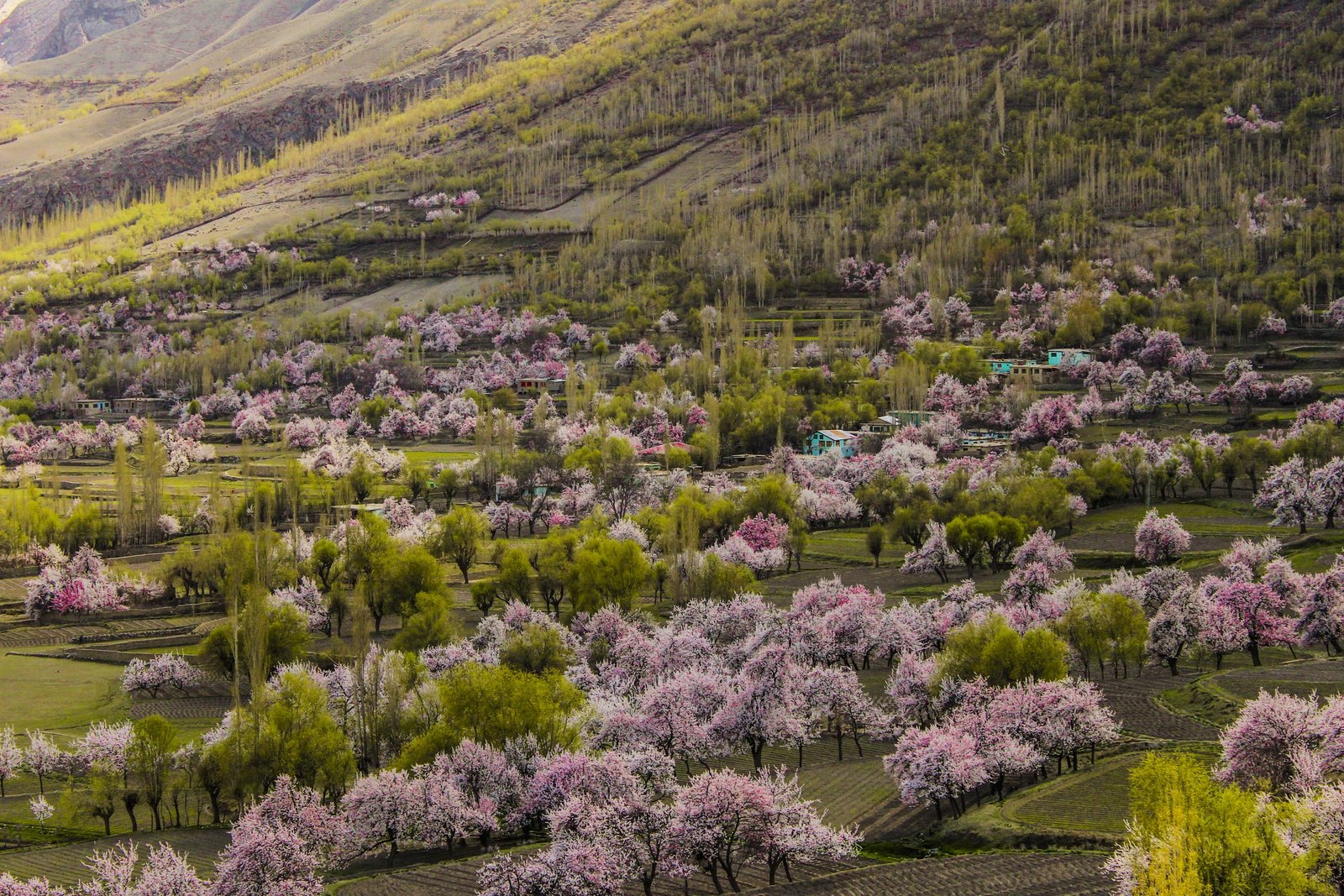
April brings blossom to the lower valley — the photographer’s spring. May and June are green, quiet and ideal for viewpoints, villages and the first base-camp treks. July and August are peak season: warmest weather, the full trekking menu including Rush Lake and the Hispar window, and the busiest hotels. September is the connoisseur’s month — clear skies, thin crowds, harvest coming in. October is apricot harvest and famous autumn colour, with cold nights returning. November to March is winter: the highway viewpoints are still reachable and Rakaposhi is at its most sculptural after snowfall, but most trekking stops and many hotels close. If you must pick one window, pick mid-May to early October. Pairing Nagar with the other bank? The same month logic is mapped in our best time to visit Hunza Valley guide.
Where to Stay in Nagar Valley
- Minapin — the trekkers’ base: guesthouses among the orchards, with owners who arrange guides and porters. Roughly PKR 3,000–6,000 a night (approximate, 2026), meals on top.
- Rakaposhi View Point / Ghulmet — the widest choice, priced for the panorama: roughly PKR 5,000–15,000 a night in season (approximate). Book ahead in July and August.
- Nagar Khas — simpler, cheaper hotels near the bazaar, best for the palace garden and onward jeeps to Hopar and Hispar.
- Hopar — glacier-side lodges and cafés, quieter than Ghulmet, perfect before a Rush Lake trek.
Our full rundown of the top hotels in Nagar Valley compares the main options village by village.
What to Eat in Nagar Valley
Start with chapshuro at Thole (above), then go deeper into a kitchen that runs on apricots, walnuts and wheat. Look for gialing (buckwheat pancakes), diram phiti (apricot-kernel sweet bread), buttering dowdo (apricot soup), hearty noodle soups on cold trekking evenings, and tumuro — wild thyme tea — at altitude. In July and August the apricots are the event: fresh in the orchards, dried on rooftops for winter, sold in every bazaar alongside walnuts, almonds and cherries. Guesthouse cooking is the valley’s real restaurant scene — eat where you sleep.
Nagar Valley Costs Snapshot
Approximate 2026 prices, to help you budget — confirm on the ground, as rates move with the season:
| Item | Typical cost (PKR) |
|---|---|
| Guesthouse room, Minapin | 3,000–6,000 / night |
| View hotel, Rakaposhi View Point (season) | 5,000–15,000 / night |
| Local meal / chapshuro stop | 300–1,500 |
| Trekking guide (base-camp treks) | ≈ 5,000 / day |
| Porter | ≈ 3,000–4,000 / day |
| Hired car / 4×4 for valley sights | 8,000–15,000 / day |
Frequently Asked Questions
What is the best time to visit Nagar Valley?
April to October is the main season. Come in April for blossom, June to September for the high treks (Rakaposhi base camp, Rush Lake, Hispar), September for clear and quiet trails, and October for apricot harvest and autumn colour. Winter suits the highway viewpoints only — most trekking stops and many hotels close from November to March.
How many days do you need in Nagar Valley?
Two to three days cover the highlights: Rakaposhi View Point, Minapin, Hopar Glacier and a food stop at Thole. Add a day for the Rakaposhi base camp trek (four to five days total), and a full week if Rush Lake is on your list.
How do I reach Nagar Valley from Islamabad or Hunza?
From Islamabad, fly to Gilgit (about an hour, weather permitting) and drive two hours up the Karakoram Highway, or come by road in 14–16 hours (less via Babusar Pass in summer). From Hunza, simply cross the river: Minapin is under an hour from Karimabad, and Nagar’s viewpoints sit directly on the KKH.
Is Nagar Valley safe to visit?
Yes. Nagar is a community-run tourism valley with a strong local ethic of looking after guests, tourist police patrol the Karakoram Highway, and villages like Minapin and Hopar host foreign trekkers every season. Normal mountain sense applies: dress modestly in villages, and never wander glaciers or high trails without a local guide.
What is the difference between Nagar and Hunza?
They are twin valleys divided by the Hunza River — and for centuries, rival princely states. Hunza is famous for its forts, Karimabad and polished tourism. Nagar, on the south bank, is Rakaposhi’s home side: rawer, greener, glacier-heavy and far less crowded — and languages split too, Burushaski above, Shina around Chalt.
Do I need a permit to visit Nagar Valley?
No permit is needed to tour the main valley — it is open to visitors, and international travellers enter on a normal Pakistan visa. The exception is expedition country: the Hispar–Snow Lake traverse crosses a restricted zone, so permits are required and arranged by the licensed operator running the trek. High base-camp treks need no permits, just a local guide.
Nagar doesn’t shout the way Hunza does. It waits — behind a zipline viewpoint, up a village lane, at the far end of a glacier — for the travellers willing to give it days instead of minutes. Give it the days.
Planning a Nagar Valley tour or a Rakaposhi or Rush Lake trek? Explore Nagar Travels, the local team behind this guide, can build the trip with you — just use the contact page.


19 Responses