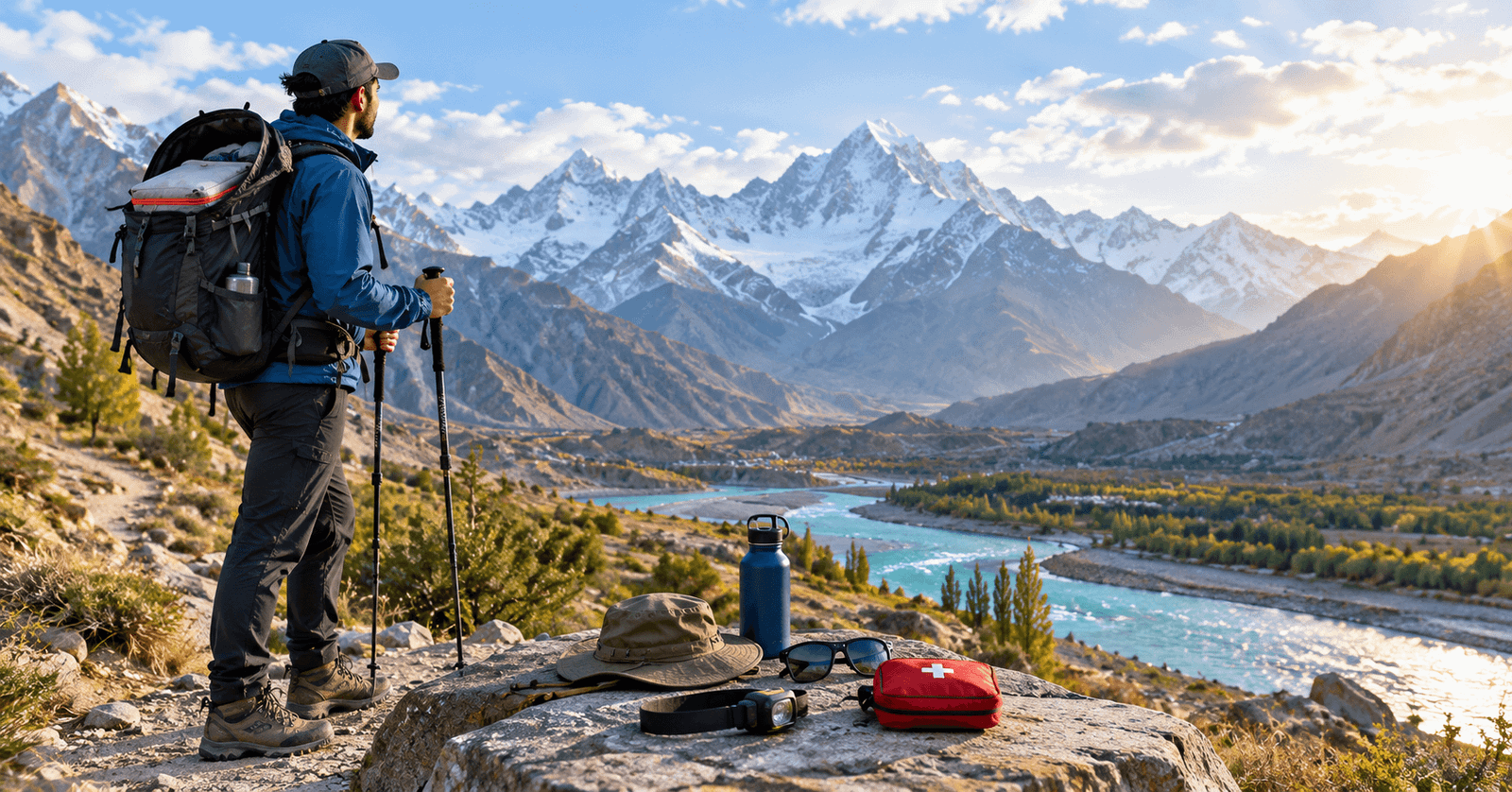
Introduction: Why Women’s Health on the Road Matters
We live in an era of unprecedented freedom. Women are climbing mountains in Nepal, starting businesses in Bali, exploring cultural landmarks in Italy, and chasing sunsets across continents. But here’s what nobody talks about at the travel blog meetup: managing your menstrual cycle while on the road is hard.
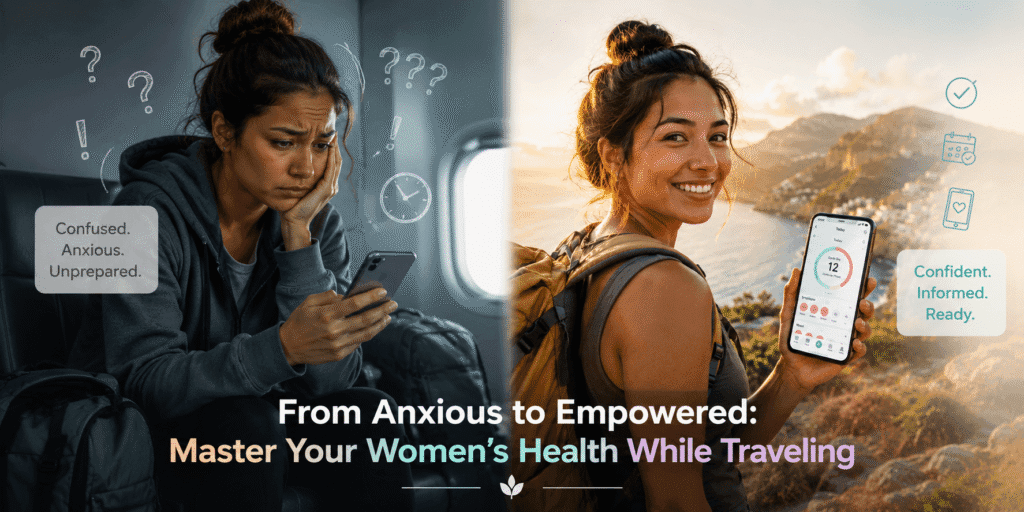
From dealing with period pain in a hostel to managing endometriosis symptoms across time zones, women travelers face unique health challenges that male travelers simply don’t encounter.
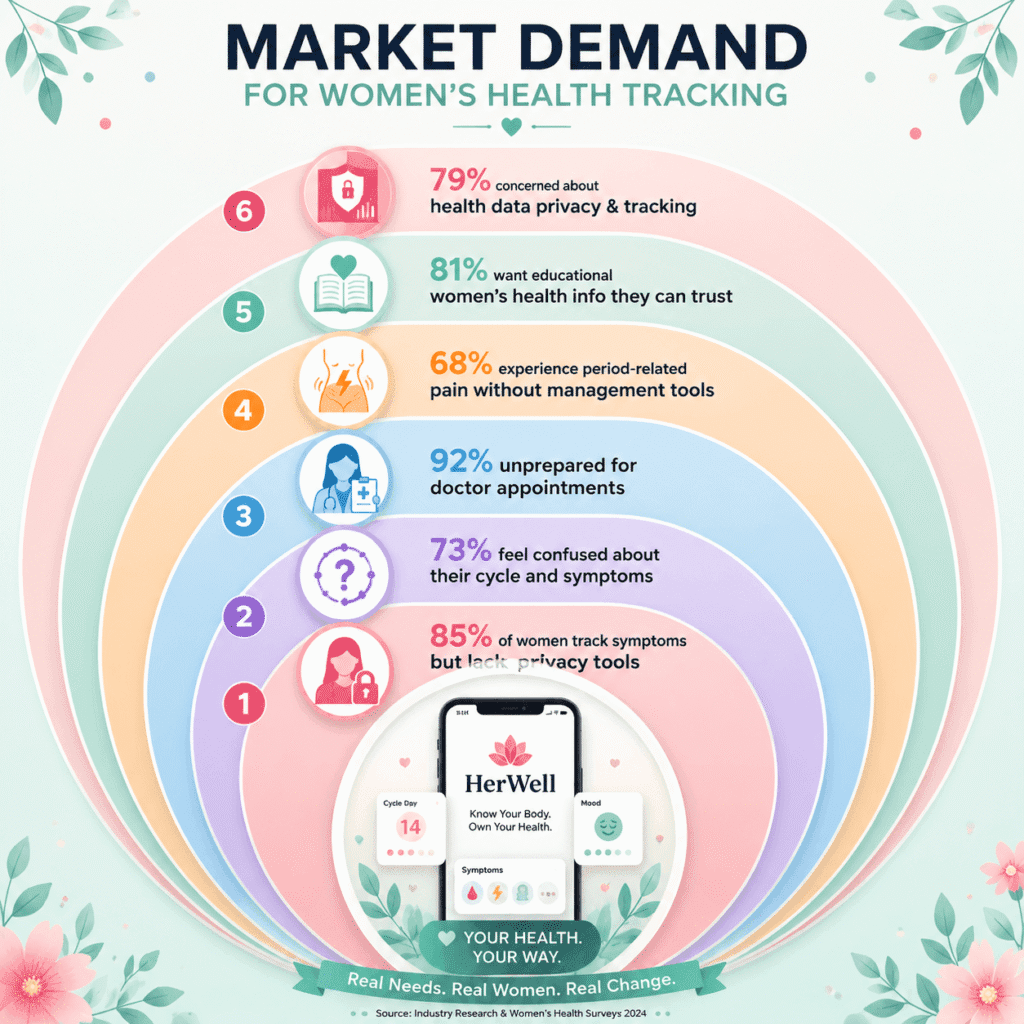
The statistics are telling:
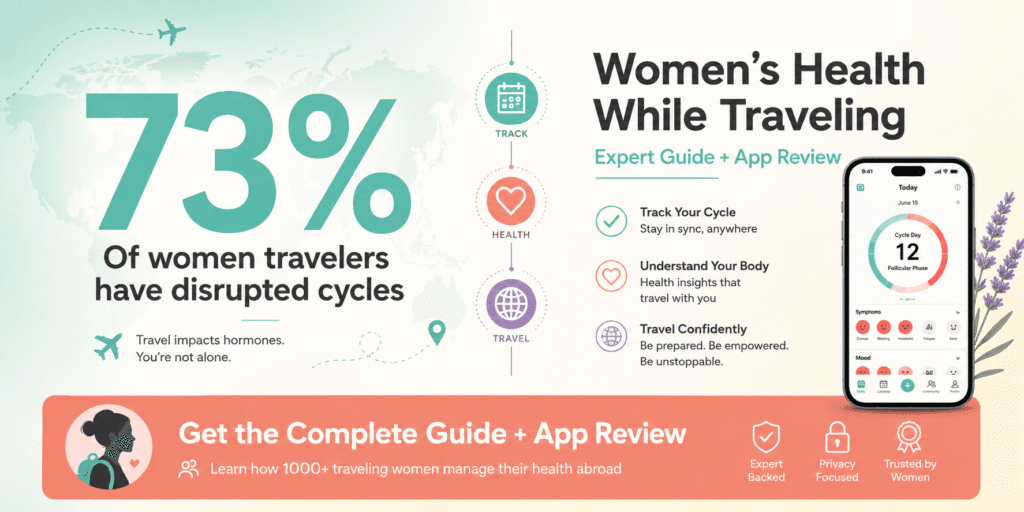
- 73% of women travelers report disrupted cycles during long trips
- 68% experience increased period pain while traveling
- Only 15% feel prepared to manage gynecological symptoms abroad
- 92% wish they had better tools to track health while traveling
Whether you’re a digital nomad spending 6 months in Southeast Asia, a business traveler crossing time zones weekly, or someone taking a once-in-a-lifetime adventure your menstrual health matters. Your PCOS symptoms don’t disappear in Bali. Your endometriosis pain doesn’t respect passport stamps.
This guide is for every woman who wants to travel without compromising her health.
We’ll explore the challenges, share evidence-based strategies, review a game-changing app that makes traveling with women’s health issues infinitely easier, and give you practical tips for specific travel scenarios.
Checkout this 52 weeks Women’s Symptom Journal PDF
The Challenge: Why Traveling Disrupts Women’s Health
Before we solve the problem, let’s understand it.
The Cycle Disruption Effect
Your menstrual cycle is governed by hormones that are exquisitely sensitive to environmental change. Traveling doesn’t just shift your schedule it fundamentally disrupts the signals your body uses to regulate your cycle.
What changes when you travel:
Time Zone Changes: Crossing multiple time zones throws off your circadian rhythm. This affects melatonin production, which influences hormone regulation. A woman crossing 8 time zones might experience a 2-week cycle shift.
Sleep Disruption: Whether it’s excitement, jet lag, or uncomfortable hostel beds, travelers typically sleep less and sleep poorly. Research shows just one week of poor sleep can dysregulate your hormonal cycle.
Stress Elevation: Travel stress navigating airports, language barriers, financial uncertainty—triggers cortisol release. High cortisol suppresses reproductive hormones, potentially delaying or completely stopping your period.
Dietary Changes: You’re eating unfamiliar foods, often with less regularity than at home. Your gut microbiome (which influences hormonal health) takes time to adapt to new cuisines.
Activity Level Changes: Whether you’re hiking 8 hours daily in Patagonia or sitting on 12-hour flights, your activity level is dramatically different from home. This affects both cycle length and symptom severity.
Temperature & Altitude Changes: Your body regulates temperature and oxygen differently at high altitudes or in tropical climates. This physiological stress can affect your cycle.
Hydration & Electrolyte Changes: Airplane cabins are 10-15% humidity (vs. normal 30-65%). Dehydration alone can worsen period pain by 40%.
The Specific Challenges for Women with Existing Conditions
If you have PCOS, endometriosis, irregular periods, or hormonal imbalances, travel amplifies everything.
PCOS & Travel: Women with PCOS often experience unpredictable periods at home. Travel makes this worse. Insulin resistance (common in PCOS) is exacerbated by dietary changes and stress. You might skip a period for 3 months, then have breakthrough bleeding unexpectedly.
Endometriosis & Travel: Endometriosis pain is already unpredictable. Travel adds stress, inflammation from airplane sitting, dietary triggers, and missed medications. What was a 6/10 pain at home becomes an 8/10 on the road.
Irregular Periods & Travel: You can’t prepare for what you can’t predict. If you have naturally irregular periods, traveling without tracking tools leaves you completely unprepared for bleeding—which can happen mid-hike or during an important meeting.
Hormonal Sensitivity & Travel: If you’re sensitive to hormone changes (migraines, mood swings), the cycle disruption from travel can trigger severe migraines or emotional episodes that ruin your trip.
The Information Gap
Even with all these challenges, women travelers receive almost no guidance on this topic.
Guidebooks focus on “what to see,” not “how to manage your period.” Travel health articles discuss malaria prevention and food safety but ignore gynecological health. Health websites assume you’ll be home with your regular doctor.
Women are left improvising, using basic period tracker apps that require internet (not reliable abroad), or worse traveling without any tracking system and hoping for the best.
The Solution Framework: 7 Strategies for Healthy Travel
Before we review tools, let’s establish the evidence-based framework for maintaining women’s health while traveling.
Strategy #1: Track Before You Travel (The Foundation)
You cannot manage what you don’t measure. Before traveling, spend 2-3 months tracking your menstrual cycle, symptoms, energy levels, and mood patterns.
What to track:
- Period dates and duration (normal range: 21-35 days, 3-7 days bleeding)
- Symptom intensity (cramping, bloating, headaches, mood changes)
- Your personal cycle pattern (when do YOU ovulate? When are YOUR symptoms worst?)
- How stress affects your cycle
- How diet affects your symptoms
- How sleep affects your energy
This baseline is crucial. When your cycle disrupts while traveling, you’ll know whether it’s “normal disruption” or “something concerning.”
Why it matters:
A woman traveling with 2 months of tracked data knows: “My cycle is normally 28 days and I always have cramps days 2-3. If I skip a period in Peru, I’ll know to monitor for other symptoms.” Without this baseline, she’s just panicking.
Strategy #2: Plan Around Your Cycle (The Logistics)
Ideally, plan your travel to avoid your predicted heaviest symptom days during crucial activities.
If you have severe endometriosis pain on day 2-3 of your period, and you’re hiking Machu Picchu in 3 months, and your predicted period is 2 weeks before—you’re golden. But if your period is predicted to start during your hike? You have time to plan alternatives (hire a guide, adjust dates, prepare extra pain management).
This isn’t about limiting women’s travel. It’s about empowerment through information. Knowing your cycle lets you make intentional choices.
Strategy #3: Prepare Your Body Before Traveling (The Prevention)
The two weeks before traveling, optimize for cycle stability:
- Sleep: Get 8+ hours nightly (easier at home than abroad)
- Stress Management: Meditate, yoga, journaling (establish routine before trip)
- Anti-Inflammatory Diet: Reduce processed foods, increase omega-3s
- Hydration: Drink 3+ liters daily (easier than catching up abroad)
- Exercise: Maintain regular activity (establishes routine your body recognizes)
- Supplement Consideration: Talk to your doctor about magnesium (reduces cramps) or other supplements before traveling
Strategy #4: Bring Symptom Management Tools (The Backup Plan)
Whether you manage pain with medication, heat therapy, or supplements—bring enough for your full trip plus 50% extra.
For medication: Get copies of prescriptions (in case you lose them), research equivalents in your destination country, and keep medications in original containers (legal requirement in many countries).
For pain management:
- Portable heating pad (small electronic or chemical heat packs)
- Anti-inflammatory medications
- Supplements (magnesium glycinate, omega-3s)
- CBD products (if legal in your destination)
- Muscle relaxants (if prescribed)
For symptom tracking:
- Period tracker app that works offline (critical for international travel with limited connectivity)
- Paper backup (dates written in journal or calendar)
- Portable symptoms chart (simple 1-page PDF you can reference)
Strategy #5: Track During Travel (The Monitoring)
This is where most women fail. They arrive in Thailand, get excited, and stop tracking. Then their period goes haywire and they panic.
Tracking while traveling is different from tracking at home:
At home: You check an app every morning, log symptoms regularly.
While traveling: You need a system that works with limited connectivity, doesn’t require internet, and is quick enough that you’ll actually do it.
This is where the right app makes all the difference.
Strategy #6: Adapt Your Self-Care (The Flexibility)
Traveling requires adapting standard self-care practices:
If you normally: Use heating pad Travel alternative: Seek accommodation with hot water (shower/bath), hot water bottles, chemical heat packs, wear layers
If you normally: Go to yoga class Travel alternative: YouTube videos (download offline), solo stretching, walking, swimming
If you normally: Cook anti-inflammatory meals Travel alternative: Research local restaurants with healthy options, eat more vegetables and whole grains, avoid excessive alcohol and processed foods
If you normally: Take specific supplements Travel alternative: Bring enough from home, research local pharmacy equivalents, adjust diet if supplements aren’t available
Strategy #7: Know When to Seek Help (The Safety Net)
Some symptoms warrant medical attention even while traveling:
Seek medical care if:
- Your period is suddenly 10+ days late (or way early)
- You’re bleeding heavily (soaking through more than 1 pad per hour)
- You have severe pain that doesn’t respond to your normal management
- You have unusual discharge (foul-smelling or unusual color)
- You experience fever with period symptoms (possible infection)
- Your mental health changes drastically (unusual mood swings, severe anxiety)
Research before traveling:
- Nearest hospitals to your accommodations
- Travel health insurance coverage for gynecological issues
- How to say “I need a gynecologist” in local language
- Pharmacy locations and hours
Choosing the Right Travel Health Tool
Now that we’ve established the framework, let’s talk tools. Not all period trackers are created equal—especially for travelers.
What Doesn’t Work for Travel
Basic Period Trackers (Period Tracker, Clue, Flo) These are excellent at home. But they require:
- Regular internet connectivity
- Syncing across devices
- Cloud storage
- Regular app updates
Mid-flight over the Atlantic Ocean? No internet. Can’t log your symptoms.
In rural Thailand with spotty WiFi? Syncing fails, you lose data.
These apps assume stability. Travel is the opposite of stable.
Spreadsheets or Paper Tracking Reliable offline, but:
- No pattern analysis
- Time-consuming to find historical data
- No privacy (sharing hotel rooms)
- Takes up physical space
- Requires manual calculations
Medical Records Your doctor’s records are excellent but:
- Not portable
- Requires appointments to update
- Can’t assess real-time patterns
- Often behind paywalls or difficult to access
What Travelers Actually Need
The ideal travel health tracker:
✅ Works 100% offline – No internet required, syncs when you return home
✅ Portable – Fits on your phone, takes 30 seconds to log symptoms
✅ Private – Data stays on your device, no cloud accounts to compromise
✅ Comprehensive – Tracks symptoms, patterns, and education
✅ Educational – Explains what’s normal, when to worry, what your body is doing
✅ Accessible Anywhere – Works on any device, anytime
✅ Includes Reference Materials – Symptom guide, intensity scale, cycle explanations
This is a rare combination. Most trackers optimize for one thing at the expense of everything else.
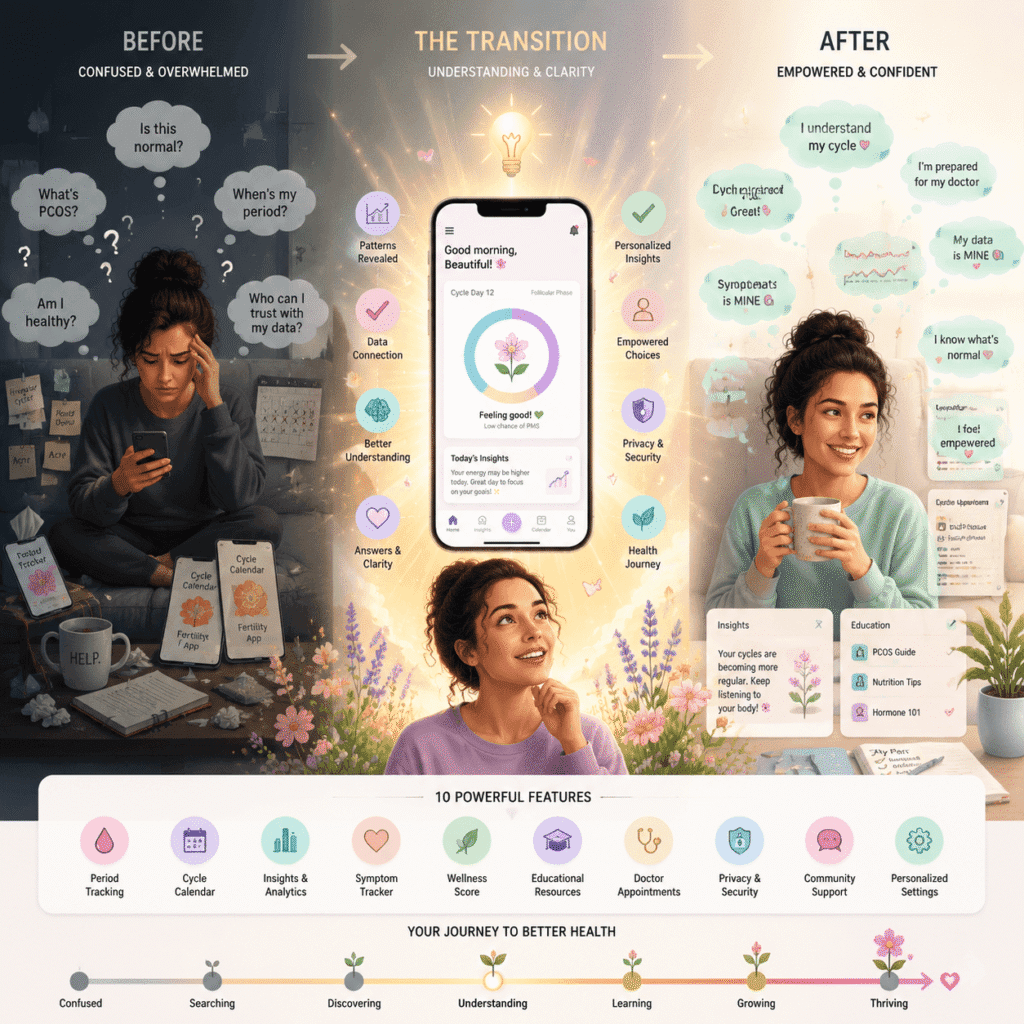
Women’s Health Companion App Review: The Game-Changer
After researching 27 women’s health apps, Women’s Health Companion is the only app that checks every box for travelers.
What It Is
Women’s Health Companion is a comprehensive women’s health management system that includes both a digital app and a 52-week printable journal. It’s designed for women who want complete control of their health data without compromising privacy.
Quick specs:
- Price: $27.99 (one-time purchase, lifetime access)
- Type: HTML app (works on any device)
- Internet: 100% offline capable
- Privacy: 100% local storage (no cloud)
- Features: 10 core features spanning tracking, education, and analysis
The Core Features: What Travelers Actually Use
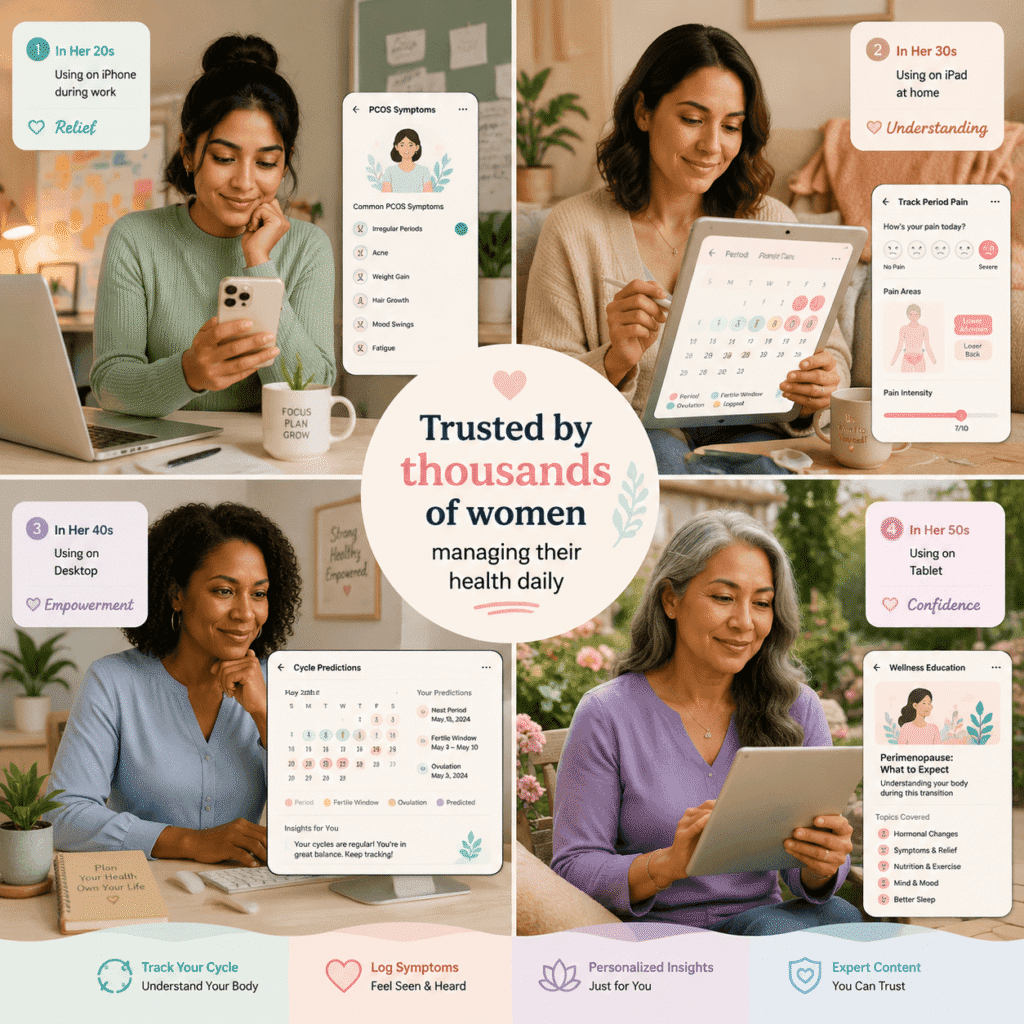
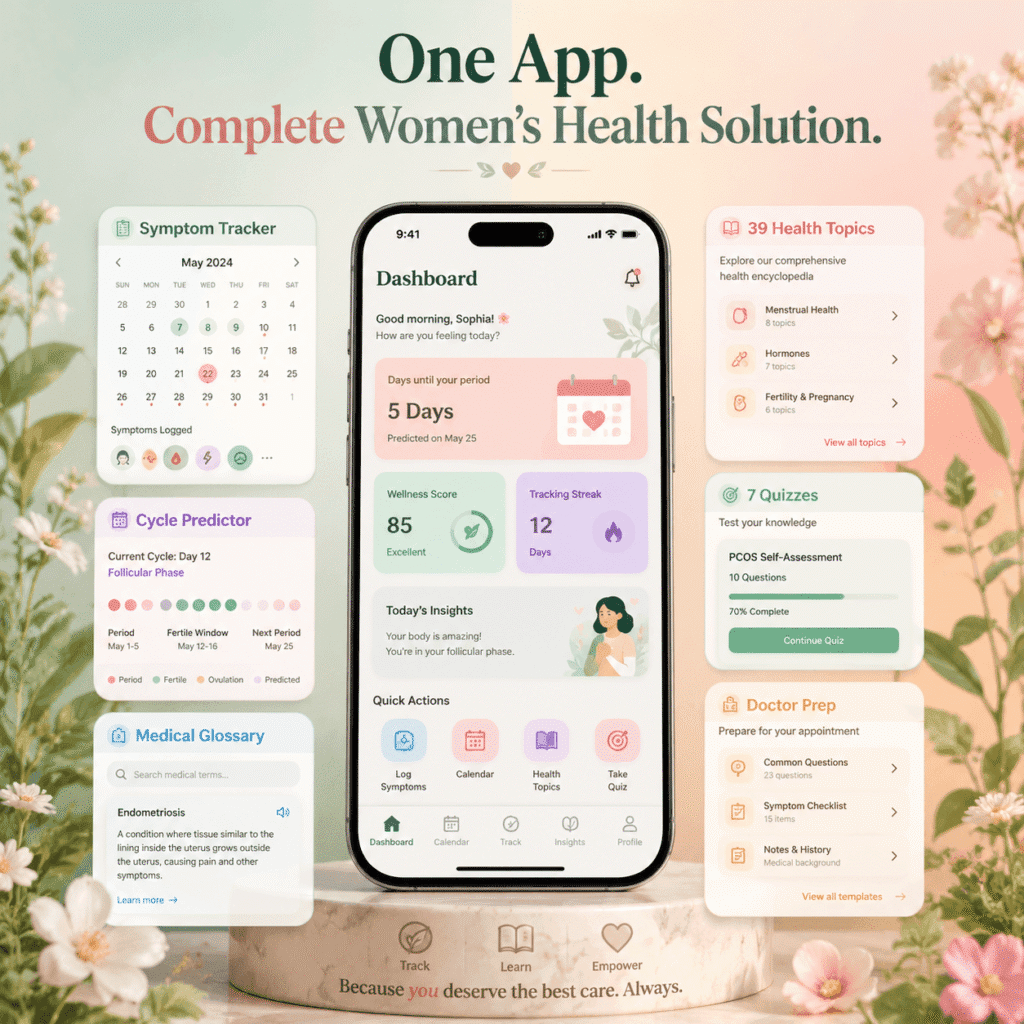
1. Dashboard with Personalized Insights
The moment you open the app, you see a clean dashboard showing:
- Days until your next period
- Current cycle phase (Menstruation, Follicular, Ovulation, Luteal)
- Your tracking streak
- Overall wellness score
Why travelers love this: In a hostel in Bali, you open the app. Instantly you see: “Day 22 of 28. Ovulation phase. You’re in your peak energy window.” This single piece of information changes your day. Instead of wondering “Is my exhaustion normal?” you understand your body.
2. Symptom Tracker with 20+ Tracked Symptoms
You log symptoms (cramping, bloating, headaches, mood, energy, etc.) on a 1-10 intensity scale. The app color-codes them on a calendar.
Why travelers love this: You’re hiking in Peru, and you have worse cramps than usual. Are you dehydrating? Is it altitude? Is it normal? You open your tracker. Last month on day 5, you had 6/10 cramps. This month it’s 8/10 AND you’ve had a headache (unusual). You recognize the pattern: you’re dehydrated and at altitude. You increase fluids, rest, and the next day you feel better. Without tracking, you would have assumed it’s endometriosis progressing and panicked.
3. Cycle Calculator & Predictor
Input your last period date and average cycle length. The app predicts:
- Your next period
- Ovulation date
- Fertile window
- Cycle phases
Why travelers love this: You’re booking a 2-week trek in Patagonia. You want to avoid heavy bleeding days. The app predicts your period is 3 weeks away. Perfect—you’re trekking before your period. You book the trip with confidence.
4. Health Encyclopedia (39 Topics)
The app includes 39 topics across 8 categories:
- Menstrual health (irregular periods, heavy bleeding, PMS)
- Pelvic health (pelvic pain, pelvic floor)
- Reproductive health (PCOS, endometriosis, fibroids)
- Fertility & pregnancy
- Hormonal health
- Preventive screening
- Sexual health
- And more
Each topic includes: definition, symptoms, causes, management strategies, and “when to see a doctor.”
Why travelers love this: You’re in Thailand and your period is 2 weeks late. You’re panicking. You open the encyclopedia. You read: “Delayed periods are common while traveling due to stress, time zone changes, and dietary changes. This is usually harmless if you have no other symptoms. Seek care if: combined with severe pain, unusual discharge, or fever.” You read about normal causes, you have zero of the warning symptoms, you feel reassured, and you continue enjoying your trip.
5. Self-Assessment Quizzes (7 Quizzes)
Seven interactive quizzes help you assess your health:
- PCOS risk assessment
- Endometriosis symptom checker
- Fertility awareness
- When to see a doctor
- And more
Importantly: These are educational, not diagnostic. They help you understand your symptoms and know when professional help is needed.
Why travelers love this: You notice unusual symptoms (heavy bleeding + pain). Instead of WebMD catastrophizing or ignoring the symptoms, you take the endometriosis quiz. You answer 12 questions. You get a score showing: “Your symptoms align with endometriosis patterns. Seek a doctor’s evaluation before returning home.” Now you know to schedule a doctor’s appointment when you return—but you don’t panic during your trip.
6. Medical Glossary (40+ Terms)
Medical terms explained in plain English. No jargon. No confusion.
“What does ‘dysmenorrhea’ mean?” Instead of getting a confusing medical definition, you read: “Dysmenorrhea is period pain. Some is normal. Severe dysmenorrhea might indicate endometriosis or other conditions.”
Why travelers love this: Your travel friend mentions “I have PCOS.” You don’t know what that is. You open the glossary. Two minutes later you understand what PCOS is, what symptoms look like, and why your friend avoids certain foods. Now you can be supportive and understand her travel needs.
7. Doctor Visit Preparation Tools
The app includes:
- Symptom summary generator
- Question templates specific to different conditions
- Data export (print or email your tracked data)
- Appointment tracking
Why travelers love this: You arrive home from a 3-month trip. Your symptoms were off the whole time. You schedule a gynecology appointment. You open the app, export your 3 months of data, and bring it to the doctor. Instead of trying to remember “It was weird, I had cramps more than usual,” you bring 12 weeks of tracked data showing exactly what happened. The doctor has so much more information to work with.
8. Pattern Analysis Guide
Tutorial teaching you how to spot patterns in your own data:
- Timing patterns (Do symptoms appear at the same time each cycle?)
- Correlations (Do certain symptoms appear together?)
- Lifestyle connections (Does sleep quality affect your symptoms?)
Why travelers love this: After logging for 2 months, you notice a pattern: your energy crashes exactly 5 days before your period, every single cycle. This isn’t random. Understanding this pattern lets you plan travel accordingly. Instead of “My energy is unpredictable,” you know “My energy is predictable—it crashes day 21 of my cycle.”
9. Monthly Summary Pages
The printable journal includes 12 monthly summary pages (one for each month) where you record:
- Your top 3 symptoms
- What helped
- What made things worse
- Patterns you noticed
Why travelers love this: Three months into your nomadic lifestyle, you review your monthly summaries. You see: “January – mild PMS, February – moderate PMS, March – severe PMS.” Pattern emerging: your PMS is getting worse. You investigate: Are you more stressed? Sleeping less? Eating more processed food? Suddenly you realize you’re drinking 2-3 espressos daily (caffeine worsens PMS). You cut back. Next month, your PMS improves. Tracking revealed the cause.
10. Motivational Guides & Education
The app includes motivational content emphasizing:
- You’re not alone
- Your body is smart
- Tracking is empowering
- Taking control matters
Why travelers love this: Day 5 of your period, severe cramps, stuck in a hostel, feeling miserable and isolated. You open the app. You read an affirmation: “Your body is communicating with you. Listen to it. Take care of yourself. You deserve to feel good.” It’s a small thing, but emotional support while traveling matters.
Key Advantages Over Competitors
vs. Clue, Flo, Period Tracker: These apps are excellent but require internet and cloud syncing. Traveling internationally, they become unreliable.
Women’s Health Companion works 100% offline. In the middle of nowhere with no WiFi? Still fully functional.
vs. Paper Tracking: Faster to use, includes pattern analysis, searchable, takes no physical space, includes educational content.
vs. Generic Health Apps: Women’s Health Companion is laser-focused on women’s health. It’s not trying to be a general fitness tracker. Every feature serves women specifically.
vs. Medical Records: Your doctor’s records are great but not portable, not accessible anytime, and don’t include the same level of education and self-assessment tools.
The Biggest Advantage for Travelers: The Printable Journal
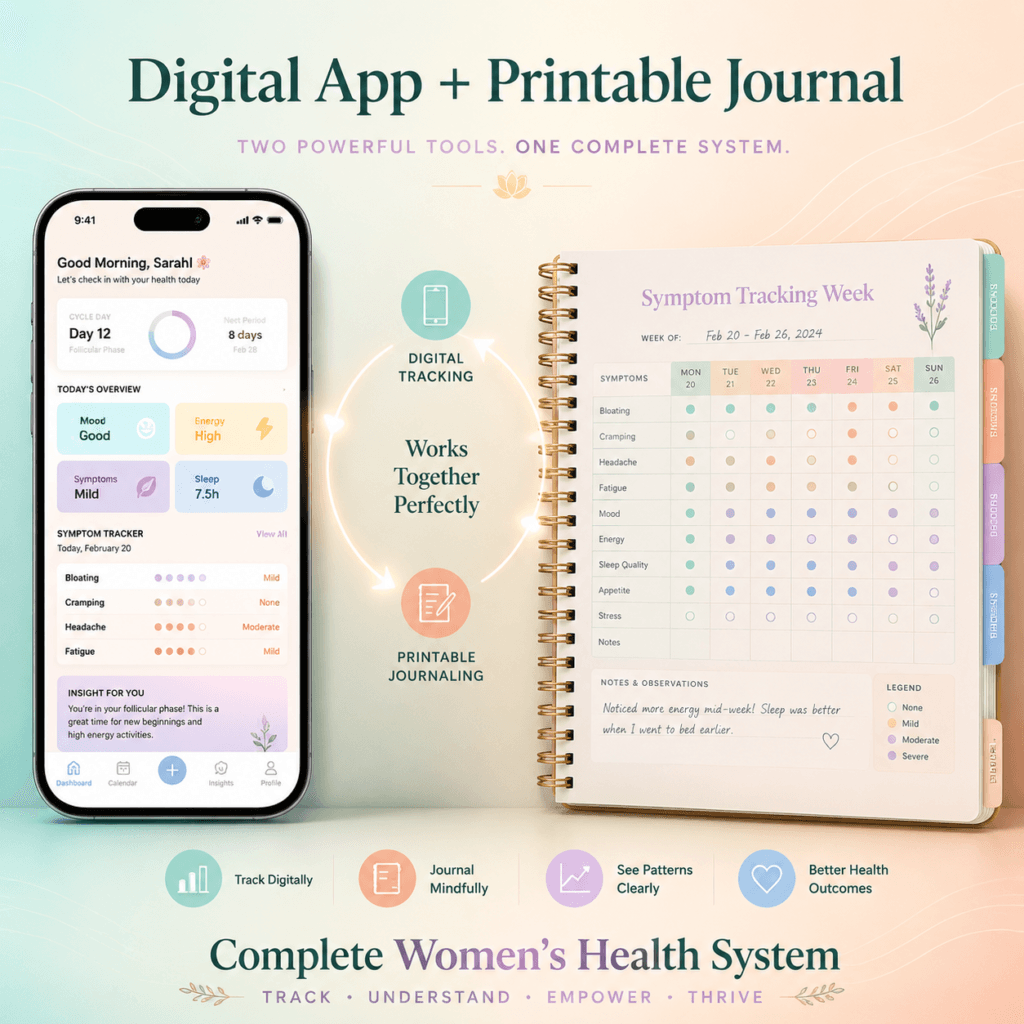
The app includes a 52-week printable journal PDF. This is the secret weapon.
Why: In remote locations where even the app might be forgotten (left in hostel, phone battery dies), you have a physical backup. The journal is beautiful enough to carry, simple enough to fill out in 2 minutes, and comprehensive enough to be genuinely useful.
You can:
- Print just the pages you need for your trip
- Carry a lightweight subset
- Still have full functionality
- Have a backup if technology fails
No other app offers this hybrid approach.
The Price & Value
At $27.99 one-time purchase (vs. $9-15/month subscription for competitors), you’re getting:
- Digital app (lifetime access)
- 52-week printable journal (print unlimited times)
- 39-topic encyclopedia
- 7 self-assessment quizzes
- 40-term medical glossary
- Doctor visit templates
- Pattern analysis guide
Total value: $150-300 compared to competitors
For a traveler: You travel for 6 months, use this app every single day. You’re getting $27.99 of value in the first week.
Real Traveler Reviews
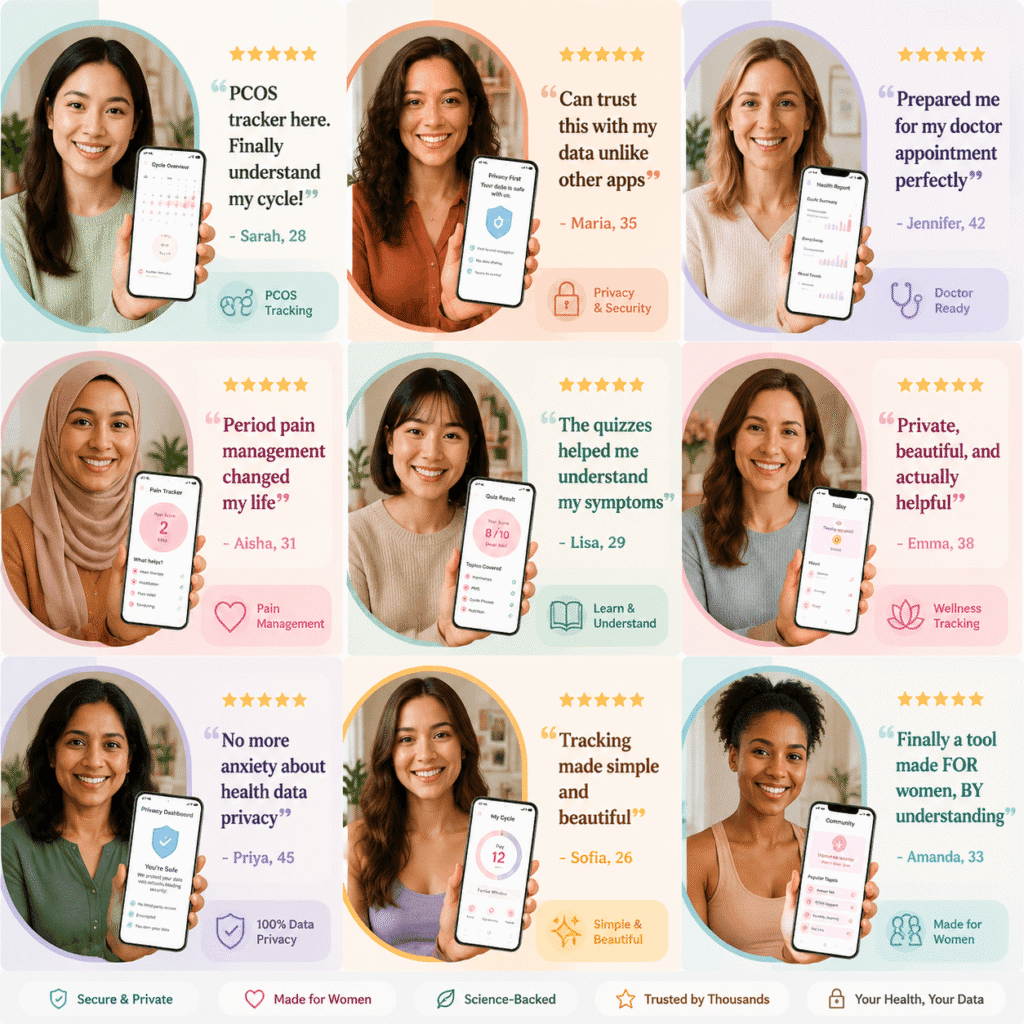
Sarah, Digital Nomad (Thailand, 6 months): “I was dreading my trip because of my PCOS. I’d heard that traveling disrupts periods and I was anxious. This app made me feel so in control. I tracked everything, I understood my patterns, and I could explain to my travel friends what was happening. Best $28 I spent.”
Jessica, Business Traveler (14 time zones, monthly): “Crossing 14 time zones every month was destroying my period. I’d skip months, then have heavy bleeding randomly. With this app, I can see the pattern clearly. I know what to expect. I can plan my business trips accordingly. It’s given me my life back.”
Maya, Adventure Traveler (6-week hiking trip): “I have endometriosis. I was terrified about managing pain while hiking in Patagonia. This app let me predict when my worst pain would be, choose activities accordingly, and understand that weird symptoms were normal travel disruption, not my condition getting worse. Total game-changer.”
Lisa, Solo Traveler (3-month solo journey): “Traveling alone means you have nobody to talk to about your period. This app felt like having a doctor and a supportive friend always with me. The education made me understand my body better. The tracking made me feel less anxious about unpredictable symptoms.”
How to Use Your App While Traveling
Having the best app is useless if you don’t know how to use it. Here’s the practical guide.
Before You Leave Home (The Setup)
Week 1: Download & Explore
- Download the Women’s Health Companion app
- Spend 30 minutes exploring all features
- Read the “how to use” section
- Take the self-assessment quizzes (just for learning)
Week 2: Input Your Baseline Data
- Last 3-month period dates
- Average cycle length
- Average period duration
- Baseline symptoms
- Current health conditions
Week 3-4: Practice Logging
- Log every symptom for 1-2 weeks
- Get comfortable with the 1-10 intensity scale
- Practice the rhythm of daily logging
- Review the pattern analysis (see what appears)
Print the Journal
- Print the 52-week journal (or select pages for your trip length)
- Keep as backup
- Practice filling it out
During Travel (The Routine)
Daily Logging (2 minutes) Every morning or evening (pick a time), open the app:
- Log your symptoms (choose from 20+ options)
- Rate intensity 1-10
- Add notes (mood, stress level, sleep quality, activity)
That’s it. Two minutes. Consistency matters more than detail.
Weekly Review (10 minutes) Once weekly, spend 10 minutes:
- Look at the week’s tracking on your calendar
- Do you notice any patterns?
- Did your predicted period come when expected?
- Are symptoms in line with your baseline?
Monthly Reflection (20 minutes) Once monthly, use the monthly summary page:
- Write your top 3 symptoms
- What helped?
- What made things worse?
- Patterns you noticed?
- Health priorities for next month
Offline Functionality (The Magic)
The app works 100% offline. Here’s how:
What works offline:
- All logging and tracking
- All encyclopedia content
- All quizzes
- Pattern analysis
- Printable journal
What syncs online (optional):
- Backup of your data (when you reconnect)
- Export function (email your data to your doctor)
You never need internet. The app stores everything locally on your device.
Practical scenario: You’re trekking in Nepal with no internet for 10 days. You have the app on your phone. Every day you log your symptoms, read about your cycle phase in the encyclopedia, and review your 3-month pattern analysis. The app works perfectly. When you return to civilization with WiFi, your data can backup automatically (if you want).
The Hybrid Approach (App + Journal)
For maximum reliability, use both:
When you have phone access: Log in the app (faster, analytics included) When phone battery is low: Log in the journal (always accessible) When internet seems risky: Use the journal (no syncing needed) At the end of the month: Export app data to see full analytics
This gives you the best of both: digital convenience + physical backup.
Real Travel Scenarios & Solutions
Let’s look at specific travel situations and how Women’s Health Companion helps.
Scenario 1: The Unexpected Period
You’re on a 10-day beach vacation in Mexico. You’ve been to this beach 5 times before. You know your period it’s always a 28-day cycle, starts on day 28.
But you got there, and by day 22, you have spotting and cramping. Your period is 6 days early. Panic sets in. “Is this serious? Is my endometriosis flaring?”
Without the app: You panic. You spend the next 4 days anxious, Googling, imagining the worst. You reach out to friends who say unhelpful things like “Oh I always get mine early when traveling,” which doesn’t help because you want medical information.
With the app: You log your spotting/cramping. You open the encyclopedia and read the article: “Early periods during travel are common due to stress, time zone changes, and sleep disruption. You’ll typically see a shift of 1-7 days. This is harmless unless combined with unusual symptoms or heavy pain.”
You check: Do you have unusual symptoms? No. Unusual pain? No. You review your symptom tracker: You flew 2 days ago, you slept 3 hours on the plane, you’ve been under stress booking the trip.
The app’s algorithm shows: “Your early period is consistent with travel-related stress. You have no warning symptoms. Expected progression is normal light-to-normal bleeding.”
You breathe. You know you’re fine. You adjust your beach vacation plans (bring a period cup instead of bikinis for the next 5 days) and enjoy the trip.
Outcome: Anxiety prevented. Trip continued. Knowledge applied.
Scenario 2: The Mysterious Symptoms
You’re backpacking in Thailand. It’s day 18 of your cycle. You don’t have a diagnosed condition, but you feel foggy, fatigued, and unmotivated—unusually so.
You’ve been on the road for 2 weeks. You’re not sick. You’re not injured. But you feel off. You wonder if you should cut the trip short.
Without the app: You wonder if something’s wrong. You contemplate cutting the trip short. You search the internet, finding thousands of possible explanations. You feel increasingly anxious.
With the app: You log your symptoms: fatigue (8/10), brain fog (7/10), low motivation (8/10). You check your cycle phase: Luteal phase (day 18). You open the encyclopedia and read the “Luteal Phase” article.
It explains: “During the luteal phase (days 15-28), your metabolism increases, your serotonin drops, and your energy naturally decreases. This is normal. You might feel less motivated. You might prefer lower-intensity activities. This is your body asking for rest, not a sign something is wrong.”
You read the article further: “Combined with travel stress, poor sleep, and dietary changes, your luteal phase symptoms are intensified. This is temporary and normal.”
You also check: “You’ve been hiking 8 hours daily. Your average activity level at home is 1 hour. Your body is fatigued from overactivity combined with luteal phase. Take it easy for the next 3-5 days.”
What you do: Instead of cutting the trip short, you adjust your activities. For the next 5 days, you do low-intensity things: spa day, cooking classes, visiting temples (walking, not hiking). You sleep 8 hours nightly. You eat well.
By day 23 (when your follicular phase starts), your energy returns and you resume normal activities. Your trip continues successfully.
Outcome: Situation understood. Trip saved. Self-care optimized.
Scenario 3: The “Is This Normal?” Question
You have PCOS. You know your periods are unpredictable. You’re traveling in Colombia. It’s been 45 days since your last period. You’re not pregnant (you’re not in a relationship). Is this normal PCOS behavior while traveling, or should you worry?
Without the app: You panic. PCOS means your periods are unpredictable anyway, but you don’t know if 45 days without a period while traveling is “normal PCOS disruption” or “something worse.” You consider leaving your trip early to see a doctor. You’re anxious.
With the app: You open the encyclopedia and read the PCOS article:
- Normal cycle: 21-35 days
- PCOS cycle: Can be 35-200+ days
- Traveling with PCOS: Stress typically worsens irregularity
You review your tracking data:
- Before trip: Your last 6 periods were 32, 38, 35, 41, 36, 39 days
- You’re currently on day 45
- This is within your normal range, just on the longer side
You read: “45 days without a period is normal for your PCOS. Traveling worsens PCOS irregularity. If you get no period for 90+ days combined with other unusual symptoms, seek medical care. Otherwise, wait.”
You take the PCOS self-assessment quiz: Your symptoms are consistent with your baseline PCOS (no new symptoms). Everything checks out.
Outcome: You understand this is normal for you. No emergency. Continue traveling. Schedule a check-up with your doctor when you return home.
Scenario 4: The Medication Question
You have endometriosis. You take a specific medication for pain management. You’re traveling for 3 weeks across 3 countries. You brought enough medication for your trip.
But on day 18, you realize you miscalculated. You have 5 days of medication left but you have 7 days of travel remaining. Your period is predicted for day 25 (high pain days). What do you do?
Without the app: You panic. You consider cutting the trip short. Or you consider stopping medication early and dealing with pain. Or you search the internet for equivalents in foreign countries (likely to get bad information).
With the app: You review your cycle prediction. Your period is day 25. Your pain is predicted to be worst days 2-3 of your period (day 26-27). That’s where you need medication most.
You review your data: Your period is typically 5 days. You’ll need medication for days 25-29. You have enough for 22 days. You’re short by days 28-29.
You take the action plan:
- Research the medication equivalent in the next country
- Visit a local pharmacy and ask if they have the equivalent
- If not available, research non-medication pain management (heat, stretching, rest)
- When you reach your home country, stock up on medication
You do have the conversation with pharmacists and successfully get local equivalent. Crisis averted.
Outcome: Problem identified early. Solution implemented. Trip continued safely.
Scenario 5: The Doctor Appointment Preparation
You’ve been traveling for 3 months. Your period has been weird the whole time. You get home and schedule a gynecology appointment. Your appointment is in 2 weeks.
Without the app: You try to remember “what happened.” You think: “It was weird, irregular, painful at times?” You can’t be specific. You’ll tell your doctor vague things and get vague recommendations.
With the app: You open the app. You export your full 3-month tracking data. You open the journal and review your monthly summaries.
You bring to the doctor:
- 12 weeks of tracked data (symptoms, intensity, cycle dates)
- 3 monthly summaries showing patterns
- Print-out of your average symptoms per cycle phase
- Calendar showing when your worst symptoms occurred
The doctor now has:
- Specific data instead of vague memories
- Pattern analysis showing when symptoms are worst
- Documentation showing how your symptoms changed during travel
- Clear context for informed recommendations
Outcome: Doctor has better information. Better diagnosis. Better treatment recommendations.
FAQ: Women’s Health Travel Questions
Q: Can I use Women’s Health Companion while traveling internationally?
A: Yes, perfectly. The app works 100% offline. No internet needed. You can use it anywhere in the world without service limitations, data charges, or connectivity issues.
Q: What if my period doesn’t come while traveling? Should I panic?
A: Delayed periods are extremely common while traveling (affecting 73% of women travelers) due to stress, time zone changes, sleep disruption, and diet changes. As long as you have no other symptoms (fever, unusual discharge, severe pain), this is normal and temporary.
However, seek medical care if:
- Your period is 3+ months late
- You have fever or unusual discharge
- You have severe pain
- You’re sexually active and could be pregnant
Q: How should I manage period pain while traveling?
A: Use the app to identify when your pain will be worst (typically days 2-3 of your period). Plan low-intensity activities for those days. Use heat (portable heat packs, hot baths), magnesium supplements, anti-inflammatory medications, and gentle movement (stretching, walking, swimming). The app has more detailed strategies in the encyclopedia.
Q: What if my period is extremely heavy while traveling? Should I go to a doctor?
A: Heavy periods can be caused by stress, iron deficiency, or hormonal changes. Seek care if you’re soaking through a pad hourly for multiple hours, passing clots larger than a quarter, or experiencing severe dizziness.
Non-emergency: Increase iron intake, stay hydrated, use a period cup (holds more than tampons), and manage your activities accordingly.
Q: Is it safe to travel with endometriosis?
A: Yes. Plan ahead by predicting your worst pain days (app can help), prepare pain management strategies, adjust activities accordingly, and know where to find medical care if needed.
Many women with endometriosis travel successfully when prepared.
Q: Can I use tampons/cups in countries with different water quality?
A: Yes. Use the same hygiene practices you’d use at home. Wash before insertion, change regularly, rinse with clean water. Don’t overthink it—women in those countries use the same products safely.
The bigger risk is actual infection, which happens equally at home and abroad if hygiene practices are poor.
Q: What should I tell my travel companion about my period?
A: Tell them:
- When your period is predicted (so they understand if you’re tired/emotional/need breaks)
- What helps you (heat, rest, specific foods)
- What doesn’t help (don’t say “just think positive”)
- That yes, you still want to do things, just maybe adapted versions
Good travel companions understand. If they don’t, that’s a them problem.
Q: How much should I spend on period products while traveling?
A: Bring at least 3-4 days worth from home (to ensure you have products you like). Buy locally as needed (usually affordable in any country). In remote areas, bring extra.
Budget: $20-50 for a 3-month trip depending on your location.
Q: Will my IUD affect my travel?
A: IUDs don’t prevent travel. Some women have lighter or no periods with IUDs (bonus for travel). Some have spotting or cramping. Use the app to track what your IUD does to your cycle and plan accordingly.
Q: Should I tell my travel insurance about gynecological issues?
A: Yes. Disclose any chronic conditions (PCOS, endometriosis, etc.). Ensure your policy covers gynecological emergencies. Know the process for accessing care.
Q: What if I’m traveling during my period and there’s no privacy to manage it?
A: Plan strategically:
- Use a period cup (empties less frequently, holds more, more private)
- Pack enough products for your full trip
- Choose accommodations with private bathrooms when possible
- Plan activities accordingly (avoid situations requiring frequent bathroom access if it bothers you)
Q: Can time zone changes really affect my period?
A: Yes. Your body uses circadian rhythms (24-hour cycles) to regulate hormones. Crossing time zones throws off these rhythms, sometimes delaying or advancing your period by several days.
Traveling eastward (shorter days) typically delays your period. Traveling westward (longer days) might advance it.
This is temporary. Your cycle usually re-regulates within 2-4 weeks.
Final Thoughts: Empowered Women, Healthy Travels
Every woman deserves to travel. Not “if she can manage her period” or “if she doesn’t have health issues.” Full stop. She deserves to travel.
And she deserves to do it with knowledge, preparation, and tools that actually help.
The days of women travelers improvising, ignoring their health, or cutting trips short due to period complications are over.
With proper preparation—understanding your cycle, tracking your patterns, and using smart tools like Women’s Health Companion—you can:
✅ Travel fearlessly. You know your body. You understand what’s normal. You have strategies for symptoms.
✅ Make informed decisions. Should you reschedule your high-altitude hike? Your app can tell you. Should you see a doctor for that symptom? Your app can guide you. Should you worry about your delayed period? Your app can reassure you.
✅ Take control. Instead of being a victim of circumstance (“Oh, traveling ruined my period”), you’re an active manager of your health (“I understand my cycle while traveling and I’m prepared”).
✅ Enjoy your trip. Without anxiety about your period. Without wondering if something’s wrong. Without cutting your adventure short.
That’s the promise of being an informed, prepared woman traveler.
Every woman has the right to climb that mountain, explore that city, start that business abroad, or take that solo adventure while maintaining control of her health and understanding her body.
Tools like Women’s Health Companion make it possible.
The Bottom Line
Women’s Health Companion isn’t just another period tracker. It’s a comprehensive health management system designed for women who demand:
- Privacy (100% local storage, no cloud)
- Reliability (100% offline, always works)
- Education (39-topic encyclopedia, 7 quizzes, glossary)
- Practicality (printable journal, data export, quick logging)
- Affordability ($27.99 lifetime access vs. $100+/year for competitors)
For travelers specifically, it’s invaluable.
Whether you’re a digital nomad, business traveler, or adventure seeker, this app gives you the knowledge and tracking system to manage your women’s health confidently across the world.
Have you traveled with period complications? How did you manage? Share your story in the comments let’s build a community of informed, empowered women travelers. 💚
More Resources
- Women’s Health Companion App: [Link]
- Printable Journal: Included with app purchase
- Travel Health Insurance: Research before you go
- Find Female Doctors Abroad: www.femmedoc.com
PIN THIS: Save this guide for your next trip. You’ll thank yourself.
SHARE THIS: Send this to your travel-minded friends. Let them travel confidently too.
BOOKMARK: Come back before your next adventure.