Short Answer
The Prime Minister’s Youth Business and Agriculture Loan Scheme (PMYBALS) is the main government loan route for tour guides and tourism companies in Gilgit-Baltistan. It lends from Rs 500,000 interest free up to Rs 25 million, for new and existing businesses, and tour operators, guesthouses, hotels, restaurants and jeep hire firms are all eligible because the scheme covers all business sectors. You apply online only at pmybals.pmyp.gov.pk or through the PMYP app, never through an agent and never for a fee. You must be a Pakistani citizen with a valid CNIC, aged 21 to 45, and for a company or partnership at least one owner, partner or director must be in that age bracket.
What is the PM Youth Business Loan?
The Prime Minister’s Youth Business and Agriculture Loan Scheme, known as PMYBALS, is the federal government’s main loan scheme for young people starting or growing a small business. It was earlier called the Kamyab Jawan Youth Entrepreneurship Scheme, and it now runs under the Prime Minister’s Youth Programme.
The scheme is run through banks. You apply on the government portal, a participating bank processes the application, and the government pays part of the markup so that the rate you pay stays fixed and low. The State Bank of Pakistan publishes the scheme terms, and the portal is the only place to apply.
There is no separate tourism-only PM loan. No tourism-only window or Gilgit-Baltistan-only PM loan exists. Tourism and hospitality businesses use the same scheme as every other business, and that is enough, because the scheme accepts all sectors.
How much can you borrow, and at what rate?
The scheme is divided into tiers by loan size. The rate you pay is fixed for your tier, and it does not move with KIBOR. The government pays the bank the difference.
| Tier | Loan size | Markup you pay | Longest repayment |
|---|---|---|---|
| Tier 1 | Up to Rs 500,000 | 0%, interest free | 3 years |
| Tier 2 | Above Rs 500,000 to Rs 1.5 million | 5% per year | Up to 8 years |
| Tier 3 | Above Rs 1.5 million to Rs 7.5 million | 7% per year | Up to 8 years |
| Tier 4, new | Above Rs 7.5 million to Rs 25 million | 8% per year | Up to 8 years |
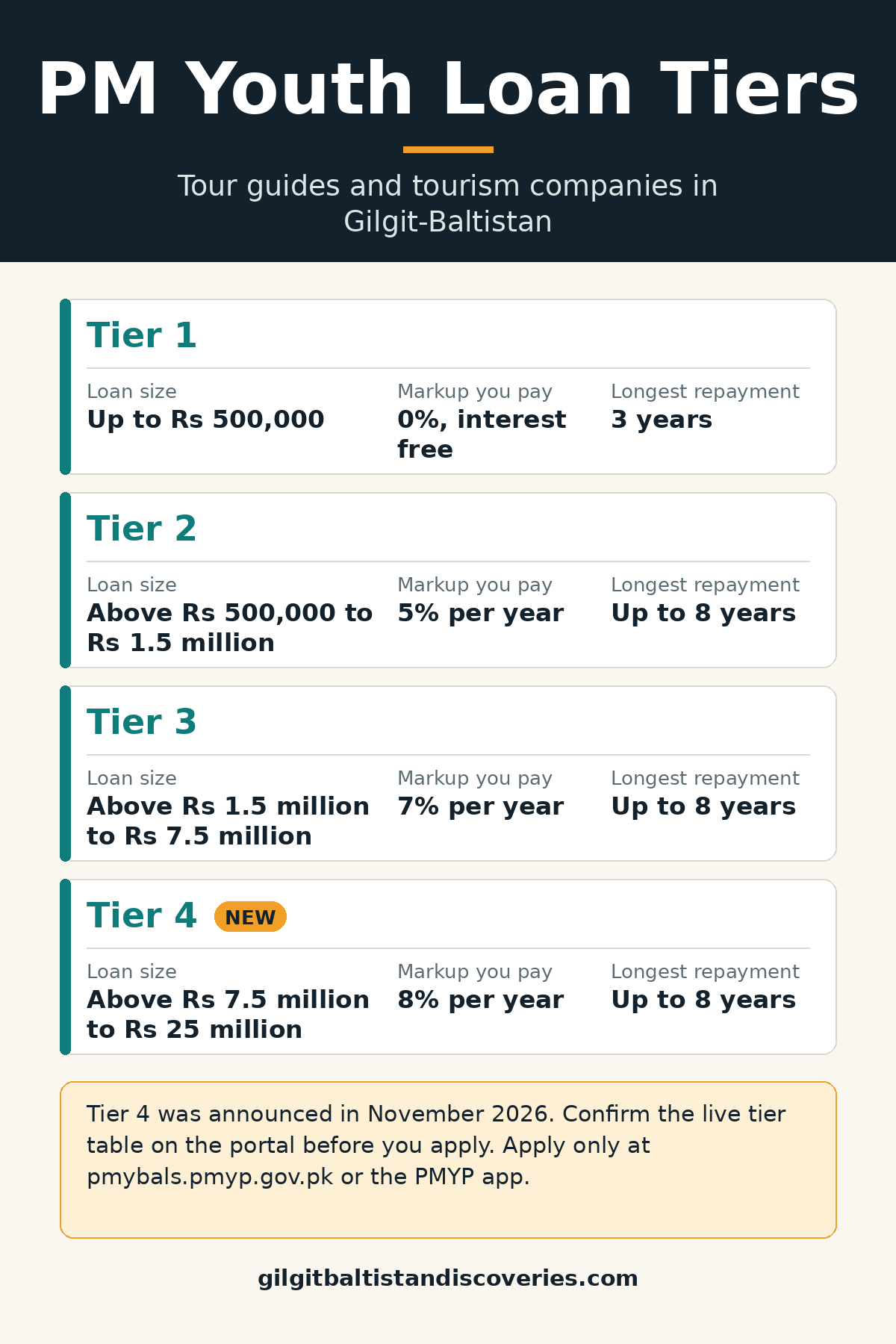
Tier 1 is the entry point. About three in four borrowers are expected to fall in Tier 1, and funds are split equally between agriculture and small business. Working capital and production loans under Tier 2 and Tier 3 run for up to 5 years, and banks may let you pay only the markup for the first 2 years and then principal plus markup over the next 3 years. Tier 2 and Tier 3 long term loans carry a grace period of up to one year inside the 8 year limit.
The new Tier 4 was announced in November 2026. The Economic Coordination Committee approved it on 4 November 2026, the federal cabinet ratified it, and the Prime Minister’s Youth Programme chairman announced it on 10 November 2026. It is meant for businesses ready to scale, and the sectors named are agro-processing, cold chains, mechanised farming, solar energy, manufacturing and exports. A large guesthouse or an established tour company growing into a bigger operation is the kind of business Tier 4 is aimed at, but the tourism sector was not named in the announcement, so a tourism business applying for Tier 4 should confirm its eligibility on the portal first.
One caution. The State Bank’s published scheme page, read on 25 November 2026, still shows the old structure of three business tiers plus a separate tier for laptops and overseas workers. The new business Tier 4 had not yet appeared on that page. Treat the new tier as announced, and confirm the live tier table on the portal before you apply.
Who can apply?
| Requirement | What it means |
|---|---|
| Citizenship | Pakistani citizen, holding a valid CNIC |
| Age | 21 to 45 years |
| IT and e-commerce | Lower age limit 18 years |
| Company or partnership | At least one owner, partner or director must be in the age bracket |
| Business type | New business or existing business, any sector including tourism and hospitality |
| Business size | Small and medium enterprises, startups and existing businesses owned by youth |
There is no education requirement for a general business loan. The matriculation requirement applies only to IT and e-commerce businesses. The scheme earmarks 25% of loans for women borrowers, which matters for women running guesthouses, cafes, craft shops or tour companies in Gilgit-Baltistan.
A tour guide applying as an individual qualifies if he or she is 21 to 45 with a valid CNIC. A registered tour company qualifies if at least one director or partner is in the age bracket, even if the other partners are older. An existing guesthouse that wants to add rooms qualifies as an existing business, and it does not need to put in its own equity, because the debt-equity rule is nil for existing businesses.
What can the money be used for?
The scheme finances long term loans and working capital, including murabaha and leasing. For a tourism business in Gilgit-Baltistan, that covers the real costs of starting or growing.
| Use | How it fits the scheme |
|---|---|
| Building and renovation | Up to 65% of the total financing can be used for civil works, so adding rooms, a dining hall or a washroom block to a guesthouse fits |
| Vehicles | Financing of locally manufactured vehicles for commercial use, one vehicle per borrower, so a jeep or van for tourist transport fits if it is locally manufactured |
| Equipment | Long term finance for generators, solar panels, kitchen equipment, furniture and trekking gear |
| Working capital | Fuel, staff wages, food supplies, marketing and booking costs through the season, up to 5 years |
Two limits to note. First, only locally manufactured vehicles are financed, so confirm with the bank before you plan around a specific imported jeep. Second, only one vehicle per borrower is allowed, except for food franchise and distribution businesses, which may get more than one.
Think in tiers. Tier 1, up to Rs 500,000 interest free, suits a guide buying gear, a small cafe adding seating, or a homestay furnishing two rooms. Tier 2, up to Rs 1.5 million at 5%, suits a guesthouse adding a floor or a tour company buying its first vehicle. Tier 3, up to Rs 7.5 million at 7%, suits a proper hotel extension or a fleet addition. Tier 4, up to Rs 25 million at 8%, suits an established operator building a new property or scaling up.
How much of your own money do you need?
For a new business, you must contribute part of the project cost yourself. For Tier 1 the debt-equity ratio is 90:10, so you put in 10% and the bank lends 90%. For Tier 2 and Tier 3 it is 80:20, so you put in 20%. Your contribution can be cash or immovable property, and it is required after the loan is approved, not before you apply.
For an existing business, the debt-equity ratio is nil for all tiers. That means an existing guesthouse or tour company does not need to put in its own money alongside the loan.
Security works the same way. Tier 1 and Tier 2 loans are clean, and only your personal guarantee is required. For Tier 3, security is decided under the executing bank’s own credit policy. Any vehicle financed under the scheme serves as collateral for the loan.
How do you apply?
Apply only through the official channels. The portal is pmybals.pmyp.gov.pk, reached through pmyp.gov.pk, and the PMYP mobile app is on Google Play and the Apple App Store. No agent, no fee and no sifarish is required. Anyone who asks you for money to get the loan approved is running a scam.
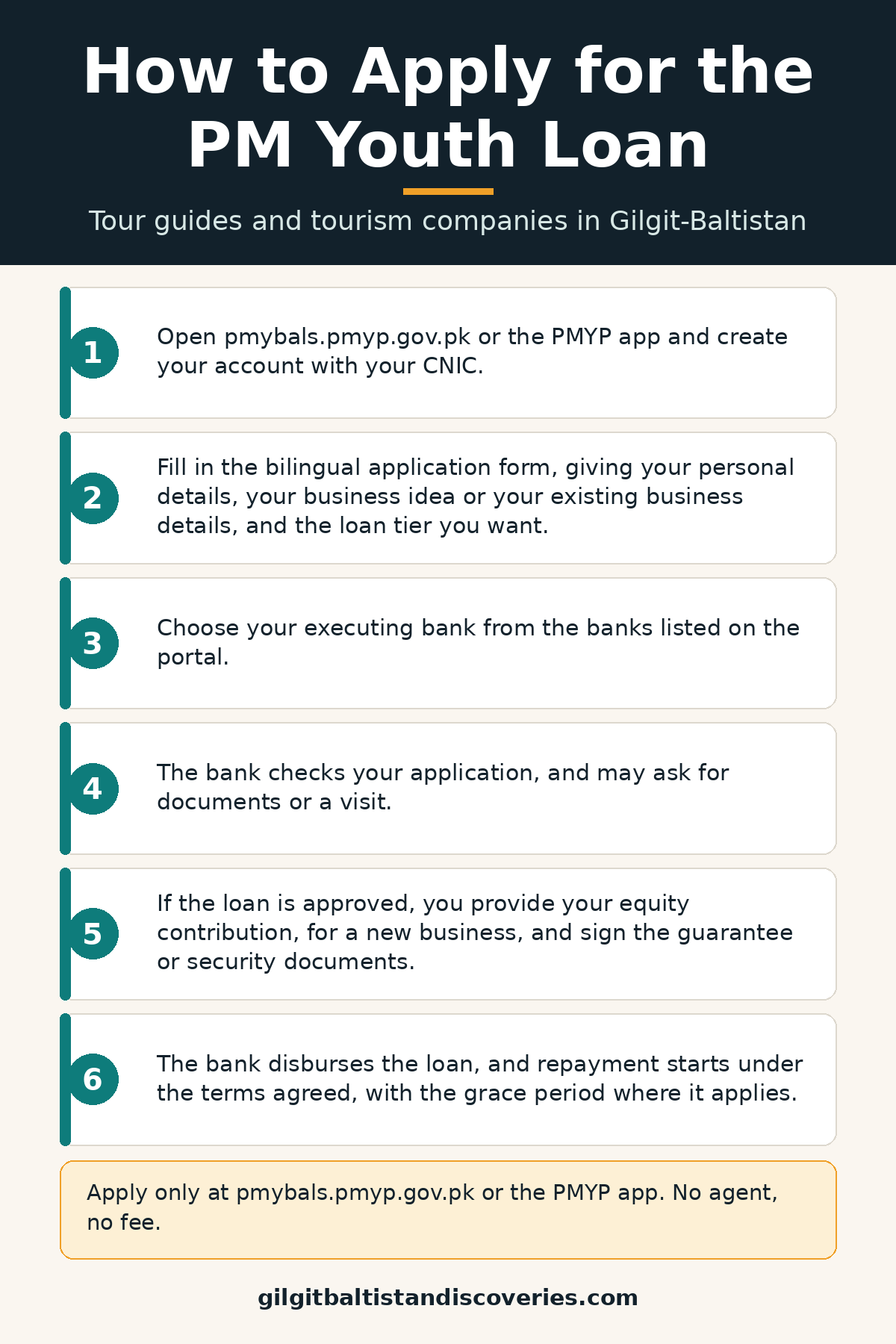
- Open pmybals.pmyp.gov.pk or the PMYP app and create your account with your CNIC.
- Fill in the bilingual application form, giving your personal details, your business idea or your existing business details, and the loan tier you want.
- Choose your executing bank from the banks listed on the portal.
- The bank checks your application, and may ask for documents or a visit.
- If the loan is approved, you provide your equity contribution, for a new business, and sign the guarantee or security documents.
- The bank disburses the loan, and repayment starts under the terms agreed, with the grace period where it applies.
Processing time is not fixed in the published scheme terms, so do not plan a season around a promised date. Apply well before the season you need the money for, and keep a copy of everything you submit.
What documents do you need?
The exact checklist varies by executing bank, so confirm it with the bank you choose. These are the items every applicant should have ready.
| Document | Notes |
|---|---|
| Valid CNIC | Verified by NADRA through the portal |
| Completed application form | Filled in on the portal, bilingual form |
| Business plan or feasibility | What the business is, what the money buys, and how it will repay |
| Proof of existing business | Registration, NTN, bank statements or booking records, for an existing business |
| Proof of equity | Cash or immovable property, required after approval for a new business |
| Personal guarantee | Required for Tier 1 and Tier 2; a family member guarantee is used for laptop and overseas worker loans |
| Security documents | For Tier 3, as the executing bank’s credit policy requires |
If you run a guesthouse, keep your booking records and any registration papers in one file before you apply. If you are a guide, keep a simple record of your trips, your clients and your income. A bank trusts a paper trail more than a promise.
What does this mean for a tourism business in Gilgit-Baltistan?
Tourism in Gilgit-Baltistan is seasonal, and a loan does not change that. The season runs roughly from spring to autumn, and winter income is thin. That makes the repayment plan the most important part of the application.
Borrow for things that earn in the season and last beyond it. Rooms, a reliable vehicle, solar power and a proper kitchen earn every season for years. Borrowing for a single season of running costs is riskier, because the money is gone when the season ends and the instalments keep coming.
Use the grace period. Tier 2 and Tier 3 long term loans allow a grace period of up to one year inside the 8 year limit, and working capital loans may let you pay only markup for the first 2 years. That helps if you borrow in winter and earn from spring, but interest still accrues, so borrow only what the business can repay.
The winter problem is real. Hotels and guesthouses in Gilgit-Baltistan face power cuts and closed roads in winter, and many close or run at low occupancy. If your business earns mainly from May to October, show the bank a repayment plan that fits that shape, and keep a cash buffer for the winter months.
A separate interest-free microfinance option exists in Gilgit-Baltistan through Akhuwat’s Chief Minister’s Self-Employment Scheme, which has run in the region since 2013. It suits very small loans. Ask at an Akhuwat branch for current terms, because they change and this guide does not track them.
The Gilgit-Baltistan Chief Minister has also asked the State Bank for a special financial package for the region, including concessional financing for young entrepreneurs, women, farmers, startups and small businesses. That is a request, not a scheme, and no such package exists yet. Until it does, PMYBALS is the route.
What to watch out for
Never pay anyone to get a loan approved. The scheme has no agent and no fee, and applications go only through the portal or the app.
Never borrow more than the business can repay in a bad season. A landslide, a road closure or a cancelled flight can cut a month of income in Gilgit-Baltistan, and the bank will still expect its instalment.
Check the new Tier 4 on the portal before you rely on it. It was announced in November 2026, but the State Bank’s published scheme page had not yet been updated when this guide was written. Confirm the live tier table, the rate and the eligibility before you apply for a loan above Rs 7.5 million.
Confirm vehicle rules before you choose a jeep. Only locally manufactured vehicles for commercial use are financed, and only one per borrower. An imported vehicle may not qualify.
Keep your business records clean. Banks in Gilgit-Baltistan are cautious about lending in the region, and the Chief Minister has had to ask the State Bank to speed up processing and simplify documentation. A clear application with real records moves faster than a thin one.
Last updated: 25 November 2026
Yes. A tour guide aged 21 to 45 with a valid CNIC can apply as an individual for a new business loan. Tier 1 offers up to Rs 500,000 interest free, which suits gear, training and a small setup. No education certificate is needed for a general business loan.
Both can apply. Individuals, sole proprietorships, partnership firms and limited companies are all accepted. For a partnership or company, at least one owner, partner or director must be aged 21 to 45, even if the others are older. A guide working alone applies as an individual.
No. There is no tourism-only PM loan and no Gilgit-Baltistan-only PM loan. Tourism and hospitality businesses use the same Prime Minister’s Youth Business and Agriculture Loan Scheme as every other business, and all sectors are eligible under it. That is the route this guide covers.
A guesthouse can borrow up to Rs 7.5 million under Tier 3 at 7% markup, or up to Rs 25 million under the new Tier 4 at 8% markup, once that tier is live on the portal. Up to 65% of the financing can go to civil works such as rooms and washrooms.
For a new business, yes. You contribute 10% under Tier 1 and 20% under Tier 2 and Tier 3, in cash or immovable property, after the loan is approved. For an existing business, no own contribution is needed, because the debt-equity ratio is nil.
Apply online only at pmybals.pmyp.gov.pk or through the PMYP mobile app. Fill in the form, choose your bank, and wait for the bank’s decision. There is no fee and no agent is needed, and anyone asking for money to approve your loan is running a scam.