Last updated: 1 November 2026
Short Answer
For the K2 base camp trek, buy a sleeping bag by its comfort rating — not its headline temperature — and choose one with a comfort rating of −10°C or lower. Nights at Concordia (about 4,600 m) can drop to −10°C at any time of the trekking season, even in July and August, and higher camps are colder still. That single fact decides the purchase: a bag whose comfort rating is 0°C will leave you cold at Concordia, however good its marketing sounds. Down gives the best warmth for weight on a long glacier trek where porters carry loads and every gram counts; synthetic is the safer choice if your bag is likely to get wet. And budget for the pad as well as the bag: the insulation squashed flat beneath you stops insulating, so your sleeping pad — not your bag — keeps the cold ground from stealing your warmth all night.
What do comfort, limit and extreme ratings actually mean?
Most reputable sleeping bags are tested to the ISO 23537 standard (which replaced the European EN 13537 standard in 2016). The test uses a heated manikin in a climate chamber and produces three numbers. Only one of them is a buying guide.
| Rating | What it means | Use it to buy? |
|---|---|---|
| Comfort | The lowest temperature at which a standard cold sleeper can sleep relaxed, on their back, without feeling cold | Yes — shop by this number |
| Limit (lower limit) | The lowest temperature at which a standard warm sleeper can sleep curled up for 8 hours without waking from cold — coping, not comfortable | Only if you know you sleep warm |
| Extreme | A survival figure: the temperature at which a standard sleeper avoids life-threatening hypothermia for 6 hours, cold and uncomfortable throughout | Never — it is not a sleeping temperature |
The gap between comfort and limit on the same bag is typically around 5–8°C, and extreme sits far below both. So a bag advertised as “−20°C” on its extreme rating may only be comfortable at around 0°C. If a product page quotes a single temperature with no mention of comfort, limit or extreme, treat it as unverified marketing and ask the manufacturer which rating it is — or choose a bag that states all three.
How cold is it at night on the K2 trek?
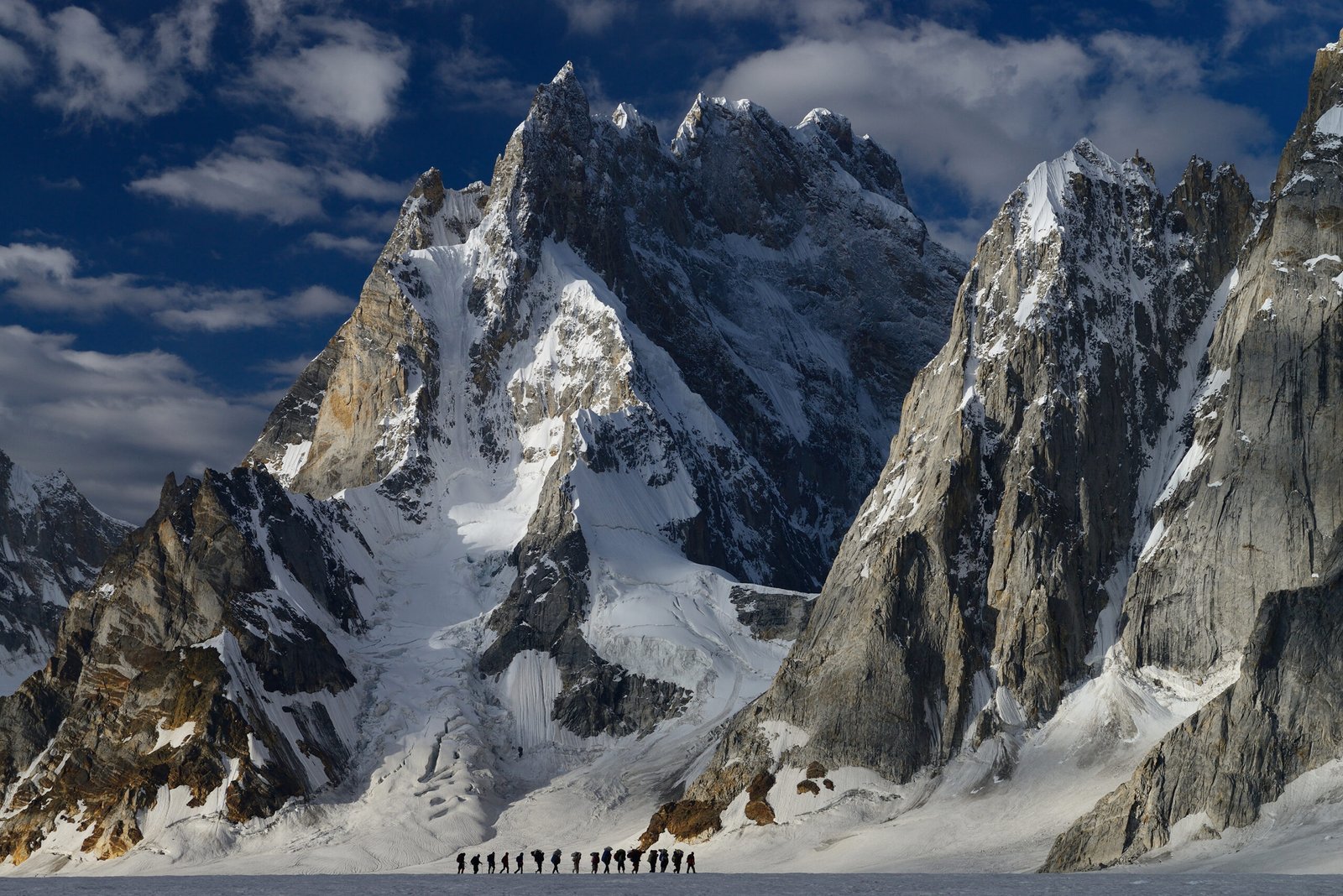
The K2 base camp trek runs in summer, roughly June to September, but “summer” at 4,600 m is not summer as most travellers know it. Operator trip notes for the Baltoro route report that night-time temperatures at Concordia can drop to as low as −10°C at any time of the season, with snow possible at Concordia even in August, and that nights above Paiju generally fall to freezing levels. Published monthly tables for the higher camps put July nights around −3°C and September nights around −10°C — and those are averages, not worst cases.
| Camp | Altitude | What to expect at night in season |
|---|---|---|
| Askole (trailhead) | About 3,000 m | Cool nights, well above freezing |
| Paiju | About 3,420 m | Nights around freezing once above this point |
| Urdukas / Goro II | About 3,900–4,250 m | Regularly below freezing |
| Concordia | About 4,600 m | Can drop to −10°C at any time of season |
| K2 base camp | About 5,150 m | Colder than Concordia; plan for −10°C or below |
That is why the recommendation is a comfort rating of −10°C or lower for the full trek: it covers a bad night at Concordia rather than just an average one. If you sleep cold, go colder still or add a sleeping-bag liner, which typically adds a few degrees of warmth and keeps the bag cleaner over a 2–3 week trek.
Should I buy down or synthetic?
| Factor | Down | Synthetic |
|---|---|---|
| Warmth for weight | Best — the lightest way to carry −10°C comfort over a 2–3 week trek | Heavier and bulkier for the same warmth |
| When wet | Loses loft and warmth, dries slowly | Keeps much of its warmth, dries faster |
| Pack size | Compresses smallest — matters when porters carry loads on the Baltoro | Bulkier in the duffel |
| Durability | Long-lived if kept dry and stored uncompressed | Loses loft faster over years of compression |
| Cost | Higher for high fill power | Usually cheaper |
For the classic dry-summer Baltoro trek, down wins on weight and pack size. For a shoulder-season trek, a wet-weather itinerary or a trekker who knows their kit gets damp, synthetic is the safer choice. Whichever you choose, keep the bag in a waterproof dry bag inside your duffel: river crossings and glacier rain soak duffels from the outside, and a wet sleeping bag at Concordia is a serious problem, not an inconvenience.
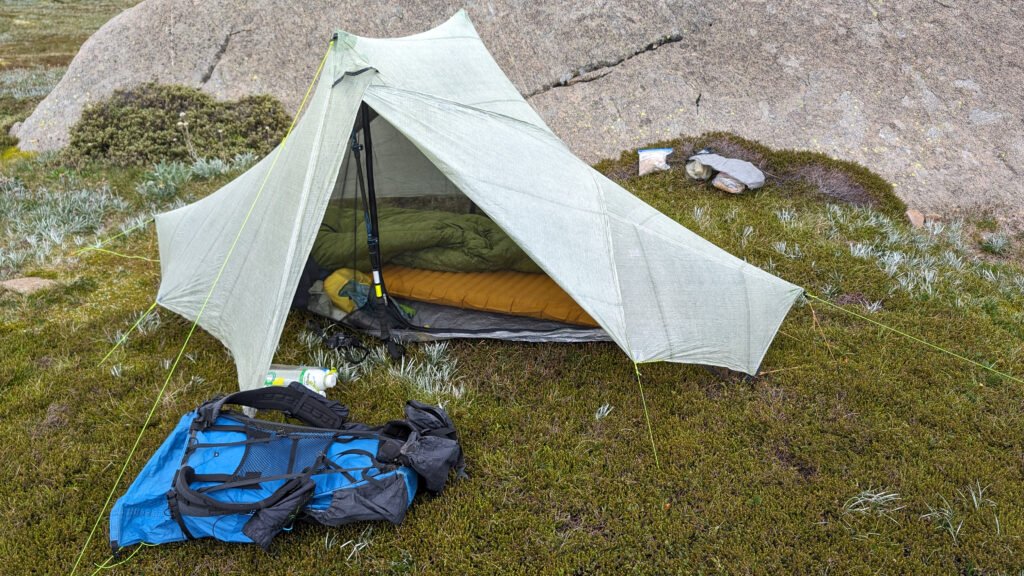
Why does the sleeping pad matter as much as the bag?
Because the down or synthetic fill underneath you is compressed flat by your body weight, and compressed insulation traps almost no warm air. Your bag insulates you from above and from the sides; your pad insulates you from the ground. A −10°C comfort bag on a thin summer pad will still leave you cold from below.
Pad warmth is measured by R-value — thermal resistance, tested to the ASTM F3340 standard so that figures from reputable brands are comparable. Higher is warmer, and R-values add when pads are stacked.
| Conditions | Pad R-value to look for |
|---|---|
| Warm summer nights above 15°C | 1–2 |
| Typical 3-season camping | 3–4 |
| Frost and snow, including Concordia nights | 5.5 or more |
| Stacked option: foam pad (about R-2) under an insulated air pad (R-3 to 4) | About R-5 to 6 combined |
For the K2 trek, aim for R-5 or above, either as one insulated winter pad or as a foam pad stacked under an insulated air pad — the foam layer also protects the air pad from punctures on rocky glacier camps. If you sleep cold, add a point to whatever the table says: an over-warm pad costs a few grams, an under-warm one costs the whole night.
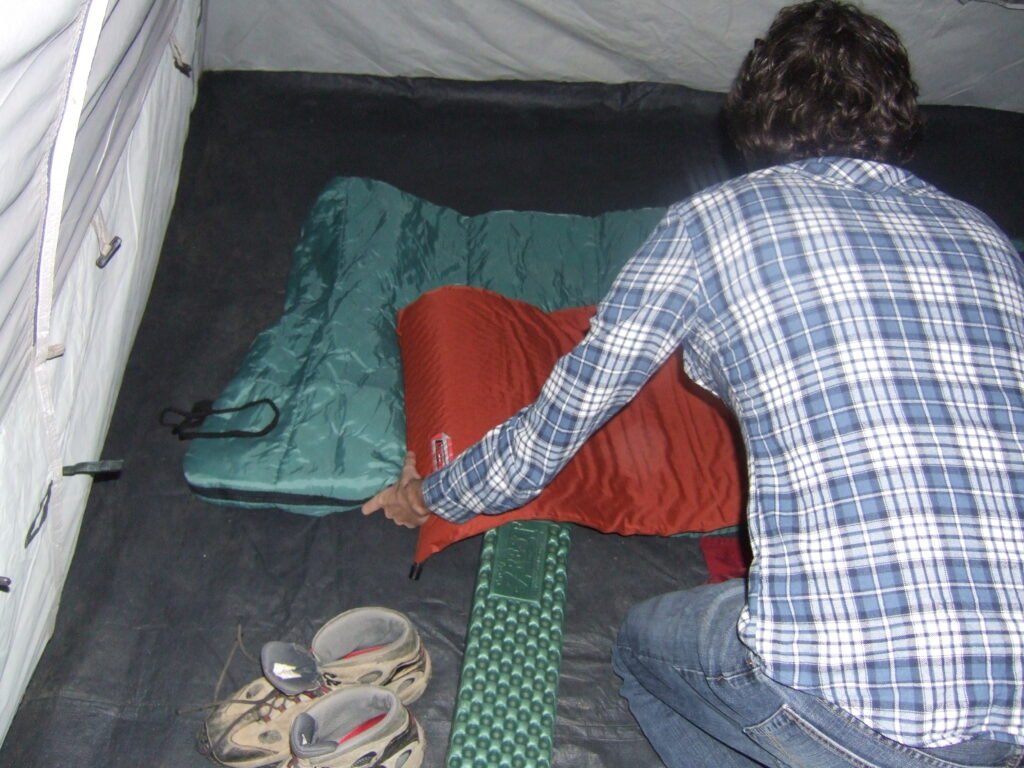
What should I actually buy? A decision checklist
Use this checklist in order, on the product page or in the shop:
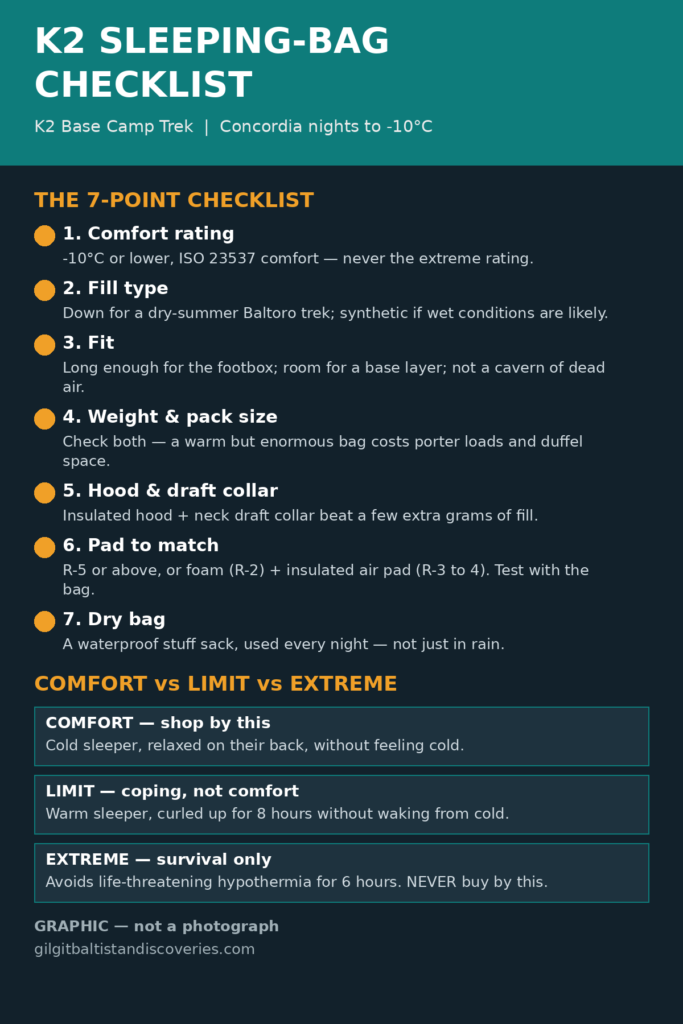
- Comfort rating: −10°C or lower, stated as an ISO 23537 / EN comfort rating — not an extreme rating, not an unlabelled headline number.
- Fill type: down for a dry-summer Baltoro trek (best warmth for weight); synthetic if wet conditions are likely.
- Fit: long enough that your feet do not compress the footbox, roomy enough to wear a base layer inside, but not so roomy that you heat a cavern of dead air.
- Weight and pack size: check both — on a 2–3 week trek, a bag that is warm but enormous costs porter loads and duffel space.
- Hood and draft collar: a well-fitting insulated hood and a draft collar around the neck are worth more than a few extra grams of fill, because most heat escapes from the head and neck opening.
- Pad to match: R-5 or above, or a stacked foam-plus-air combination — bought and tested with the bag, not as an afterthought.
- Dry bag: a waterproof stuff sack for the bag, used every night on the trek, not just in rain.
No specific product or price is claimed in this guide: prices change, and a stale price misleads more than no price. Use a tagged search to compare current options — sleeping bags for −10°C on Amazon — and judge every option against the checklist above. Keep your phone and batteries warm inside the bag overnight: cold drains batteries fast, and a power bank such as the Anker PowerCore on Amazon charges them again in the morning.
Frequently Asked Questions
What temperature rating do I need for K2 base camp?
A comfort rating of −10°C or lower, stated under ISO 23537. Nights at Concordia (about 4,600 m) can drop to −10°C at any time of the trekking season, and K2 base camp at about 5,150 m is colder still. Shop by the comfort rating, never by the extreme rating, which is a survival figure rather than a sleeping temperature.
Should I buy a down or synthetic sleeping bag for the Baltoro?
Down for a dry-summer Baltoro trek, because it gives the best warmth for the least weight and pack size over a 2–3 week trek. Choose synthetic instead if wet conditions are likely, since synthetic insulation keeps much of its warmth when damp while down loses loft. Either way, carry the bag in a waterproof dry bag inside your duffel.
What is the difference between comfort, limit and extreme ratings?
Comfort is the lowest temperature at which a standard cold sleeper sleeps relaxed without feeling cold, and it is the number to shop by. Limit is the lowest temperature at which a standard warm sleeper can sleep curled up for 8 hours while coping, not comfortable. Extreme is a survival figure, never a buying guide.
Do I really need a winter sleeping pad for a summer trek?
Yes, at Concordia altitudes. The fill beneath you compresses flat and stops insulating, so your pad does the work of keeping ground cold out. Aim for an R-value of 5 or above — one insulated winter pad, or a foam pad of about R-2 stacked under an insulated air pad of R-3 to 4, which also protects against punctures on rocky camps.
How much does a K2 base-camp sleeping bag weigh?
It varies too widely by fill type and rating for a single figure to be honest. As a rule, a down bag rated to −10°C comfort packs far smaller and lighter than a synthetic bag of the same warmth, which is why down dominates on long porter-supported treks. Compare packed size and weight against your duffel allowance.
Related guides: K2 Base Camp Trek Packing List, Best Down Jacket for High-Altitude Trekking in Pakistan, What to Pack for Northern Pakistan, and Altitude Sickness in Gilgit-Baltistan.