Last updated: 1 November 2026
Short Answer
For high-altitude trekking in Pakistan, buy a policy that names trekking at your trek’s maximum altitude — in writing, in the policy wording, not in a marketing headline. The K2 base camp trek reaches about 5,150 m and the Gondogoro La crossing reaches 5,585 m, yet most standard travel policies stop covering trekking at 2,500 to 3,000 m. That gap is the whole story: a standard policy can be completely void on the upper Baltoro Glacier even though it covers you perfectly well in Skardu town. Before you buy, confirm four things in the actual wording: the altitude limit, helicopter evacuation for a medical emergency, cover for altitude sickness as an illness (not an exclusion), and whether ropes, crampons or fixed ropes push you from “trekking” into “mountaineering” — a category many standard policies exclude outright. No specific insurer is recommended in this guide, because policy terms change and vary by your country of residence; the checklist below is what to verify, whoever you buy from.
Why does standard travel insurance fail at altitude?
Standard travel policies are written for holidays, not expeditions. Their activity lists commonly cover “hiking” or “trekking” only up to a set altitude — commonly around 3,000 m — and exclude anything above it. Some also exclude “hazardous activities” or “adventure sports” entirely unless you buy an add-on. The result is a policy that looks comprehensive in Islamabad and stops working exactly where you need it most: on a glacier, days from a road, at 4,600 m.
| What the policy says | What it means on a Pakistan trek |
|---|---|
| Trekking covered up to 3,000 m | Void at Paiju (about 3,420 m) and everywhere above it on the Baltoro |
| “Hazardous activities” excluded | May exclude the Gondogoro La crossing, which uses fixed ropes and crampons on slopes up to 50 degrees |
| Altitude sickness excluded | A claim for evacuation after severe altitude sickness could be refused even below the altitude limit |
| Search and rescue not included | A policy may pay for a helicopter once you are found, but not for the search that finds you |
Read the policy wording — the full document, not the summary page — and search it for the words “altitude”, “trekking”, “mountaineering”, “evacuation” and “search and rescue” before you pay.
What altitude limit do I actually need for Pakistan’s treks?
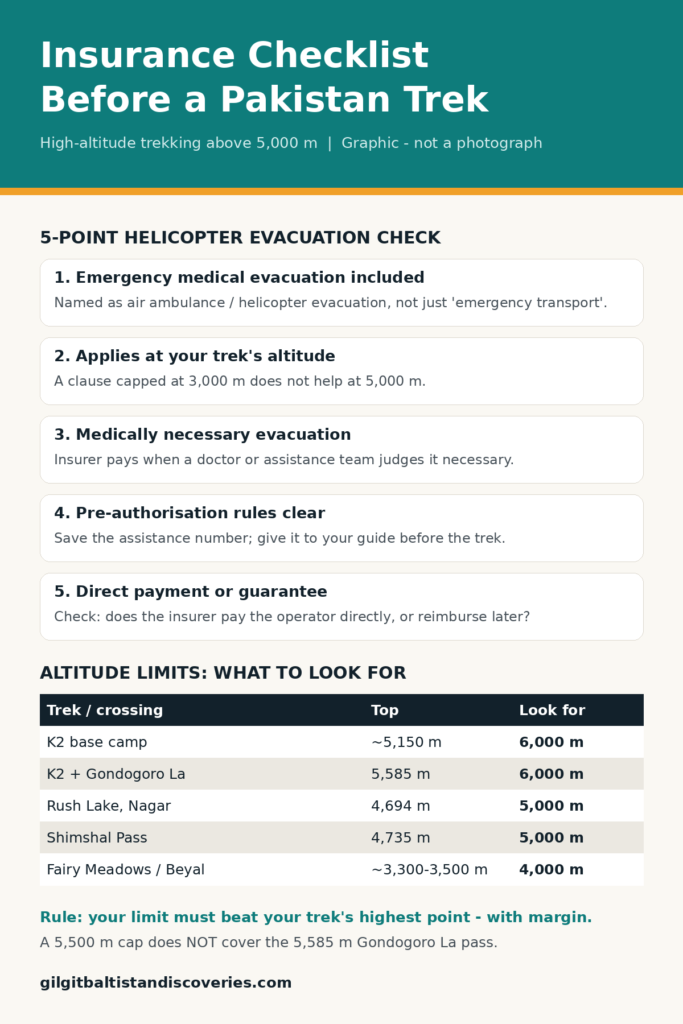
Your policy’s altitude limit must be higher than the highest point you will sleep at or cross — not just the average altitude of the trek. Add a margin: if your trek tops out at 5,585 m, a policy capped at 5,500 m does not cover the pass.
| Trek or crossing | Maximum altitude | Minimum policy limit to look for |
|---|---|---|
| K2 base camp trek (Concordia and base camp) | About 5,150 m | 6,000 m |
| K2 base camp trek with Gondogoro La | 5,585 m | 6,000 m |
| Rush Lake trek, Nagar District | 4,694 m | 5,000 m |
| Shimshal Pass | 4,735 m | 5,000 m |
| Fairy Meadows and Beyal Camp | About 3,300–3,500 m | 4,000 m |
K2 base camp is commonly listed at about 5,150 m and Concordia at about 4,600 m, though sources vary by tens of metres depending on the exact camp location; the 6,000 m recommendation above gives a margin over every published figure. Rush Lake sits at 4,694 m and Shimshal Pass at 4,735 m. Note that some comparison sites list specialist policies covering trekking to 6,000 m or higher — treat those figures as a starting point for your own check, not as confirmed terms, because an insurer’s wording for your country of residence is the only version that binds.
What must helicopter evacuation cover actually say?
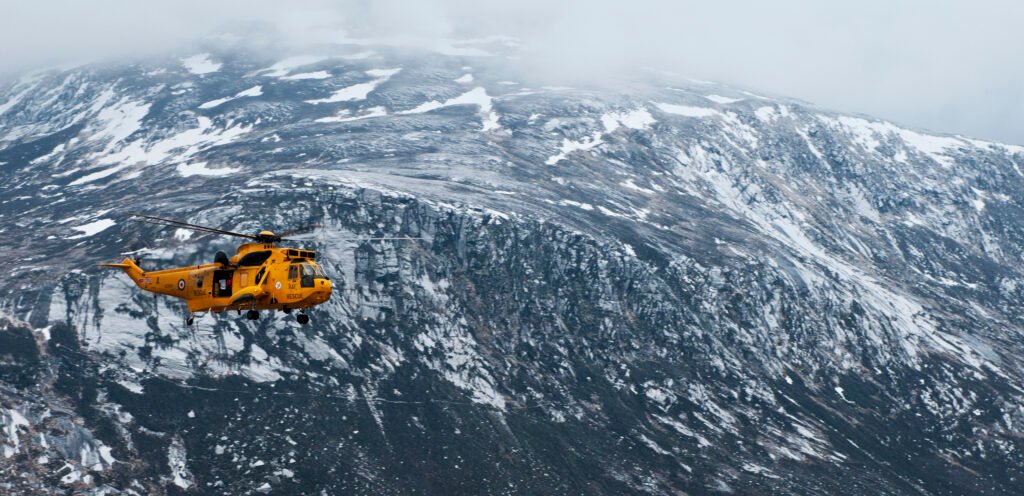
From a glacier camp on the upper Baltoro, evacuation in a genuine emergency is by helicopter or on foot over several days — there is no road and no ambulance. So the evacuation clause is the most valuable part of the policy, and the easiest to get wrong. Confirm each of these:
- “Emergency medical evacuation” is included — ideally described as air ambulance or helicopter evacuation, not just “emergency transport”.
- It applies at your trek’s altitude — an evacuation clause inside a policy capped at 3,000 m does not help at 5,000 m.
- It covers medically necessary evacuation — insurers pay when a doctor or their assistance team judges the evacuation medically necessary. A helicopter because you are tired, behind schedule or want to skip a hard day is not covered, and you would pay the full cost yourself.
- Pre-authorisation rules are clear — many policies require you (or your guide) to contact the insurer’s assistance line before the helicopter flies, except where that is impossible. Save that number in your phone and give it to your guide before the trek starts.
- Direct payment or a guarantee of payment — check whether the insurer pays the operator directly or reimburses you afterwards. In remote Pakistan, paying a large rescue bill upfront and claiming later is a very different proposition from direct settlement.
Not verified for Pakistan: the cost of a helicopter rescue in Gilgit-Baltistan. Published rescue-cost figures of several thousand US dollars relate to Nepal, not Pakistan, and are not quoted here as Pakistan prices. Do not rely on any figure you cannot confirm with your operator or insurer; instead, make sure your evacuation limit is high enough that the exact bill does not become your problem.
What exclusions should I check before buying?
| Exclusion to check | Why it matters in Pakistan |
|---|---|
| Altitude cap (commonly 2,500–3,000 m standard) | The single most common reason a trekking claim fails |
| Mountaineering vs trekking | Fixed ropes and crampons on Gondogoro La may reclassify your trek as mountaineering |
| Altitude sickness as an excluded illness | Some policies exclude altitude-related illness specifically |
| Pre-existing medical conditions | Declare them; an undeclared condition can void a claim even if it seems unrelated |
| Solo trekking or unguided travel | Some policies require a licensed guide; check before trekking independently |
| Search and rescue | Distinct from evacuation — check whether searching for you is covered at all |
| Trip bought after departure | Most high-altitude policies must be bought before you leave your home country |
Two more practical points. First, buy the policy before you leave home: most specialist high-altitude cover cannot be bought once you are already travelling. Second, carry proof: a printed copy of the policy certificate plus the assistance number, and a copy on your phone — cold kills phone batteries, so keep the phone warm inside your jacket and carry a power bank such as the Anker PowerCore on Amazon.
What should I do if something goes wrong on the trail?
- Stop ascending. If altitude sickness is suspected, do not climb higher to “push through” — rest at the same altitude or descend.
- Tell your guide immediately. Your guide knows the evacuation options from that camp and will contact the insurer’s assistance line.
- Get the evacuation authorised where the policy requires it, and keep every receipt, medical report and record of who authorised what.
- Keep the insurer informed from the first hospital or clinic, not days later — late notification is a common reason claims are reduced or refused.
- Do not promise payment to an operator on the insurer’s behalf unless the assistance team has confirmed cover; get names, times and reference numbers for every call.
Frequently Asked Questions
Does standard travel insurance cover trekking to K2 base camp?
Usually not. Most standard policies cap trekking cover at around 2,500 to 3,000 m, while K2 base camp sits at about 5,150 m and Concordia at about 4,600 m. You need a specialist or adventure add-on policy whose wording explicitly covers trekking to at least 6,000 m, confirmed in the full policy document before you travel.
What altitude limit do I need for the Gondogoro La crossing?
At least 6,000 m. The pass itself is 5,585 m, so a policy capped at 5,500 m would not cover the highest point of the trek. Choose a limit with a margin above your trek’s maximum altitude, and check that the limit applies to both trekking and helicopter evacuation, not just to one of them.
Does travel insurance cover helicopter rescue in Pakistan?
Only if your policy explicitly includes emergency medical evacuation at your trek’s altitude and the evacuation is medically necessary. Check whether pre-authorisation is required, whether the insurer pays the operator directly, and whether search and rescue is included separately. Pakistan-specific rescue costs could not be verified for this guide, so do not rely on any quoted price.
Is altitude sickness covered by trekking insurance?
Not automatically. Some policies exclude altitude-related illness specifically, even when they cover trekking to the altitude where it struck. Check the policy wording for altitude sickness as a named condition, and declare any pre-existing medical conditions when you buy — an undeclared condition can void a claim even if it seems unrelated to altitude.
Can I buy high-altitude trekking insurance after I arrive in Pakistan?
In most cases, no. Specialist high-altitude policies generally must be purchased before you leave your home country, and many cannot be bought once you are already travelling. Buy before departure, carry a printed certificate plus the insurer’s assistance number, and give that number to your guide before the trek starts.
Related guides: K2 Base Camp Trek Packing List, Altitude Sickness in Gilgit-Baltistan, Best Down Jacket for High-Altitude Trekking in Pakistan, Gondogoro La Trek Guide: K2 Base Camp to Hushe.