Last updated: 1 November 2026
Short Answer
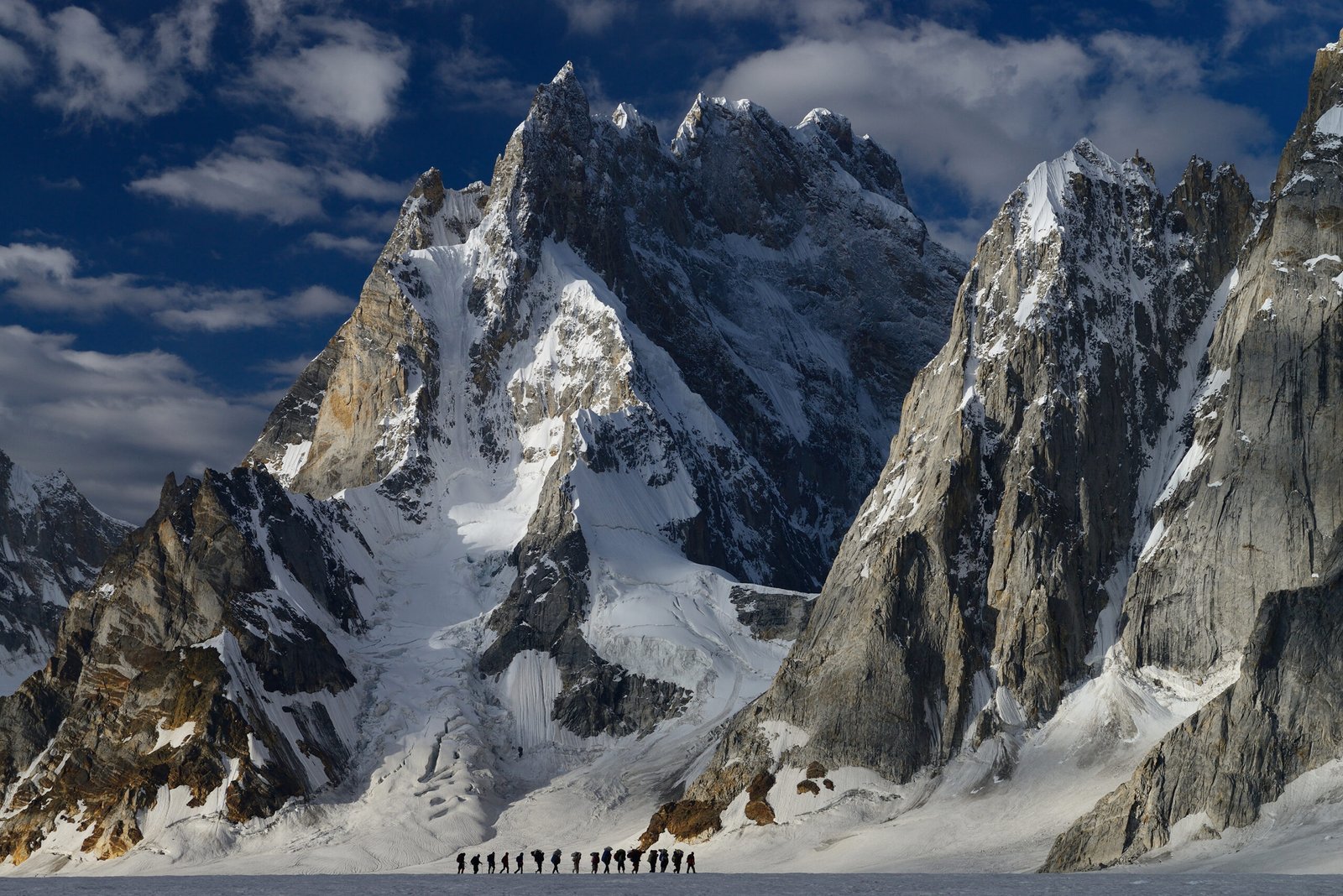
For glacier travel and high mountaineering in the Karakoram, buy Category 4 glacier glasses with side shields — not ordinary sunglasses, however dark they look. Category 4 lenses transmit only 3–8% of visible light, which is what long days on snow and ice at 4,000 m and above demand: ultraviolet intensity rises roughly 10–12% with every 1,000 m of altitude, and fresh snow reflects about 80% of UV radiation back up into your eyes, so on a glacier you are hit from above and below at once. The frame matters as much as the lens: without side shields or a wraparound fit, reflected light leaks in around the edges and the darkest lens in the world still leaves you exposed. Category 4 lenses are too dark for driving and carry a crossed-out car symbol for exactly that reason — keep a lighter Category 3 pair for the road journey and the valley, and save the glacier glasses for the ice.
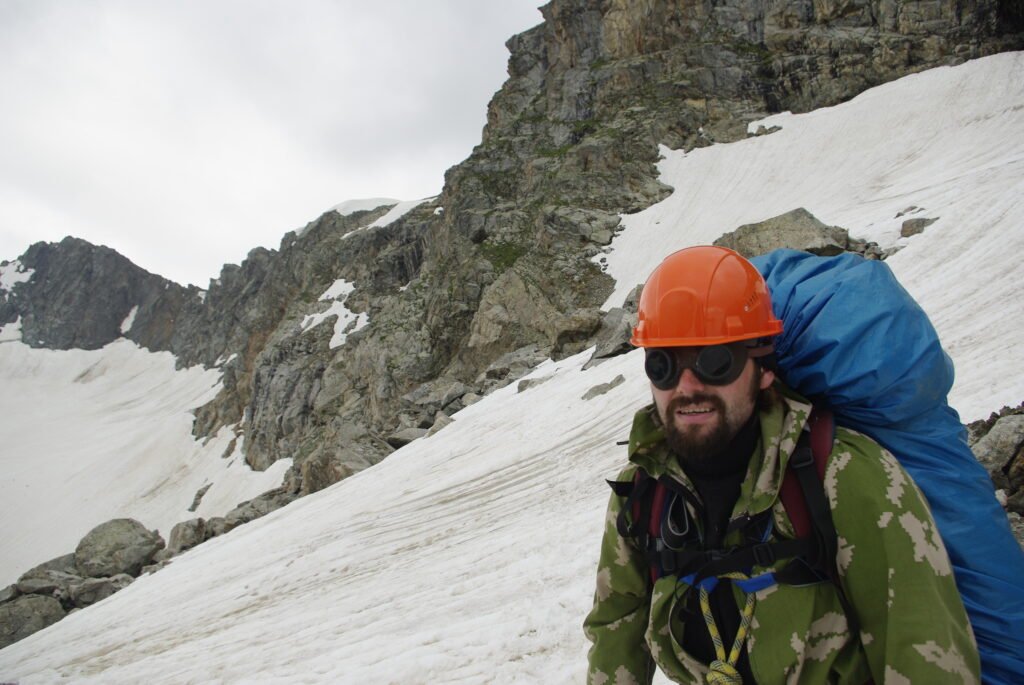
Why is glacier light different from ordinary bright light?
Three factors combine on a glacier, and no one of them applies to a normal sunny day at sea level:
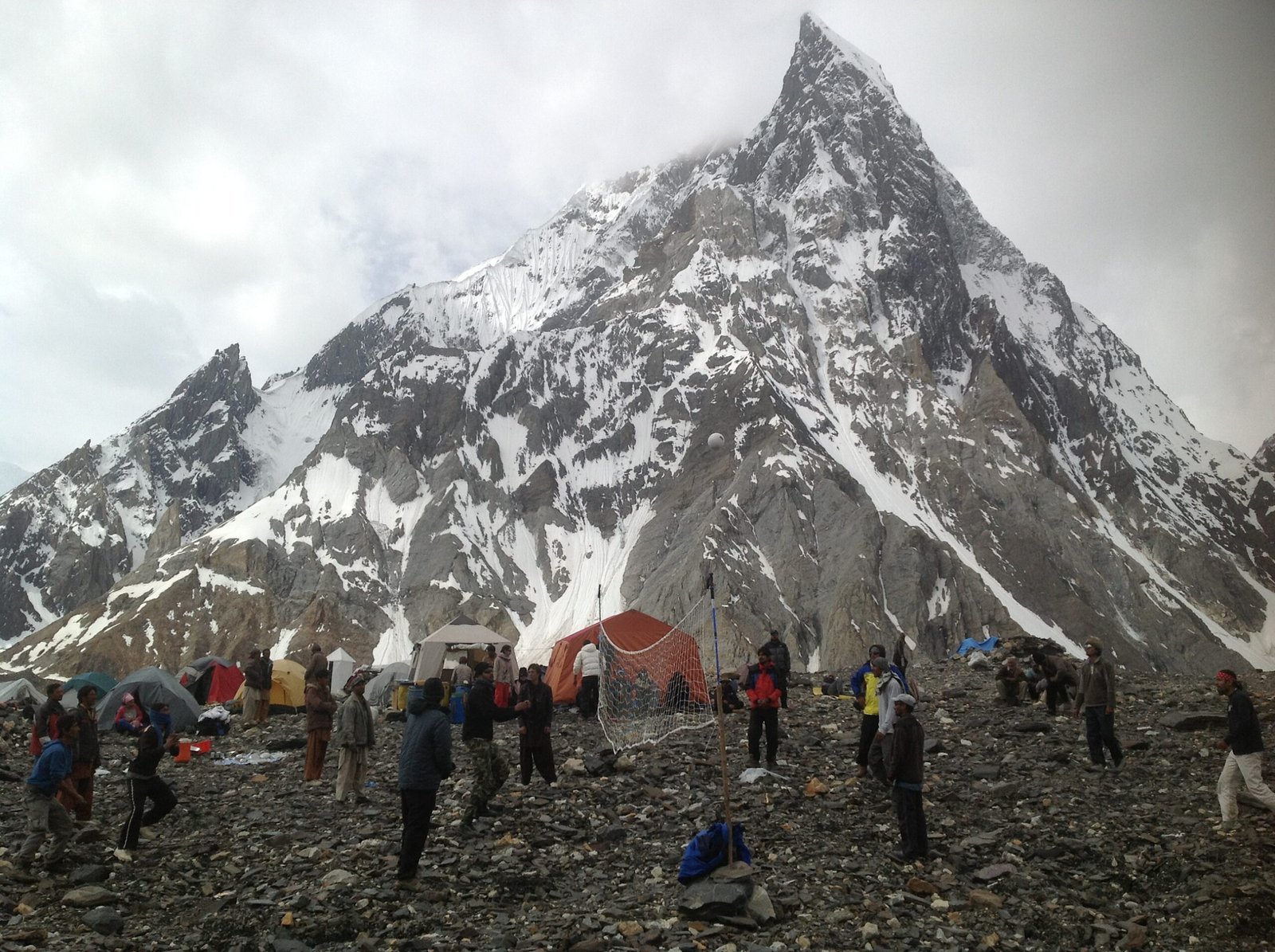
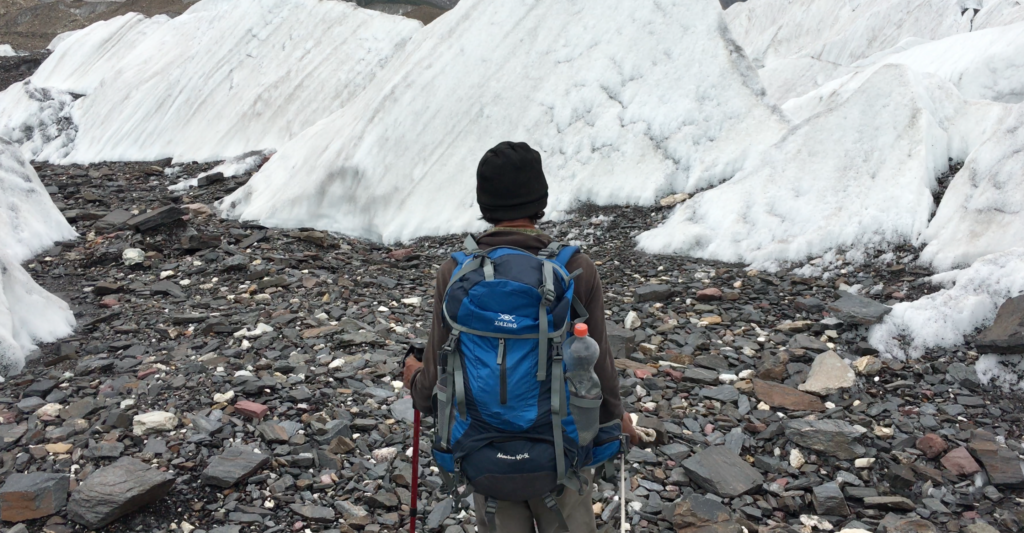
- Thinner air filters less UV. Ultraviolet intensity increases by roughly 10–12% for every 1,000 m of altitude gained. At Concordia (about 4,600 m), UV is roughly 50% stronger than at sea level before reflection is even counted.
- Snow and ice reflect it back. Fresh snow reflects about 80% of UV radiation. Your eyes receive direct sunlight from above plus reflected UV from below and from every surrounding slope — a double exposure that ordinary sunglasses were never designed for.
- Exposure lasts all day. A glacier crossing is 6–10 hours of unbroken bright snow, not a short walk to lunch. Snow blindness (photokeratitis — sunburn of the cornea) typically appears 6–12 hours after exposure, which means a morning without proper glasses can end with painful, gritty, light-sensitive eyes in camp that night, with symptoms usually resolving within 24–72 hours if further exposure is avoided.
Cloud does not save you: UV passes through cloud, and glare off snow remains dangerous on overcast days. Wear the glasses whenever you are on snow or ice, not just when the sun feels strong.
What do lens categories actually mean?
Sunglass lenses are graded Category 0 to 4 under the ISO 12312-1 standard, by how much visible light they transmit. Category 4 is the darkest grade made, and it is the grade built for glaciers.
| Category | Visible light transmitted | Suitable for |
|---|---|---|
| Category 0–1 | Most light (very light tints) | Overcast days, indoor use — not glacier use |
| Category 2 | Moderate tint | Ordinary bright days at low altitude |
| Category 3 | About 8–18% transmitted (blocks 82–92%) | Bright sun, driving, valley trekking — not enough alone on glaciers |
| Category 4 | Only 3–8% transmitted (blocks 92–97%) | Glaciers, snowfields, high altitude — the mountaineering grade |
Check the marking on the inside of the temple arm: it should read Cat. 4 (or Category 4) alongside the CE mark and ISO 12312-1, and Category 4 lenses carry a crossed-out car symbol because they are not suitable for driving. A lens that is merely “dark” or “UV400” without a category marking has not been verified to this standard — darkness alone is not protection, and a dark lens without full UV filtering is worse than a lighter one, because it opens your pupils while letting UV through.
What makes a glacier frame, not just a glacier lens?
| Feature | Why it matters on a glacier |
|---|---|
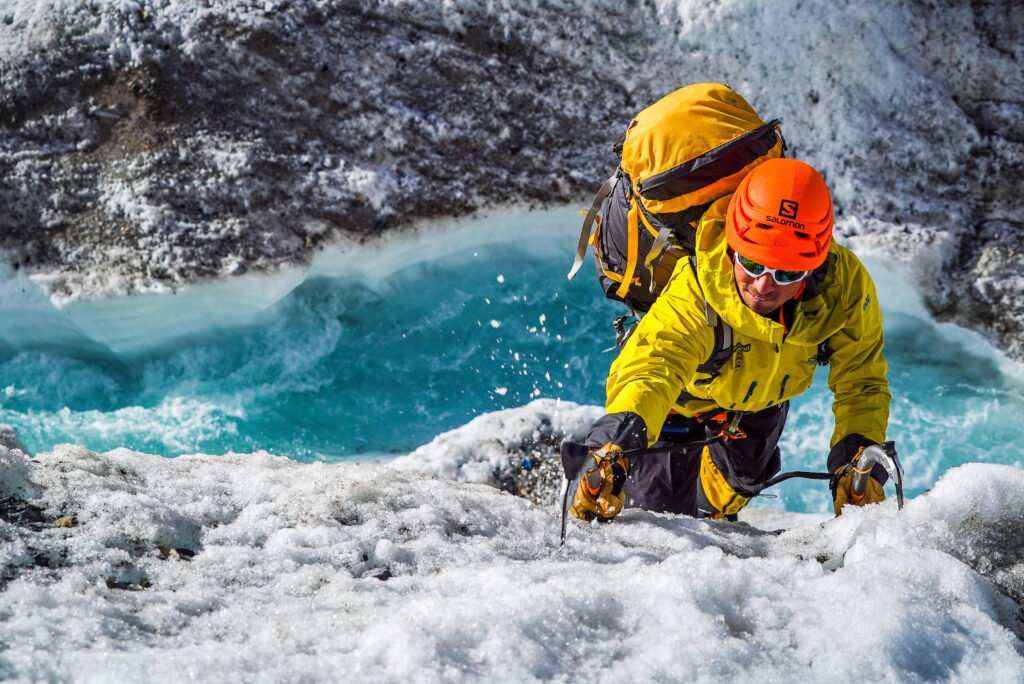
| Side shields (often removable) | Block reflected light entering from the sides — the gap ordinary sunglasses leave open |
| Wraparound or close fit | Keeps the lens close to the face so light cannot leak in above, below or at the temples |
| Large lenses | Cover more of the eye and its surroundings than fashion-sized lenses |
| Retention cord or strap | Stops the glasses sliding off on a steep snow slope or being lost into a crevasse field — a lost pair at 5,000 m is not replaceable |
| Venting or anti-fog design | Fogging forces you to take the glasses off at exactly the moment you should not; look for venting that works with a buff or balaclava |
| Fit over layers | Must sit comfortably with a warm hat, a buff and, on technical ground, a helmet — try them on with all three |
Fit is personal and cannot be judged from a product photo: the glasses must seal against your face shape without pressing painfully on your nose or temples over a 10-hour day. If you wear prescription glasses, sort out the solution before the trek — prescription glacier glasses, or glacier glasses designed to fit over prescription frames — rather than discovering the problem at Concordia.
Should I choose fixed Category 4, photochromic or polarised lenses?
| Lens type | Strengths | Watch out for |
|---|---|---|
| Fixed Category 4 | Maximum, predictable protection on bright snow and ice; the standard choice | Too dark for shaded valleys, whiteouts and camp — carry a lighter pair too |
| Photochromic Category 4 (e.g. lenses that darken to Cat. 4 in bright UV) | Adapts as you move between glaring glacier and shaded valley | Reacts to UV, not visible light; check the darkest state is genuinely Category 4, and that the lens lightens fast enough in shade |
| Polarised | Cuts reflected glare from snow and water, improving comfort and contrast | Polarisation is not UV protection by itself — a polarised lens must also be Category 4 and 100% UV-filtering for glacier use |
| Category 3 with side shields | Fine for valley trekking, approaches and camp | Not enough alone for full days on bright glacier snow at altitude |
For the K2 base camp trek and the Gondogoro La crossing (5,585 m), the default recommendation is fixed Category 4 glacier glasses with side shields, plus a Category 3 pair for the road, the valleys and camp. Photochromic Category 4 lenses are a good single-pair alternative if their darkest state is certified Category 4 — verify the certification, do not trust the word “photochromic” alone.
What should I actually buy? A decision checklist
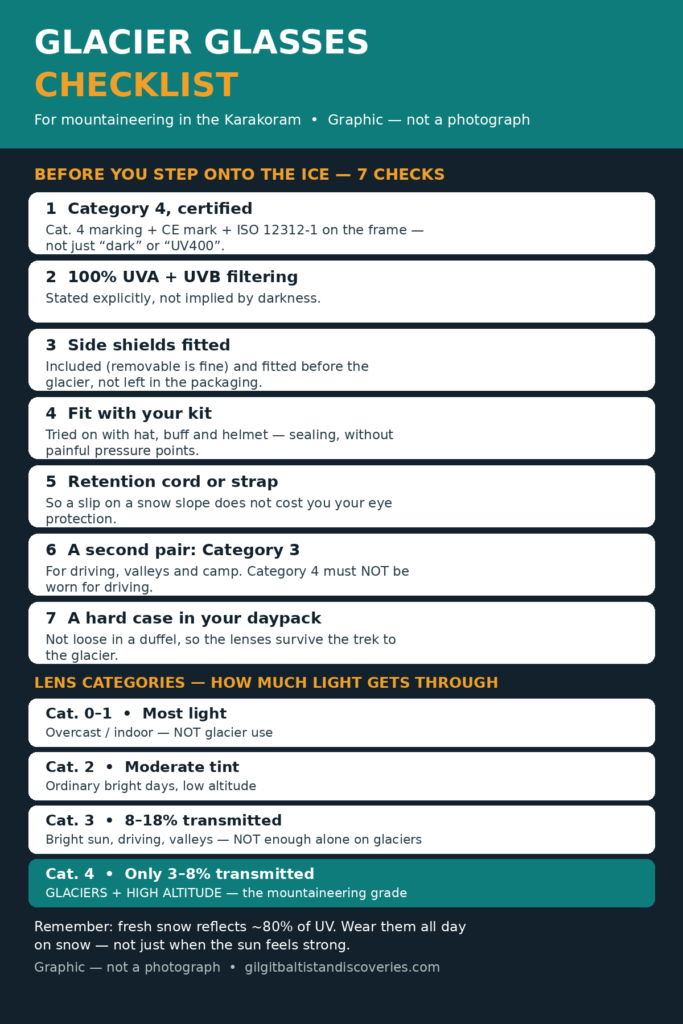
- Category 4, certified: Cat. 4 marking, CE mark and ISO 12312-1 on the frame — not just “dark” or “UV400” in the product title.
- 100% UVA and UVB filtering: stated explicitly, not implied by darkness.
- Side shields: included (removable is fine) and fitted before the glacier, not left in the packaging.
- Fit with your kit: tried on with your hat, buff and helmet, sealing without painful pressure points.
- Retention: a cord or strap so a slip on a snow slope does not cost you your eye protection.
- A second pair: a Category 3 pair for driving, valleys and camp — Category 4 lenses must not be worn for driving.
- A hard case: kept in your daypack, not loose in a duffel, so the lenses survive the trek to the glacier.
No specific model or price is claimed in this guide: prices change, and a stale price misleads more than no price. Use a tagged search to compare current options — glacier sunglasses Category 4 on Amazon — and judge every option against the checklist above, starting with the category marking on the frame.
What if snow blindness strikes anyway?
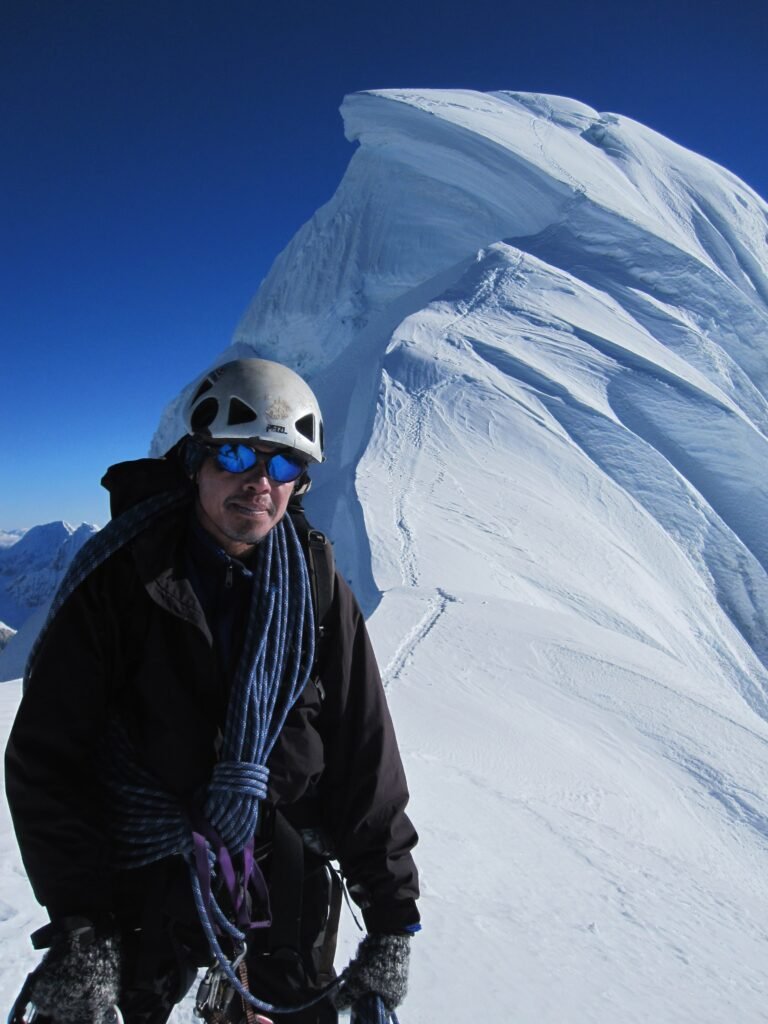
Snow blindness is the cornea’s equivalent of sunburn: pain, a gritty or burning feeling, red and watering eyes, blurred vision and sensitivity to light, typically appearing 6–12 hours after the exposure that caused it. If it happens on the trek: stop further UV exposure immediately, rest in a dark tent or room, use cool compresses and artificial tears if available, wear glasses (not contact lenses) until symptoms have fully cleared, and do not rub the eyes. Symptoms usually resolve within 24–72 hours, but if vision does not improve, pain worsens, or only one eye is affected, seek medical advice — do not wait it out in camp. Prevention is incomparably easier than recovery: the glasses above, worn all day on snow, are the whole prevention strategy.
Frequently Asked Questions
Do I really need Category 4 lenses for the K2 base camp trek?
Yes, for the glacier days. Ultraviolet intensity rises roughly 10–12% per 1,000 m of altitude, and fresh snow reflects about 80% of UV back into your eyes. Category 3 lenses suit valleys and camp, but Category 4 — transmitting only 3–8% of visible light — is the grade built for full days on snow and ice.
What is the difference between Category 3 and Category 4 sunglasses?
Category 3 lenses transmit about 8–18% of visible light and suit bright sun and driving, while Category 4 lenses transmit only 3–8% and are the darkest grade made, for glaciers and high altitude. Category 4 lenses are too dark for driving and carry a crossed-out car symbol; check the Cat. 4 marking and ISO 12312-1 on the frame.
Are polarised sunglasses enough for glacier travel?
No, not by themselves. Polarisation cuts reflected glare and improves comfort, but it is not UV protection: a polarised lens must also be Category 4 with 100% UVA and UVB filtering, plus side shields, to count as glacier glasses. A polarised Category 3 pair suits valleys and camp, not long glacier days.
Can I wear glacier glasses while driving to Skardu?
No. Category 4 lenses transmit only 3–8% of visible light, which is too dark for safe driving, and they carry a crossed-out car symbol for that reason. Carry a separate Category 3 pair for the road journey, the valleys and camp, and switch to the Category 4 glacier glasses only once you are on snow and ice.
What should I do if I get snow blindness on a trek?
Stop all further UV exposure immediately, rest in darkness, use cool compresses and artificial tears if available, and wear glasses rather than contact lenses until symptoms fully clear. Symptoms usually resolve within 24–72 hours, but if vision does not improve, pain worsens, or only one eye is affected, seek medical advice promptly instead of waiting it out in camp.
Related guides: K2 Base Camp Trek Packing List, Best Down Jacket for High-Altitude Trekking in Pakistan, Altitude Sickness in Gilgit-Baltistan, Gondogoro La Trek Guide: K2 Base Camp to Hushe.