Short Answer
Yes, you can sell Gilgit-Baltistan handicrafts to buyers in other countries, even if you have never sold anything online before. Start with one platform, Etsy or Instagram, list five of your best pieces, photograph them in daylight, tell the story of who made them and how long they took, price in US dollars so materials, hours, fees and shipping are all covered, and ship with a tracked courier. This guide walks you from zero to your first international order, step by step, in plain words.
A weaver in Karimabad
Picture a weaver in Karimabad. She spends two weeks on one woollen shawl, dyeing the wool, working the pattern her mother taught her, finishing every edge by hand. A tourist walks past her shop, admires the shawl, asks the price, and walks on. Another tourist buys one as a gift. That is the whole business, a few sales a week, only when a tourist happens to stop.
Now picture the same shawl on a phone screen in London. A buyer sees it, reads that it took two weeks to make, sees the weaver’s hands at work, and pays three times the Karimabad price without haggling, because she understands what she is buying. The shawl never changed. Only the way it was shown changed.
That is what this guide is about. You already have the hard part, the skill. The rest is showing it, pricing it and shipping it, and none of it needs training you do not have. We will explain every new word the first time it appears.
Why would a buyer abroad pay more for handmade?
A buyer abroad is not buying a shawl. She is buying a story she cannot get from a factory. A machine can copy a pattern, but it cannot copy the fact that a woman in Hunza spent two weeks making one piece by hand. That is the whole reason handmade work sells for more, and it is the reason buyers in the United States, the United Kingdom, Europe and Australia pay premium prices for it.
Three things make a buyer pay more. First, the work is one of a kind, no two pieces are exactly alike. Second, the buyer knows who made it and where, which makes the purchase feel honest. Third, the buyer is paying for time, a handmade shawl carries weeks of work inside it, and a buyer who understands that does not compare it with a factory price.
Your job is to make those three things visible. If a buyer cannot see the hands, the hours and the village, your shawl looks like any other shawl on the internet, and then price is the only thing left to compare. That is how artisans end up underpricing their own work.
What story must your craft tell?
Every listing needs a story, and a listing is simply one product page on a shop, one item with its photos, price and description. A buyer who cannot touch your work reads the story instead, so the story has to do the touching for them.
Tell four things, in this order. Who made it, and where. What it is made from, wool, wood, thread, silver, and where the material comes from. How long it took, in days or weeks, not just “a long time”. And what the pattern means, if it has a meaning, for example a motif from Hunza embroidery or a design from a village door.
Keep it short and true. Two or three sentences are enough. Do not invent a history your piece does not have, and do not call a piece handmade if a machine made most of it. Buyers who collect handmade work can tell, and one dishonest listing can end a shop.
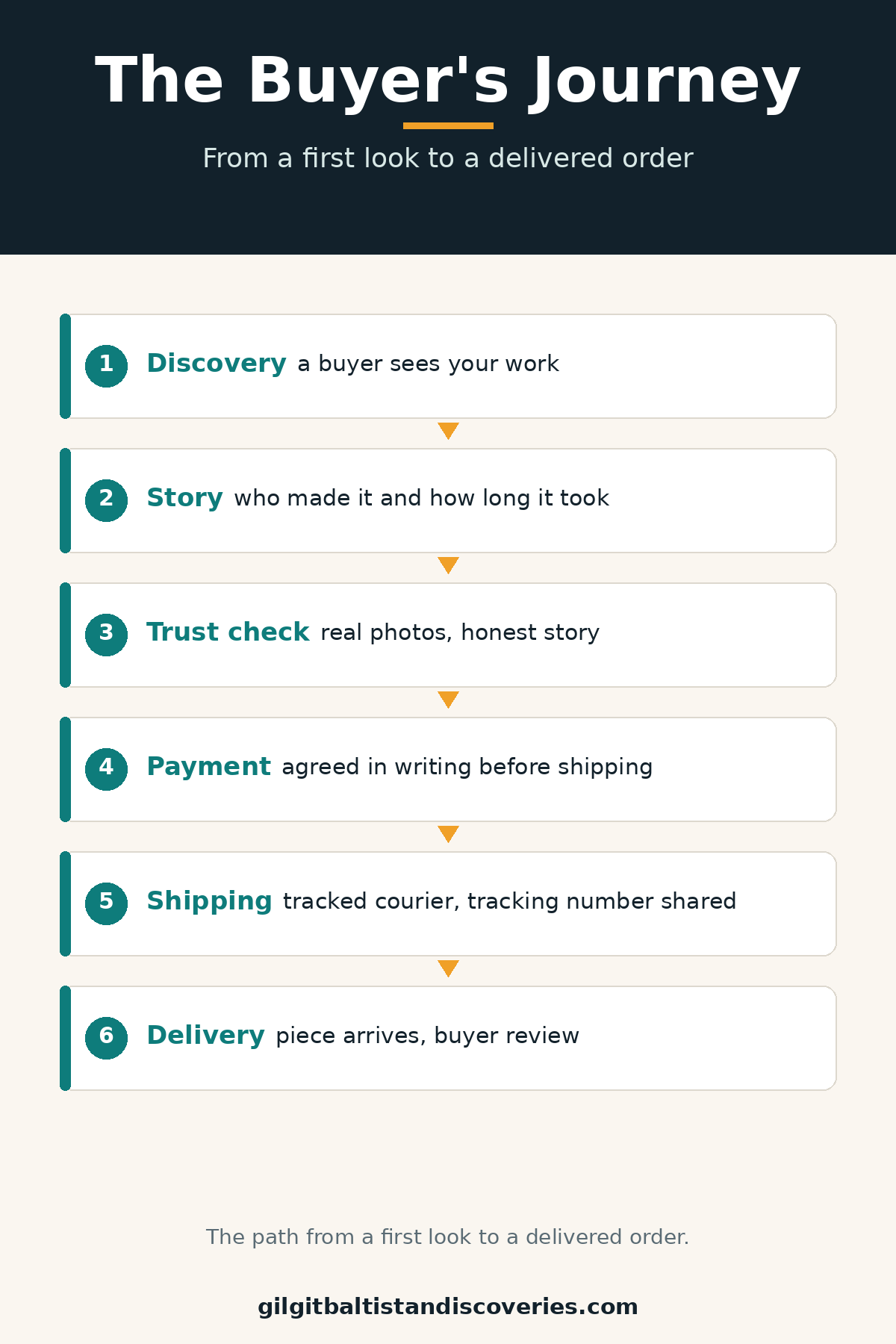
A visual guide sits with this section. It is a buyer journey diagram with six steps: discovery, story, trust check, payment, shipping, delivery. Each step carries one short label from this guide, so a beginner can see the whole path before reading further.
What must your photos show?
Photos are your shop window. A buyer cannot pick up your work, so your photos have to do that job. You do not need a camera, a phone in daylight is enough, but you do need four kinds of photo for every piece.
First, a hero shot. That means one clean photo of the piece alone on a plain background, in daylight, with nothing distracting in the frame. Second, a lifestyle shot. That means the piece in use, a shawl worn, a carved bowl holding fruit, a cap on a head, so the buyer can picture it in their own life. Third, a detail shot. Get close and show the stitching, the carving or the weave, the tiny marks that prove a human hand made it. Fourth, a scale shot. Put the piece next to something everyone knows, a hand, a mug or a book, so the buyer understands the size at a glance.
Three rules hold for every photo. Use daylight, never flash. Photograph the real piece you will ship, never another maker’s work and never a stock photo from the internet. And never edit a photo so much that the colour or the texture lies about the real thing.
Where should you sell?
You have two kinds of place to sell. A marketplace is a big website where many sellers list their work side by side, and buyers come already looking to buy. Your own website is a shop you build yourself, where you control everything but must bring the buyers yourself. Most artisans start on a marketplace, learn what sells, and build their own website later.
| Place to sell | What it is | Best for | What to watch |
|---|---|---|---|
| Etsy | The biggest marketplace for handmade work, with more than 90 million active buyers | A beginner selling one of a kind pieces to the US, UK, Canada and Australia | Etsy takes a fee on every sale, 6.5% plus 0.20 dollars per listing, and you must meet its handmade rules |
| A photo and video app where buyers discover your work, then message you to buy | Showing process videos and building followers who become buyers | Instagram is not a shop by itself, you still need a way to take payment and ship | |
| Your own website | A shop you build on Shopify or a similar tool | Keeping more of each sale and owning the customer relationship | You must bring your own visitors, through social media, search or ads |
| A chat app for taking orders directly | Buyers who found you on Instagram and want to ask questions first | Agree the price, shipping and payment in writing before you ship | |
| Craft fairs and exhibitions | Real events where buyers meet makers in person | Wholesale orders from shops and serious collectors | Travel and stall costs, and you must be ready with stock and price lists |
| Aseel | A marketplace for artisans that handles shipping, customs paperwork and tracking for you | A seller who wants the delivery side handled | Check first whether it accepts sellers from Pakistan, because it lists artisans from Afghanistan, Turkiye and beyond |
A second visual guide sits with this section. It is a platform comparison visual, the same six places as boxes, each labelled with its one line strength and its one line catch, so a beginner can compare them by looking.
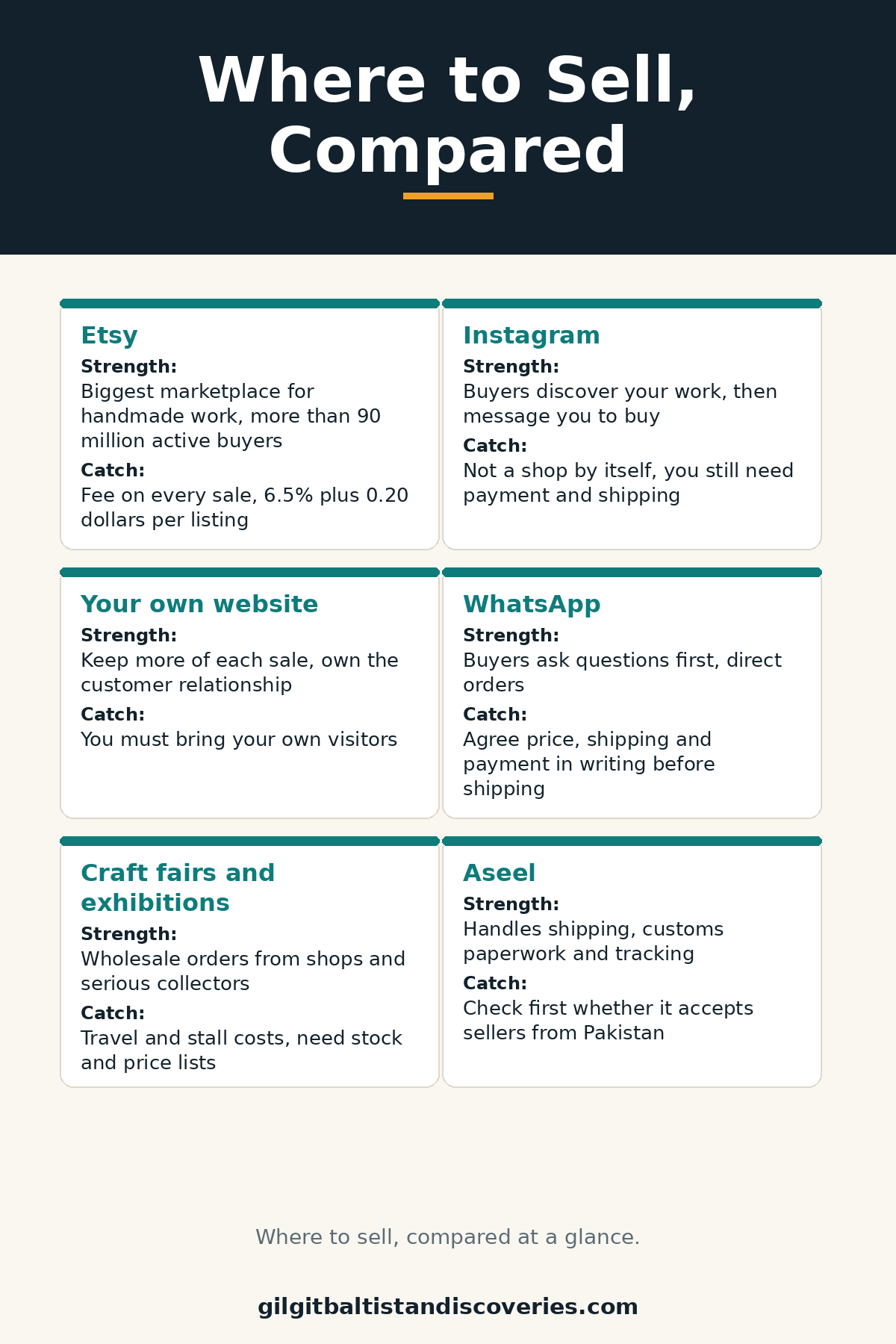
Etsy deserves a closer look, because it is the usual first step. Etsy is an online market where people buy handmade, vintage and craft supplies. A shop on Etsy is free to open, and your products go live after a review. Pakistani sellers can open a shop, and Etsy now supports Pakistani sellers through Payoneer, a payment service that receives money from abroad and moves it to a local bank account. Etsy Payments, Etsy’s own payment system, is not available in Pakistan yet, so check the current status on Etsy’s own help pages before you open your shop, because this changes.
How should you price your work?
Underpricing is the most common mistake in this whole business, and it hurts the maker most. A price is not a guess. It is a sum, and you can work it out on paper.
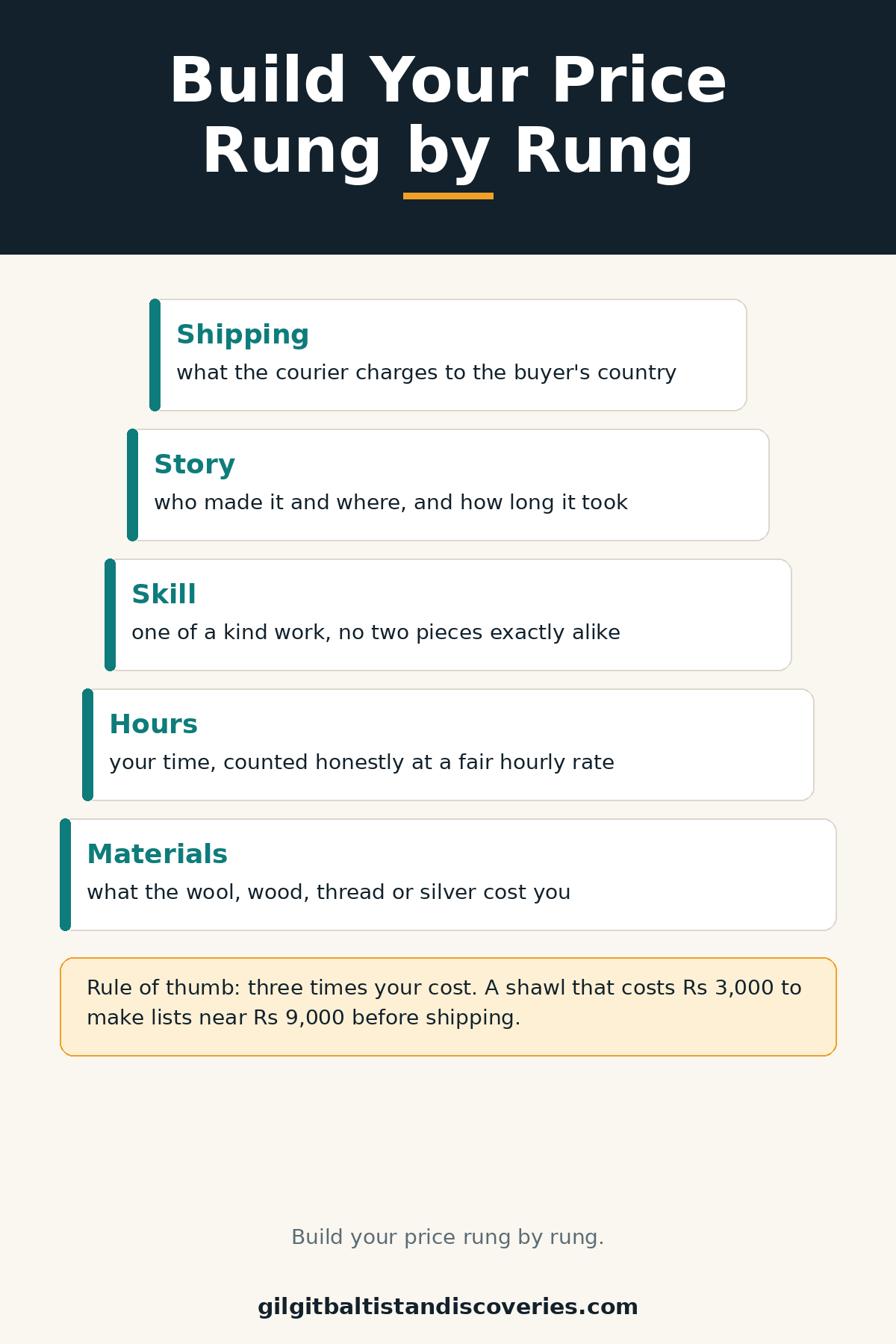
Add five things. Materials, what the wool, wood, thread or silver cost you. Hours, your time, counted honestly at a fair hourly rate. Packaging, the box, the wrapping and the card. Fees, what the platform takes from the sale. Shipping, what the courier charges to the buyer’s country. Then add your profit on top, the part that stays with you.
A common rule of thumb in export guides is three times your cost. That means a shawl that costs you Rs 3,000 to make would list near Rs 9,000 before shipping. That sounds high in Karimabad, and it is exactly right in London, because the buyer is paying for handmade work, not factory work. Price in US dollars, show the shipping cost separately, and never hide the shipping cost until the buyer reaches checkout, because that is when buyers abandon their carts.
A third visual guide sits with this section. It is a pricing ladder with five rungs, materials, hours, skill, story, shipping, each rung labelled with one line from this section, so a beginner can build a price by climbing the ladder.
How does shipping and customs work?
Shipping means sending the parcel from you to the buyer. Customs means the checks a country runs on goods crossing its border, and the paperwork that goes with them. Both are simpler than they sound, and both are the seller’s job to get right.
For a single small order, use a tracked courier. Guides for Pakistani sellers name DHL Express, FedEx, Pakistan Post EMS and Aramex as the usual choices, with DHL fastest and Pakistan Post cheapest. Tell the buyer the honest delivery time before they pay, two to three weeks for a small parcel by courier is a fair promise, and share the tracking number the day you ship. A tracking number is the code the buyer uses to watch the parcel move.
Every international parcel needs paperwork: a commercial invoice, which is a simple document saying what is in the parcel and what it is worth, a packing list, and a customs declaration. You also need the right HS code for your product, which is the international number customs uses to classify goods, for example textiles, woodwork or jewellery each have their own code. The wrong code means the wrong freight price and a parcel stuck at the border.
For regular exports, the steps are more formal. Register your business with SECP, the Securities and Exchange Commission of Pakistan, get an NTN, a National Tax Number, from FBR, the Federal Board of Revenue, and register with TDAP, the Trade Development Authority of Pakistan. You also need a Pakistan Single Window account for customs clearance, which is the online system, called WEBOC, that Pakistan customs uses. Check the current steps on the TDAP website before your first big order, because rules change. Initial export orders often need 45 to 60 days of lead time, which means the time from the order to the day you can dispatch it, because the piece may still need to be made.
TDAP also runs programmes that help makers reach buyers. It has organised more than 60 women-specific local exhibitions, sent women entrepreneurs to international exhibitions, and sponsored solo exhibitions abroad, according to Dawn in April 2024, and its WEXNET programme has offered fully subsidised participation at trade platforms. If you are a woman artisan, check TDAP for current opportunities in Gilgit-Baltistan.
How do you get paid?
Getting paid is the part beginners worry about most, and it has a simple answer: agree the method in writing before you ship, and test it once with a small amount before you trust it with a big order.
On Etsy, sellers in Pakistan receive payments through Payoneer, which moves the money to a local bank account. Payoneer charges 1 to 3 percent for currency conversion from dollars to rupees, and withdrawals to a bank take one to two days, according to guides for Pakistani sellers. Check the current terms on Payoneer and Etsy before you open your shop.
For your own website or Instagram sales, the payment method is whatever you and the buyer agree in writing. Do not ship a high value order before the payment has cleared into your account. If a buyer asks you to ship first and pay later, say no politely. That is the oldest trick in this business.
How do buyers find you?
A shop nobody visits sells nothing, so the last part of the work is being found. Three things bring buyers, and none of them costs money to start.
First, search. SEO means search engine optimisation, which is simply writing your listings and your website so Google can understand them. Use the words buyers actually type, “handmade wool shawl”, “Hunza embroidered cap”, “hand carved wooden bowl Pakistan”, in your titles and your first sentence. Second, social media. Post the process, not just the finished piece: the hands, the dye, the carving, the packing. One trip to the market or one afternoon in the workshop can become a week of posts. Third, reviews. Ask every happy buyer for a photo of the piece in their home and a few words about it. A review with a real photo is worth more than any advert.
Post regularly, four or five times a week if you can, and answer every message the same day. A buyer who waits three days for a reply has already bought from someone else.
Travellers who visit Skardu, Gilgit and Hunza often buy crafts on the trip, so make it easy for them to find your shop online afterwards.
What mistakes should you avoid?
Five mistakes end more craft shops than any other problem. Using stock photos or another maker’s photos, which buyers spot at once. Calling a piece handmade when a machine made most of it. Pricing so low that you earn nothing after fees and shipping. Hiding the shipping cost until checkout. And disappearing after one post, then wondering why no orders came. Every one of these is easy to avoid once you know it exists, which is why this guide names them plainly.
Yes. Start with one platform, Etsy or Instagram, and list five of your best pieces first. Take clear photos in daylight, write the story of each piece in plain words, and set one price that covers materials, your hours, fees and shipping. Your first sale teaches you more than weeks of planning. Do not wait until everything is perfect.
For a few small orders through a marketplace, you can start as an individual. For regular exports, register your business with SECP, get an NTN from FBR, and register with TDAP. You also need a Pakistan Single Window account for customs clearance. Check the current steps on the TDAP website before your first big order, because rules change.
Add up materials, your hours, packaging, platform fees and shipping, then add your profit. A common rule of thumb in export guides is three times your cost, so a shawl that costs you Rs 3,000 to make would list near Rs 9,000 before shipping. Price in US dollars, show shipping separately, and never hide the shipping cost until checkout.
Etsy sellers in Pakistan receive payments through Payoneer, which moves the money to a local bank account. For your own website or Instagram sales, agree on the payment method in writing before you ship, and test one small transaction first. Do not ship a high value order before the payment has cleared into your account.
You need four kinds. A clean hero shot on a plain background, a lifestyle shot of the piece in use, a close detail shot that shows the stitching or carving, and a scale shot next to a hand or a mug. Use daylight, never use another maker’s photos, and show the real piece you will ship.
Plan for two to three weeks for a small parcel by courier, and longer by post. Handmade export orders often need 45 to 60 days of lead time from order to dispatch, because the piece may still need to be made. Tell the buyer the honest date before they pay, and share the tracking number the day you ship.
Want help selling your crafts online?
Rakalogics is a marketing agency that runs Meta and Google ads and builds online stores for local businesses. If you want help reaching international buyers for your crafts, visit Rakalogics.
Last updated: 25 November 2026