Short Answer
Instagram ads for tour operators work when one ad shows one specific tour, with a real departure date and a clear price, to people in the countries your guests actually come from. You set the ads up in Meta Ads Manager, not with the Boost button, you send clicks to a WhatsApp chat or a single tour page, and you reply within minutes. Most local guides fail because they target the whole world, send clicks to a homepage, and judge the ads by likes instead of by messages that turn into deposits.
Last updated: 25 November 2026
Why do local tour guides struggle to get foreign clients?
A guide in Hunza or Skardu usually gets clients in three ways: walk-ins, local referrals, and other Pakistanis who found the number on Facebook. None of those reach a traveller in London, New York or Munich who is planning a Karakoram trip six months ahead. That traveller has never heard of you, cannot judge you from a phone number, and will not send money to a stranger. Before you advertise abroad, make sure you know how travellers actually reach Hunza Valley, because your ad must answer the same practical questions they ask first: flights, road, and bus.
Four gaps cause most of the struggle. First, visibility: your posts reach people near you, not people planning a trip from abroad. Second, trust: a foreign traveller pays in advance for a trip, which is one of the purchases people feel most nervous about, so a messy profile, no reviews and no clear price push them away. Third, language and timing: they plan in English, months ahead, while you post in the season when they have already booked. Fourth, payment: they need a clear way to pay a deposit from another country, and a chat message is not a booking.
Instagram ads fix the first gap only. The other three have to be fixed on your profile, your tour page and your reply routine, or the ads will bring clicks that never become clients.
How do Instagram ads for tour operators actually work?
Instagram ads are not set up inside the Instagram app. They run from Meta Ads Manager, the same dashboard that runs Facebook ads, at business.meta.com. The Boost button inside the app is a simpler version with far fewer options for audience, goal and tracking, and it tends to bring likes, not bookings.
Every ad has three layers. The campaign sets the objective, meaning what you want the ad to do. The ad set sets the audience, budget, placements and schedule. The ad itself is the creative, the copy and the link. Setup follows that order, and you should not skip the tracking step.
Meta offers objectives that fit a tour business. The ones that work best are messages, which open a WhatsApp or Messenger chat, leads, which collect a name, phone number and dates in a form inside the app, and sales, which send people to a tour page to book. For a small operator, the best starting point is usually message ads combined with retargeting, which means showing a reminder ad a few days later to people who already visited your tour page or watched your video.
The ad itself does not close the sale. Almost nobody books an international trip the moment they see an ad. They check with a partner, look at their holiday days, and think about the visa. The ad’s job is to move the person to the next step: a message, a form or a phone call.
Which countries should a Gilgit-Baltistan tour operator target?
Do not target the whole world. One ad set for the whole world spends your budget on the cheapest clicks, which are usually from people who will never book a Karakoram trek.
Start from proof you already have. Look at your past guests and your enquiries and write down where they came from. If your last five foreign groups came from the United States, the United Kingdom and Germany, those are your first three countries. If you have no foreign guests yet, start with the countries that already read about Gilgit-Baltistan in English and fly here most easily: the United States, the United Kingdom, Canada, Australia and western Europe.
Pick two or three countries, not ten, and run one ad set per country group so you can see which one answers. Test one country at a time when your budget is small, because ten starved ad sets teach you nothing and two well-funded ones do.
Language matters as much as location. Set the ad language to English for these markets, and write the ad in plain English, not in the English you use with local friends. If you later get steady enquiries from one non-English country, that is the moment to think about that language, not before.
| Targeting choice | What to set | Why it matters |
|---|---|---|
| Location | 2 to 3 source countries, not the whole world | Your budget reaches people who can actually fly here |
| Language | English | Your buyers plan in English, even if it is their second language |
| Age | 25 to 55 for most treks, wider for family tours | Trekkers and climbers cluster in this range |
| Placement | Instagram feed, Reels and Stories | That is where travel decisions start, on a phone |
| Exclusions | People who already booked | Stop paying to reach your own clients |
Location, language, minimum age and exclusions built from your own customer lists are enforced controls in Meta Ads Manager, meaning Meta must respect them. Interests, lookalikes, age and gender are now only suggestions that Meta can go beyond, and interest-based exclusions were removed in March 2025. The practical result is simple: set location and language deliberately, and let the video do the filtering. A video that opens on a family crossing the Hussaini Bridge finds families who want that trip far more reliably than any interest setting. The bridge sits on the route your guests actually walk, and Karimabad, the old capital they sleep in, is the place your ad should show them next.
How do you set up an Instagram ad in Meta Ads Manager?
You need four things before you spend anything. First, a Business or Creator Instagram account, connected to a Meta Business Portfolio and a Facebook Page. Second, a Facebook Page for the business, because even Instagram-only ads need one. Third, the Meta Pixel installed on your website, which is a small piece of code that tells Meta who visited which tour page and who filled in a form. Fourth, a payment method that Meta accepts for ad billing.
Then the setup runs in this order:
- Define the tour and the buyer. Write one sentence that answers who buys this tour. For example, a 14-day K2 Base Camp trek suits fit trekkers aged 30 to 55 in the United States and the United Kingdom who have trekked above 4,000 metres before. That one sentence shapes both the targeting and the ad copy.
- Set up tracking. Install the Meta Pixel and, where you can, the Conversions API, which sends booking events from your server and survives many of the ways browser tracking gets lost. Make a test booking and confirm Meta records it before you spend anything.
- Prepare images and videos. Prepare at least three different ads per tour: one that sells the place, one that sums up the itinerary, and one that answers a question people often ask.
- Test on a small budget. In the first week the goal is learning, not selling. You find out which image, which wording and which audience brings in messages at a lower cost. Then you switch off the weak ones.
- Scale and retarget. Raise the budget on the ad that works gradually, not all at once. People who visited the tour page but did not enquire see a reminder a few days later from a different angle, such as a true update on seats left or an answer to a common question.
Do not skip the tracking step. When a campaign starts without tracking, three weeks later the answer to the question did the ads work is just a guess.
What kind of ad creative works for foreign travellers?
In 2026 the creative does most of the targeting. Build the ad as if it had to find its own audience, because it does. Short vertical video made for Reels and Stories beats a landscape video cropped to fit, and phone footage of a real group on the trail usually beats a polished drone montage, because travellers buy the day, not the view.
Every ad should pass this test in the first few seconds: what it is, where it is, how long it takes, and the price it starts from. Clear offers filter out the curious and keep the buyers. Add captions, because most people watch without sound. Put a real review from a real guest in the ad, named with where they joined you, because proof with a place attached builds trust faster than any claim about being the best.
Make genuinely different concepts rather than twenty versions of one: a guest testimonial, a point-of-view clip from the trail, a behind-the-scenes look at your guide. Meta tends to treat near-identical variations as one ad, so variety of idea matters more than variety of headline. Refresh the creative when performance fades, because the same audience sees the same ads often.
What not to use: stock photos of mountains you did not take, a photo of a place your tour does not visit, and a price you will not honour. Foreign travellers compare your ad with your profile and your website, and one mismatch ends the conversation.
How much should a small tour company spend on Instagram ads?
There is no fixed price for a lead or a booking. Costs vary with your tour, your price, your audience and the season, and anyone who promises you a fixed cost per booking is guessing. The honest way to find your number is to test with a small budget and measure what a message and a booking actually cost you.
One published playbook for small adventure guide businesses suggests a total of 25 to 50 dollars a day, starting with a traffic campaign at 15 to 20 dollars a day to build an audience, plus a video views or engagement campaign at 5 to 10 dollars a day to build a warm audience of people who watched your videos. The same playbook warns to expect 4 to 8 weeks before you have enough conversion data to optimise confidently, and that early weeks are signal building, not profit generating. Treat those figures as a starting point, not a promise.
Meta’s delivery system learns best with around fifty conversion events a week per ad set. For a small operator that is a lot of bookings, so either optimise for an earlier step, such as starting checkout or sending a message, or accept slower learning. Consolidate your budget: two well-funded ad sets beat ten starved ones.
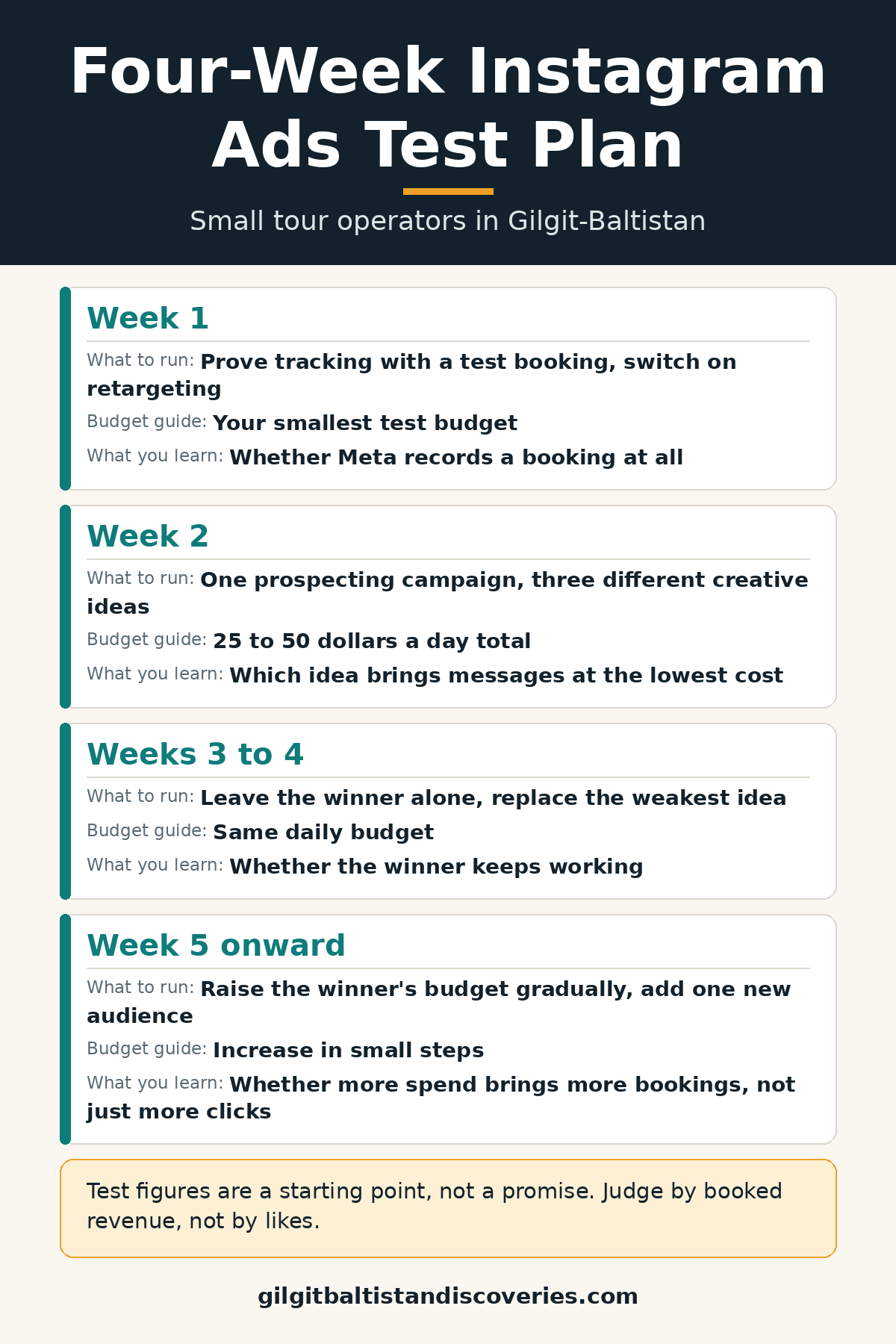
Use this four-week test plan, then judge by booked revenue, not by likes:
| Week | What to run | Budget guide | What you learn |
|---|---|---|---|
| 1 | Prove tracking with a test booking, switch on retargeting | Your smallest test budget | Whether Meta records a booking at all |
| 2 | One prospecting campaign, three different creative ideas | 25 to 50 dollars a day total | Which idea brings messages at the lowest cost |
| 3 to 4 | Leave the winner alone, replace the weakest idea | Same daily budget | Whether the winner keeps working |
| 5 onward | Raise the winner’s budget gradually, add one new audience | Increase in small steps | Whether more spend brings more bookings, not just more clicks |
One agency’s published client figures show what is possible, not what is typical: a motorcycle tour company collected more than 1,000 leads at under 4.50 Australian dollars each and more than 200,000 Australian dollars in bookings, and an India tiger safari company saw 6 of its first 10 leads book at under 6 Australian dollars a lead. Your costs will differ with your tour, your price and your audience, and you should plan your budget from your own test, not from someone else’s case study.
What happens after someone clicks your ad?
This is where most tours are won or lost. The ad brings a message at 10 p.m., the reply goes out the next afternoon, and by then the person has already written to another agency. Answer every message within the hour when you can, and within a few hours at most, even if the answer is only that you will send the full itinerary in the morning.
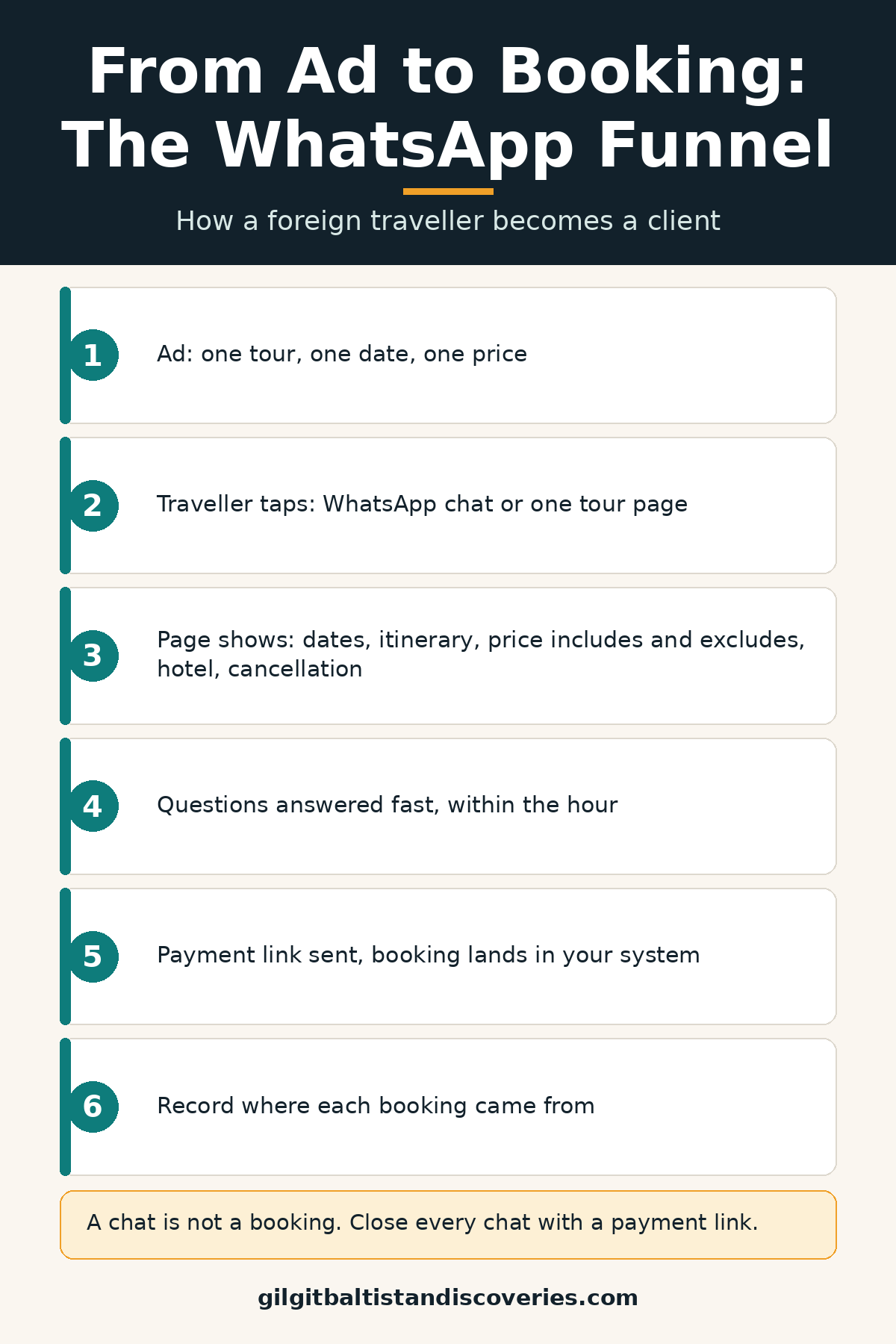
The funnel after the click looks like this: the traveller sees the ad, taps it, and lands in a WhatsApp chat or on a single tour page, not your homepage. On the page they need the dates, the day-by-day itinerary, what the price includes and excludes, the hotel standard and the cancellation policy, with a WhatsApp or call button at the top and at the bottom. They ask questions, you answer, and then you send a payment link so the booking lands in your system and you can record that it came from the ad.
A chat is not a booking, and bookings that happen later in the conversation are easy to lose track of. Close every chat with a payment link, and write down where each booking came from, so you know which ad actually earned its money.
If you use a lead form instead of a chat, keep it short: name, email and phone are usually enough, and you can ask the rest when you reply. If you get many forms from people who never answer the phone, make the form a little harder on purpose by adding the month they want to travel and the group size, and switch on the higher intent form option, which shows a review screen before they submit. You get fewer forms, but the people who fill them out are more serious.
How do you take payments and deposits from foreign clients?
State the deposit clearly in the ad and on the tour page, before the traveller has to ask. A typical structure is a deposit to hold the seat and the balance before departure, with the cancellation terms written next to it. Do not write “DM for price”, because it wears out serious buyers. Even if you would rather not publish a number, say clearly what is included.
Agree the payment method before the trip, send a payment link rather than taking card details in a chat, and confirm every payment in writing with the amount, the date and what it covers. Keep a simple record of which ad or post each booking came from, because that record is what tells you whether to keep spending.
Which payment options work for a tour company based in Pakistan is an open point in this guide: the options available to you depend on your bank and the tools it supports, and they change over time. Check with your bank before you promise a method in an ad, and do not advertise a payment option you have not tested with a real transaction.
What mistakes burn a tour operator’s ad budget?
The most common mistake is advertising the agency instead of the tour. A generic line like “Your dream vacation starts with us” moves nobody. People do not buy an agency, they buy a specific tour on a specific date.
The other mistakes that cost the most money are:
- Boosting posts blindly. The Boost button is easy, but its targeting and tracking options are limited, and it tends to bring likes, not bookings.
- Sending ads to the homepage. The visitor has to dig through menus to find the tour they saw, and many give up.
- Targeting the whole world. One worldwide audience spends your budget on the cheapest clicks, which are usually from people who will never book.
- Using the same audience for every tour. A college group trek and a slow cultural tour for retirees should not be shown to the same people.
- Judging ads by likes. Likes, comments, shares and cheap clicks are real, and none of them pay for a guide. Judge by booked revenue and cost per booking.
- Switching ads off completely after the season. Retargeting audiences and profile followers get forgotten, and next season starts from zero.
- Fake urgency. Writing “Only 2 seats left” and running the same ad every week damages trust. Use seat counts only when they are true.
- Hiding what the price includes. If the price is missing, serious buyers leave and only bargain hunters stay.
Most of the mistakes on that list happen outside the ad dashboard, not inside it. Running ads is not just adjusting settings.
When should you run ads, and when should you stop?
Plan a tour’s ads backward from the date people make their decision, not from the departure date. For a summer Karakoram trek, many people start researching in late winter or spring. For a spring blossom trip, they decide in the weeks before. Weekend trips sell just a few weeks in advance. Your own past booking records are the most reliable guide to your window. Winter trips sell differently again, because the season is short and the roads close, so check the real winter travel conditions before you promise a date in an ad.
Run the ad calendar in three phases. In the awareness phase, when the tour is announced, run a broad announcement with video and images. In the decision phase, reach interested people again with details like the itinerary, the hotel and what the price covers, using message and form ads. In the closing phase, close to departure, run short campaigns that state plainly how many seats are left. Then collect photos and reviews from travellers after the tour ends, because that material becomes the most convincing content for next season’s ads.
Stop an ad when it has spent your test budget with no messages, when its messages never turn into deposits, or when the tour is full. Do not keep an ad running out of hope. And do not judge a campaign after two days. Give a test at least a fortnight before you call it a failure, because foreign travellers take days to decide, and the booking often arrives a week after the first message.
Instagram ads run from Meta Ads Manager, not from the Instagram app. You pick an objective such as messages, leads or sales, choose the countries and language, set a budget, and upload a short vertical video of a real tour. The ad’s job is to start a conversation, not to close a booking on the spot.
Costs vary with your tour, price, audience and season, so no fixed figure is honest. One published playbook for small adventure guides suggests 25 to 50 dollars a day to start, with 4 to 8 weeks before you have enough data to optimise. Test small and measure your own cost per message and per booking.
Start from your own past guests and enquiries, and pick two or three countries where you already have proof. For most Gilgit-Baltistan operators, the United States, the United Kingdom, Canada, Australia and western Europe are the natural first markets, because they plan in English and travel here most easily.
Use Meta Ads Manager. The Boost button is quicker, but it gives you far fewer options for audience, objective and tracking, and it tends to bring likes rather than bookings. Ads Manager lets you target by country and language, run message and lead ads, and see which ad produced each conversation.
Show real trips, not stock photos: short videos of real guests, your guide talking, and reviews named with where each guest joined you. Put dates, inclusions and cancellation terms on one tour page, answer messages within the hour, and take deposits through a payment link, not through chat promises.
Expect weeks, not days. Foreign travellers take time to decide, check with family, and sort visas and flights. A sensible first month is one week proving tracking, one week testing three creative ideas, and a fortnight of letting the winner run before you judge it or scale the budget.
Want help running your ads?
Running ads takes time, and a wrong setup burns budget fast. Rakalogics is a marketing agency that runs Meta and Google ads for tour operators and local businesses. If you want help reaching foreign travellers, visit rakalogics.com.