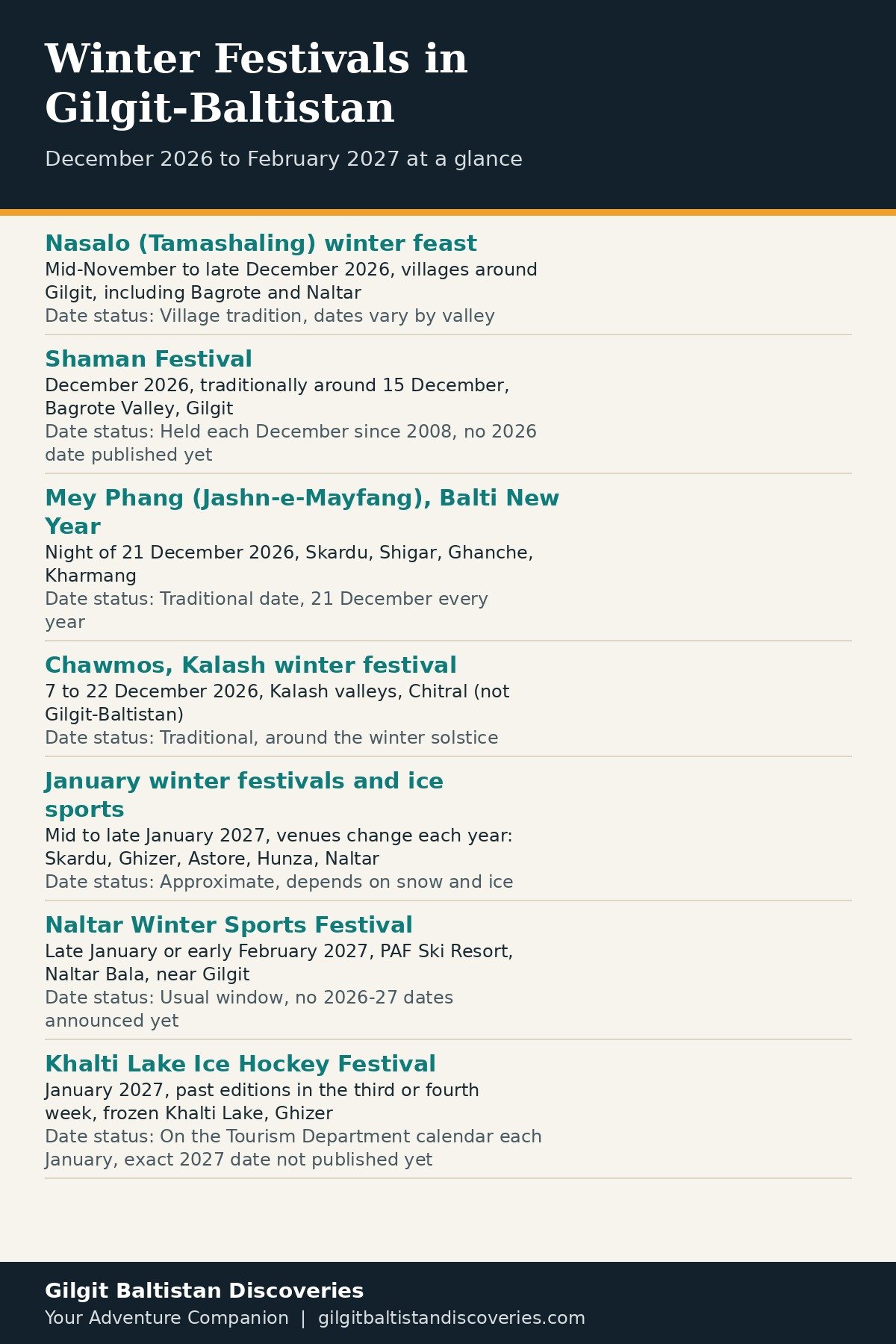
Winter in Gilgit-Baltistan runs from December to February, and it has its own festival season. December brings the old fire and feast traditions: Nasalo in the villages around Gilgit, the Shaman Festival in Bagrote Valley, and Mey Phang, the Balti New Year of fire, in Skardu and across Baltistan around 21 December. January brings the ice: the Khalti Lake Ice Hockey Festival in Ghizer and the ski and ice sport championships at Naltar, plus smaller winter festivals that move between Skardu, Hunza, Astore and Ghizer with the snow. None of these is a big ticketed event like a summer polo festival. Most are community gatherings with dates that move, so confirm locally before you travel.
Winter festivals at a glance
| When | Festival | Where | Date status |
|---|---|---|---|
| Mid-November to late December 2026 | Nasalo (Tamashaling) winter feast | Villages around Gilgit, including Bagrote and Naltar | Village tradition, dates vary by valley |
| December 2026, traditionally around 15 December | Shaman Festival | Bagrote Valley, Gilgit | Held each December since 2008, no 2026 date published yet |
| Night of 21 December 2026 | Mey Phang (Jashn-e-Mayfang), Balti New Year | Skardu, Shigar, Ghanche, Kharmang | Traditional date, 21 December every year |
| 7 to 22 December 2026 | Chawmos, Kalash winter festival | Kalash valleys, Chitral (not Gilgit-Baltistan) | Traditional, around the winter solstice |
| Mid to late January 2027 | January winter festivals and ice sports | Venues change each year: Skardu, Ghizer, Astore, Hunza, Naltar | Approximate, depends on snow and ice |
| Late January or early February 2027 | Naltar Winter Sports Festival | PAF Ski Resort, Naltar Bala, near Gilgit | Usual window, no 2026-27 dates announced yet |
| January 2027, past editions in the third or fourth week | Khalti Lake Ice Hockey Festival | Frozen Khalti Lake, Ghizer | On the Tourism Department calendar each January, exact 2027 date not published yet |
Which winter festivals happen in Gilgit-Baltistan?
Six winter gatherings matter for travellers, and they fall into two groups. December is the cultural month: Nasalo, the Shaman Festival and Mey Phang are old traditions tied to the longest night, the winter meat store and the Balti New Year. January is the sporting month: the ice hockey festival at Khalti Lake, the ski and ice sport championships at Naltar, and a moving cast of smaller winter festivals in Skardu, Hunza, Astore and Ghizer.
The Kalash festival of Chawmos also falls in December, but it belongs to the Kalash valleys of Chitral, not to Gilgit-Baltistan. It is in the calendar table above so you can see the season whole, and our full guide to it is linked below, but this guide does not cover it in depth.
One honest warning applies to the whole season. Winter festival dates in Gilgit-Baltistan are rarely fixed. The fire festivals follow tradition, the ice festivals follow the freeze, and the championships follow the competition calendar. Every date in this guide is labelled fixed, traditional or approximate, and the right move is always the same: pick your valley, then confirm the date with your guesthouse, your guide or the Gilgit-Baltistan Tourism Department a few weeks before you travel.
What is Mey Phang, and where do you see it?
Mey Phang, also written Mayfung or May Fang, is the Balti New Year festival of fire. It is celebrated on the night of 21 December, the winter solstice and the longest night of the year, to mark the end of the dark and the start of the Balti New Year, called Losar. The name comes from the Balti words for fire and for playing or throwing: May means fire, Fung means to throw or play. People light bonfires on rooftops, hillsides and open ground, wave burning wood and torches, dance, sing, let off fireworks and fly lanterns. The belief behind it is old: fire drives away evil and misfortune and brings good luck for the year ahead. The festival is also known as Thumushaling in Burushaski and Loma in Shina, and it is celebrated in Gilgit and Hunza too, though Baltistan is its home.
The main public event is usually in Skardu, at the Municipal Stadium or at Yadgar-e-Shuhada, with organised bonfires, traditional dress, music and cultural performances. Smaller public events are held in Shigar, Ghanche and Kharmang districts, and every village in Baltistan lights its own fires. Dawn reported the 2025 celebration across the region, with the main event at Skardu Municipal Stadium and crowds in traditional winter dress, and the 2020 report described temperatures of minus 16 to minus 20 degrees Celsius on the night, with Skardu lit by candles and bonfires.
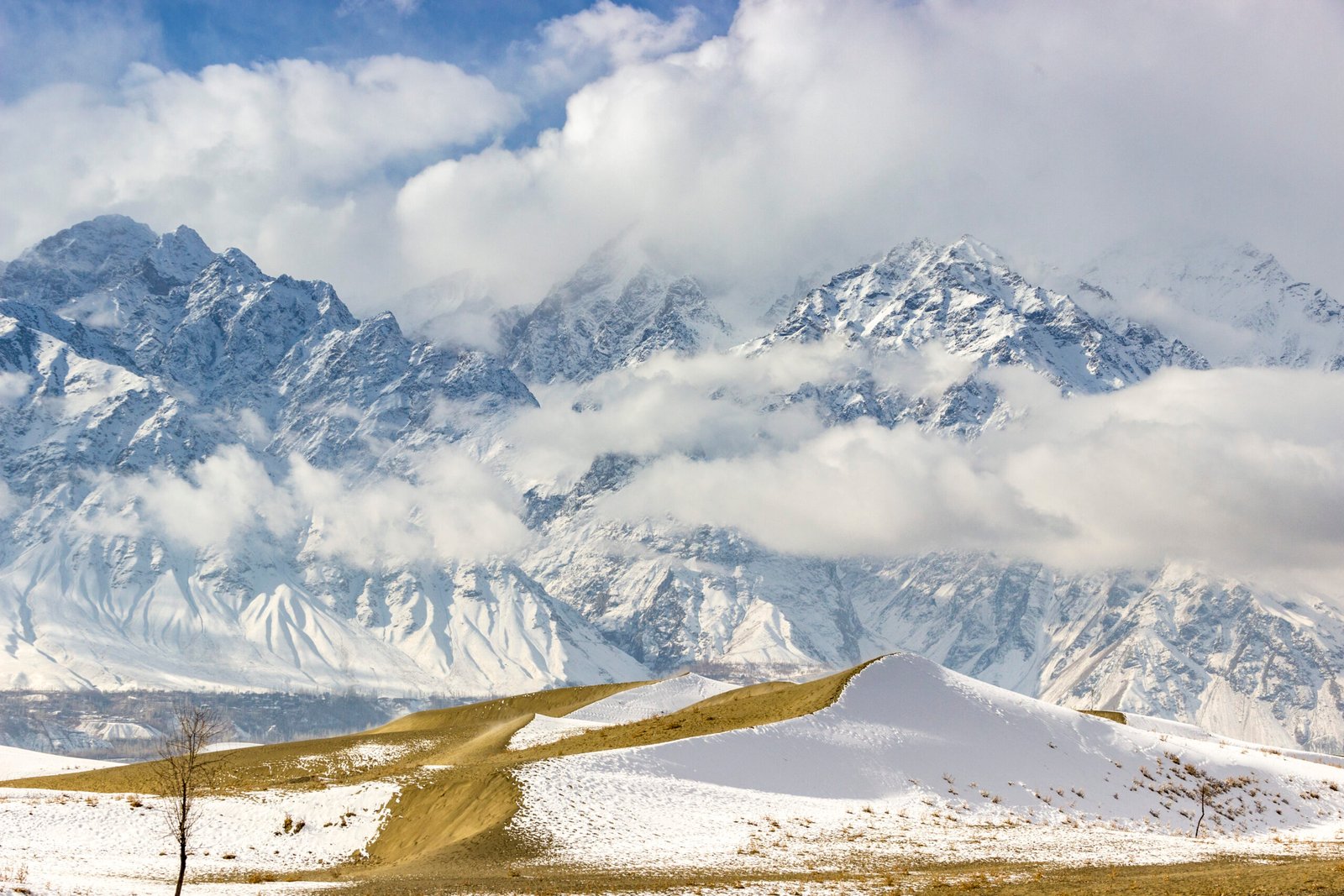
For travellers, Mey Phang is the easiest winter festival to plan around, because the date does not move: the night of 21 December, every year. Arrive in Skardu a day early, dress for deep cold, and ask your hotel where the public bonfire is that year. The rest of the night belongs to the villages, and a respectful visitor who is invited to a family fire should accept, bring something to share, and ask before taking photos.
What is Nasalo, and can travellers join in?
Nasalo is the oldest winter tradition in the Gilgit region, and it is a feast before it is a festival. Also called Tamashaling or Thumushaling in Burushaski and Nos in Shina, it is one of the oldest surviving festivals in Gilgit-Baltistan, traced back to about 700 AD in local accounts. Its purpose is practical: before the heavy snow, each household slaughters an animal, usually a yak, cow, goat, sheep or ox, depending on what the family can afford, and the meat is dried, hung in cold airy places and stored to feed the family through January, February and March. The dried meat is cooked through the coldest months, and the special dish of the season is Warki, also written Warkoo, made from the stored meat.
The celebration itself is a village gathering. People meet early in the morning at the village meeting place, each household bringing a special dish, and share a communal meal with prayers for peace and prosperity. In Bagrote Valley, where the tradition is strongest, the day includes the Shaman dance and traditional dances, and young people carry burning sticks of alpine wood to a bonfire. The legend behind the feast is the death of Shribadat, the cannibal king of local folklore, whose burning the villagers still mark with fire.
Dates vary by valley, and sources place Nasalo anywhere from mid-November to late December. The fullest accounts put the Bagrote celebration in mid-December, commonly the 13th to the 21st of December, while the events calendar for 2026 to 2027 gives the wider range of mid-November to late December. Treat mid-December as the usual window and confirm the exact day with a local host.
Can travellers join in? Sometimes, and only as respectful guests. Nasalo is not a ticketed event and there is no public schedule. Most of it happens inside homes and at village meeting places in Bagrote, Naltar and other valleys around Gilgit. If your guesthouse host or guide invites you, accept, bring fruit or dry fruit as a gift, ask before taking photos, and do not expect a fixed programme. The right way to experience Nasalo is through a local invitation, not a tour poster.
What is the Shaman Festival in Bagrote?
The Shaman Festival is Bagrote Valley’s own December event, and it is the most unusual festival in this guide. It is organised by the Gilgit-Baltistan Tourism, Sports, Culture, Archaeology and Museums Department, and it has been held every December since 2008. It showcases the valley’s indigenous shamanic traditions, the bitan or shamans, who were traditionally believed to heal the sick and foresee events through trance. The festival features the Shaman dance, Shaap performances and traditional food, and it is held in Bagrote Valley, near Gilgit.
The department’s own events calendar for 2024 to 2025 lists 15 December as the traditional date for the Shaman Festival, and press coverage of the official calendar repeats 15 December. But no date has been published for December 2026, and the 2026 to 2027 events calendar lists it as December with no fixed date published. So the honest position is this: expect it around the middle of December, traditionally around 15 December, and confirm the exact day with the Tourism Department or a Bagrote guesthouse before you travel.
Bagrote is about an hour from Gilgit city by road, and it is the valley where Nasalo is also kept most strongly. A December trip that pairs the Shaman Festival with Nasalo in the same valley is the best way to see the old Gilgit winter traditions, but it needs flexible dates and a local contact. Do not book non-refundable transport around a guessed festival day.
What happens at the January winter festivals?
January is when Gilgit-Baltistan plays on ice. The Tourism Department and local communities organise a moving programme of winter festivals across the region, and the venues change each year with the snow and the state of the frozen lakes. The events calendar for 2026 to 2027 places them in mid to late January, at venues that change each year, including Skardu, Ghizer, Astore, Hunza and Naltar.
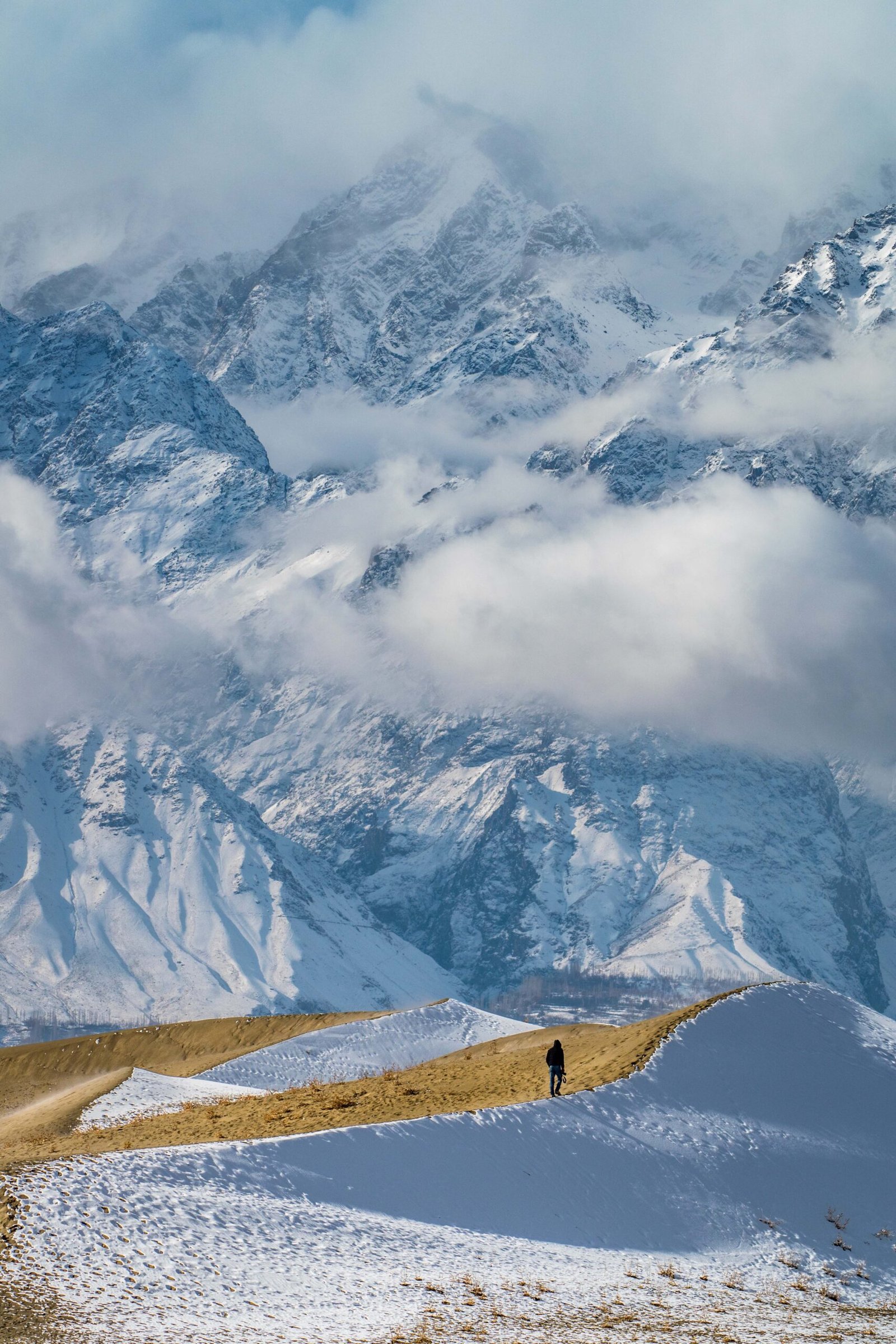
Recent editions show how the season works. The Sevendays Winter Feast, also called the Frozen Fairytale Winter Feast, began on 22 January 2024 at Khalti Lake in Ghizer, after first being planned for Skardu, then Hunza, then Naltar, because the frozen rinks were not ready elsewhere. Its third edition ran from 19 January 2025 in Hussainabad, Skardu, and Murtazabad, Hunza. The programme typically includes ice hockey, curling, speed racing, ice skating and local games, with teams from across Gilgit-Baltistan in boys and girls divisions. In January 2025, the Karakoram Winterlude Season 7 opened at Altit in Hunza on 11 January, a seven-day winter festival began in Murtazabad, Hunza, a two-day winter sports festival closed in Gorikot, Astore, and an intra-district ice hockey tournament finished in Sultanabad village in Yasin, Ghizer.
The lesson for travellers is that January has no single festival to book around. Instead, plan a January trip to one valley, Skardu, Hunza or Ghizer, and ask locally what is on that week. The ice hockey is real and competitive, the crowds are local, and the atmosphere is closer to a village sports day than a staged show. That is exactly what makes it worth seeing.
What is the Naltar Winter Sports Festival?
Naltar is the home of skiing in Pakistan, and its winter festival is the country’s main ski event. The Pakistan Air Force operates a working ski slope with a chairlift at Naltar Bala, at about 2,950 metres, and the Winter Sports Festival is organised with the Pakistan Air Force and the Winter Sports Federation of Pakistan. It usually runs in late January or early February, with skiing, snowboarding, ice hockey and ice skating competitions, and it has run as a five or six day event in past years.
Recent editions give the pattern. The 30th National Ski Championship, the 17th Shah Khan Ski Cup and the seventh Snowboarding Championship concluded at the PAF Ski Resort in Naltar in February 2023, with 93 athletes from ten teams. The Sadia Khan and Children Ski and Snowboarding Championship ran from 11 to 18 February 2024, with 62 athletes. The National Ice Sports Championship, with ice hockey, speed skating, curling, figure skating and relay races, concluded at Naltar in January 2025, with twelve teams from across the country and Gilgit-Baltistan winning the most medals. The ski season itself runs December to March, snow permitting.
No dates have been announced for the 2026 to 2027 season, and no ticket has been published for past editions. Access depends on the organisers’ rules for the year, and lift times and public access should be confirmed with the Pakistan Air Force, the Winter Sports Federation of Pakistan or the Gilgit-Baltistan Tourism Department before you travel. January and February are the genuine ski months, and our Naltar Valley guide has the full picture of the valley, the road and the resort.
What is the Khalti Lake Ice Hockey Festival?
The Khalti Lake Ice Hockey Festival is the most unusual event in this guide: an ice hockey championship played on a natural frozen lake. Khalti Lake sits at 2,217 metres beside Khalti village in Ghizer, about 110 kilometres from Gilgit via Gahkuch and Gupis, and it freezes hard enough in most winters for skating, hockey, football and cricket on the ice. The festival is on the Gilgit-Baltistan Tourism Department calendar each January, organised with the Khalti Social Development Organization.
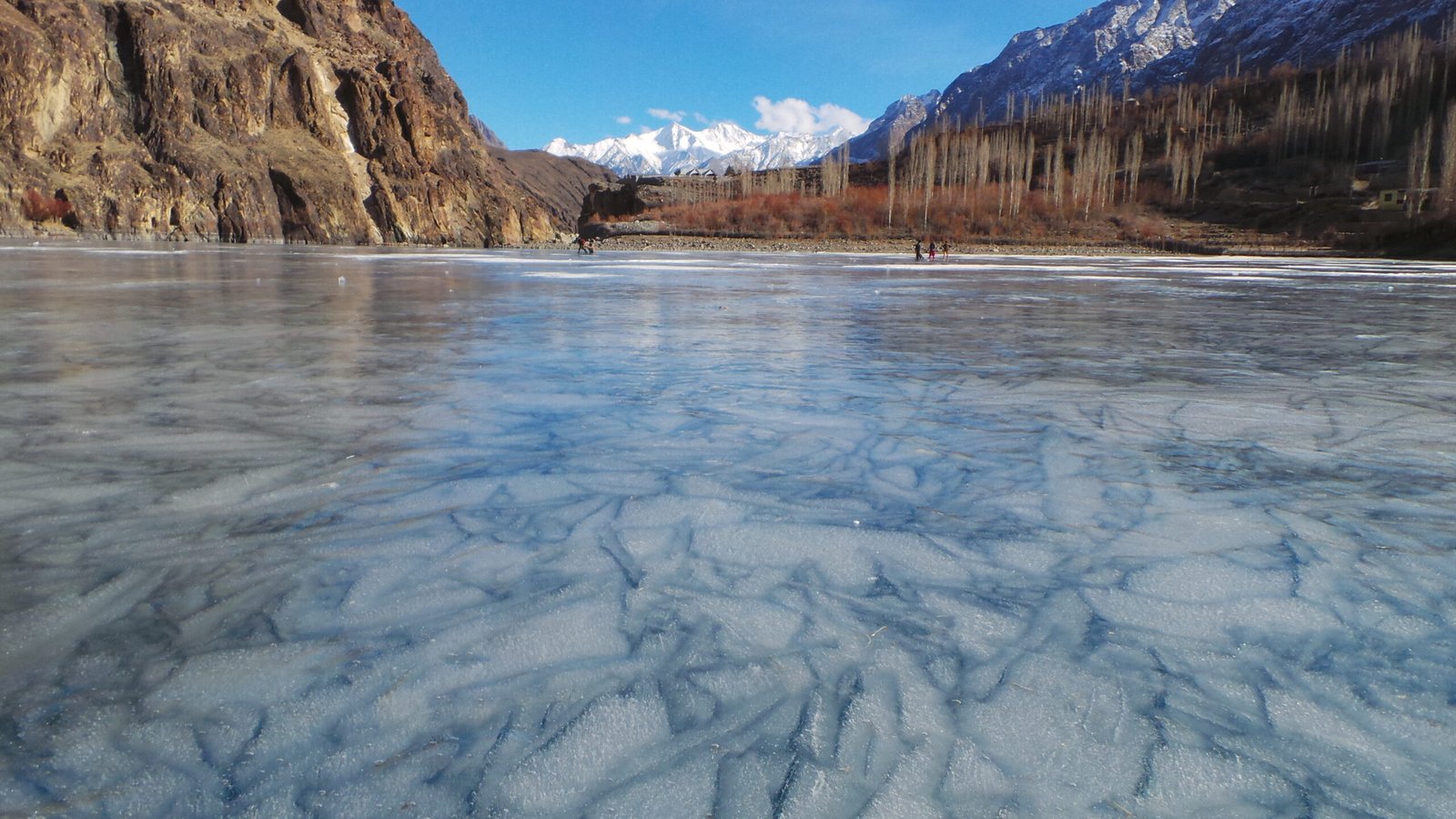
Past editions began in the third or fourth week of January. The seven-day Winter Fest 2024 kicked off on 22 January 2024 at the frozen lake, with 16 ice hockey teams, including four female teams, from across Gilgit-Baltistan, plus skating and local games. One account of the festival says it starts on 27 January each year and runs for a week, with the ice hockey championship, ice skating and ice football. The exact date for January 2027 has not been published, so treat the third or fourth week of January as the window and confirm locally.
The lake itself is the attraction, and our Khalti Lake guide covers it in full, including the freeze, the road and the safety rules. Two rules matter more than any date. First, never step on the ice unless local people and the organisers say it is safe, because thickness varies with the weather and the river flow beneath the lake. Second, expect real cold and a long day: Khalti is a day trip from Gilgit only if the road is open, and winter road conditions in Ghizer change fast.
How do you plan a trip around a winter festival?
Start with the valley, not the date. December festivals belong to Skardu and Baltistan for Mey Phang, and to Bagrote and the villages around Gilgit for Nasalo and the Shaman Festival. January ice belongs to Ghizer for Khalti, Naltar for skiing, and Skardu or Hunza for the moving winter festivals. Pick one base, then confirm the festival date a few weeks before you travel, and keep a buffer day on each side.
Getting there in winter takes patience. The Babusar Pass road is closed all winter, so the Karakoram Highway is the only road route into the region, and flights to Gilgit and Skardu depend on clear weather and are often delayed. Build in a spare day, and never book a tight onward connection after a winter flight. Our winter pillar guide covers roads, flights and conditions across the season, and the Skardu and Hunza winter guides cover what stays open in each valley.
Staying warm is part of the plan. Hotels that stay open in winter are fewer than in summer, and the winter-open hotels guide lists them valley by valley. Power cuts are a normal part of winter in Gilgit-Baltistan, so charge devices whenever you have electricity, and carry a power bank for the cold, which drains phone batteries fast.
What should you pack, and how cold does it get?
Pack for nights well below freezing. Skardu averages about 3 degrees Celsius by day and minus 8 at night in January, and Gilgit about 10 by day and minus 3 at night. Naltar and the high valleys are colder still, with nights down to minus 15. Bring a warm down jacket, thermal layers, waterproof boots with grip, gloves, a warm hat, sunglasses for snow glare and lip balm. A power bank is essential, not optional: cold drains batteries, and power cuts are common, so keep the power bank in an inside pocket where it stays warm.
As an Amazon Associate, Gilgit Baltistan Discoveries earns from qualifying purchases. A compact power bank is the one piece of gear every winter festival trip needs: Anker PowerCore 10000.
Festival etiquette is simple. These are community events, not shows. Dress modestly, ask before photographing people, especially women and children, accept food and tea when it is offered, and do not push into the front of a ritual or a game. A small gift of fruit or dry fruit is always welcome at a village gathering.
What comes after winter?
The winter festival season ends with February, and the next fixed date on the calendar is Navroz on 21 March 2027, the spring festival and regional holiday, with Ramadan expected from 8 or 9 February 2027 depending on the moon sighting. Neither is a winter festival, but both shape travel in the weeks after the ice melts. Our Navroz guide covers the spring festival in Hunza and Nagar.
If you want help building a winter festival trip, our team plans it with local guides and winter-open hotels.
December is the best month for culture, with Nasalo in the Gilgit villages, the Shaman Festival in Bagrote and Mey Phang in Baltistan around 21 December. January is the best month for sport, with the ice festivals at Khalti Lake and the ski events at Naltar. February is quieter, with good snow but fewer organised events.
Yes. Mey Phang marks the winter solstice and the Balti New Year, so it falls on the night of 21 December, the longest night of the year. The main public event is at the Municipal Stadium or Yadgar-e-Shuhada in Skardu, with smaller gatherings in Shigar, Ghanche and Kharmang. Village bonfires start after dark, so arrive in Skardu a day early.
Sometimes, and only as respectful guests. Nasalo is a village feast, not a ticketed event, and most of it happens inside homes and at village meeting places in Bagrote and Naltar. If your host or guide invites you, accept, bring fruit or dry fruit as a gift, ask before taking photos, and do not expect a fixed schedule.
No ticket has been published for past editions. The festival is organised by the Pakistan Air Force and the Winter Sports Federation of Pakistan, so access depends on their rules for the year. The ski season runs December to March, snow permitting, but championship dates move with snow and the competition calendar. Confirm lift times and access before you travel.
Only when local people and the organisers say so. Khalti Lake freezes hard in most winters, and the January ice hockey festival is played on the natural ice, but thickness varies with the weather and the river flow beneath. Never walk on the ice alone, and ask at Gupis or Khalti village about conditions on the day.
Pack for nights well below freezing, especially in Skardu, Naltar and Ghizer. Bring a warm down jacket, thermal layers, waterproof boots with grip, gloves, a warm hat and lip balm. Cold drains phone batteries fast, so carry a power bank and keep it in an inside pocket. Power cuts are common in winter, so charge everything whenever you have electricity.