Last updated: 4 November 2026
Short Answer
You cannot buy a trophy hunt in Pakistan the way you buy a holiday. The only legal route is: pick a licensed outfitter months in advance, give them a maximum bid and a deposit, let them bid for you at the provincial wildlife department’s September auction, and — only if they win — complete gun permits, a visa, the hunt itself in season, and CITES export paperwork for the trophy. For Gilgit-Baltistan in 2026–27, the auction is over (10 September 2026, Forest Complex, Jutial) and the season runs 15 October 2026 – 10 April 2027, so a new booking now means preparing for the next auction cycle, not hunting this month. Anyone offering you a markhor hunt without an auction permit is offering an illegal hunt.
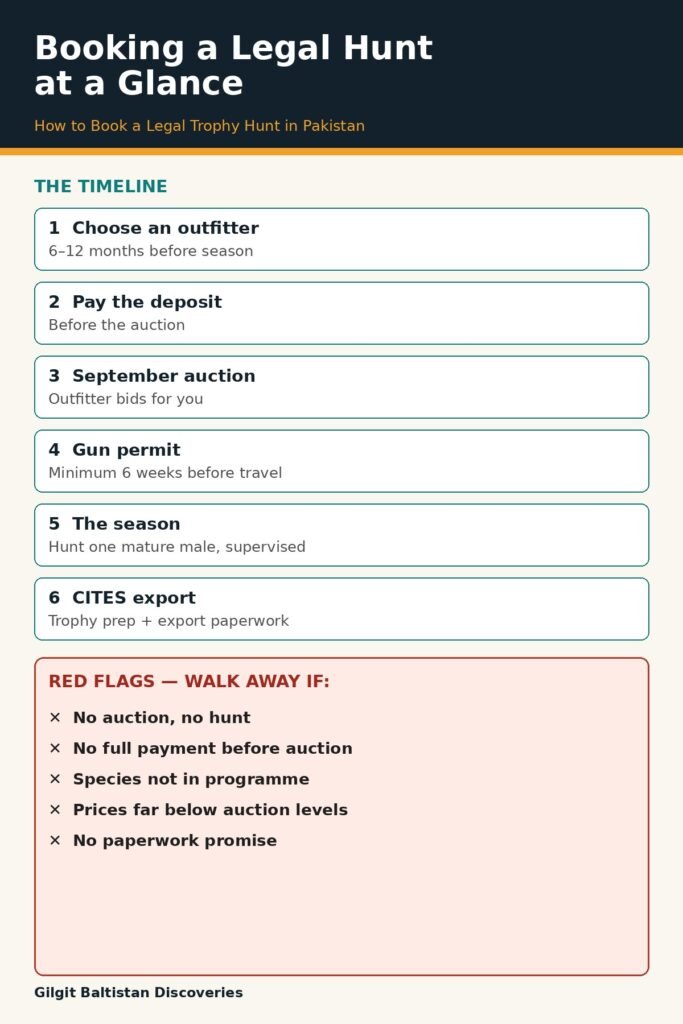
The Legal Route in One Timeline
| When | Step | What happens |
|---|---|---|
| 6–12 months before season | Choose an outfitter | Pick a licensed Pakistani outfitter; agree species, area preference and a maximum bid |
| Before the auction | Deposit | Pay an earnest deposit (outfitter practice: 25–50% of the minimum permit fee, or a fixed escrow deposit) |
| September | Auction | The outfitter bids at the provincial wildlife department auction (GB: Forest Complex, Jutial) |
| 1–3 weeks after winning | Balance | Pay the remaining permit fee; unsuccessful bidders’ earnest money is refunded (typically 6–8 weeks) |
| At least 6 weeks before travel | Gun permit | Outfitter obtains your firearm import permit (bolt-action rifles only) |
| Before travel | Visa | 30-day single-entry tourist visa (most nationalities; apply via visa.nadra.gov.pk) |
| Season (GB 2026–27: 15 Oct – 10 Apr) | The hunt | Fly to Islamabad, transfer to the conservation area, hunt one mature male under supervision |
| After the hunt | Trophy prep + export | Outfitter prepares the trophy (clean skull, dried cape) and obtains export CITES permits; air cargo to your country |
Step 1: Choose a Licensed Outfitter (This Is the Whole Decision)
In Pakistan you do not bid at the auction yourself — licensed outfitters bid on your behalf. That makes the outfitter the single most important choice in the whole process, and the place where scams happen.
What a legitimate outfitter does, based on how the trade describes its own process:
- Takes your species and area preference plus a maximum bid in writing, and bids only up to that limit.
- Holds your deposit in escrow or as an earnest payment, and refunds it if the permit cannot be obtained at or below your maximum (terms vary by outfitter — get the refund rule in writing before paying anything).
- Handles gun import permits, hunting licences, guiding, trophy preparation and export paperwork as part of the package.
- Is licensed in the province where you will hunt — GB hunts go through the GB Wildlife Department; Chitral hunts through KP’s.
Outfitters whose names appear in Dawn’s GB auction coverage include Shikar Safaris and Markhor Safaris (and Zoon Safari, linked to the 2025–26 French hunter’s Haramosh hunt). Those names are press-reported auction participants, not endorsements: check any outfitter’s current licence, recent clients and refund terms yourself before sending money. A genuine outfitter will never ask you to pay a full markhor fee before an auction has happened.
Step 2: The Auction — What Your Money Actually Buys
Permits are awarded to the highest bidder at an open auction advertised in national print media shortly before the date. For GB, the auction is held at the Forest Complex in Jutial, Gilgit. Recent GB results show what “winning” costs:
- 2026–27: markhor base $200,000, winning bids $294,000–$356,000 for three new permits (a fourth exportable permit was carried forward from 2025–26); blue sheep base $25,000 (top $31,200); ibex base $11,000 (top $13,200).
- 2025–26: markhor base $200,000, winning bids $240,000–$370,000.
The permit fee is only part of the total cost. A full hunt package typically also includes the gun permit, guiding and support staff, ground transfers, meals and accommodation during the hunt, and trophy preparation — while international airfare, insurance, trophy shipping and destination charges are usually extra. Outfitter package prices for 2026–27 quoted in the trade press run to around $56,000 for an exportable blue sheep and around $13,900–$19,900 for Himalayan ibex, with markhor priced on inquiry because the auction decides it. Treat every price in this paragraph as indicative and time-limited: the auction, not any article, sets the real number.
Exportable vs non-exportable — decide before you bid. On an exportable permit you may take the trophy home under CITES rules. On a non-exportable permit the hunt happens but the horns remain with the wildlife department. Non-exportable hunts are cheaper, but if your goal is a trophy on your wall, bidding on the wrong permit type is an expensive mistake.
Step 3: Guns, Visas and Getting There
Firearm import. The outfitter obtains your weapon permit — trade sources say to allow a minimum of six weeks. Only bolt-action hunting rifles are allowed; semi-automatic actions and suppressors are not legal for import. Many hunters instead rent a rifle from the outfitter, which removes this step entirely; ask about rental before shipping your own rifle.
Visa. Foreign visitors of most countries need a 30-day single-entry tourist visa for Pakistan, applied for online. Your outfitter will advise on the current process, but the visa is your responsibility — apply early, because a delayed visa can kill a season-dated hunt.
Arrival and transfer. Hunts start at Islamabad International Airport, where the outfitter meets you, clears firearms with customs, and transfers you onward — by road or chartered mountain flight to Gilgit, then to the designated community conservation area. Expect a multi-day journey to the hunting ground itself; a typical Pakistan mountain hunt runs about 10 days door to door, with roughly half as hunting days.
Step 4: The Hunt Itself — Rules on the Ground
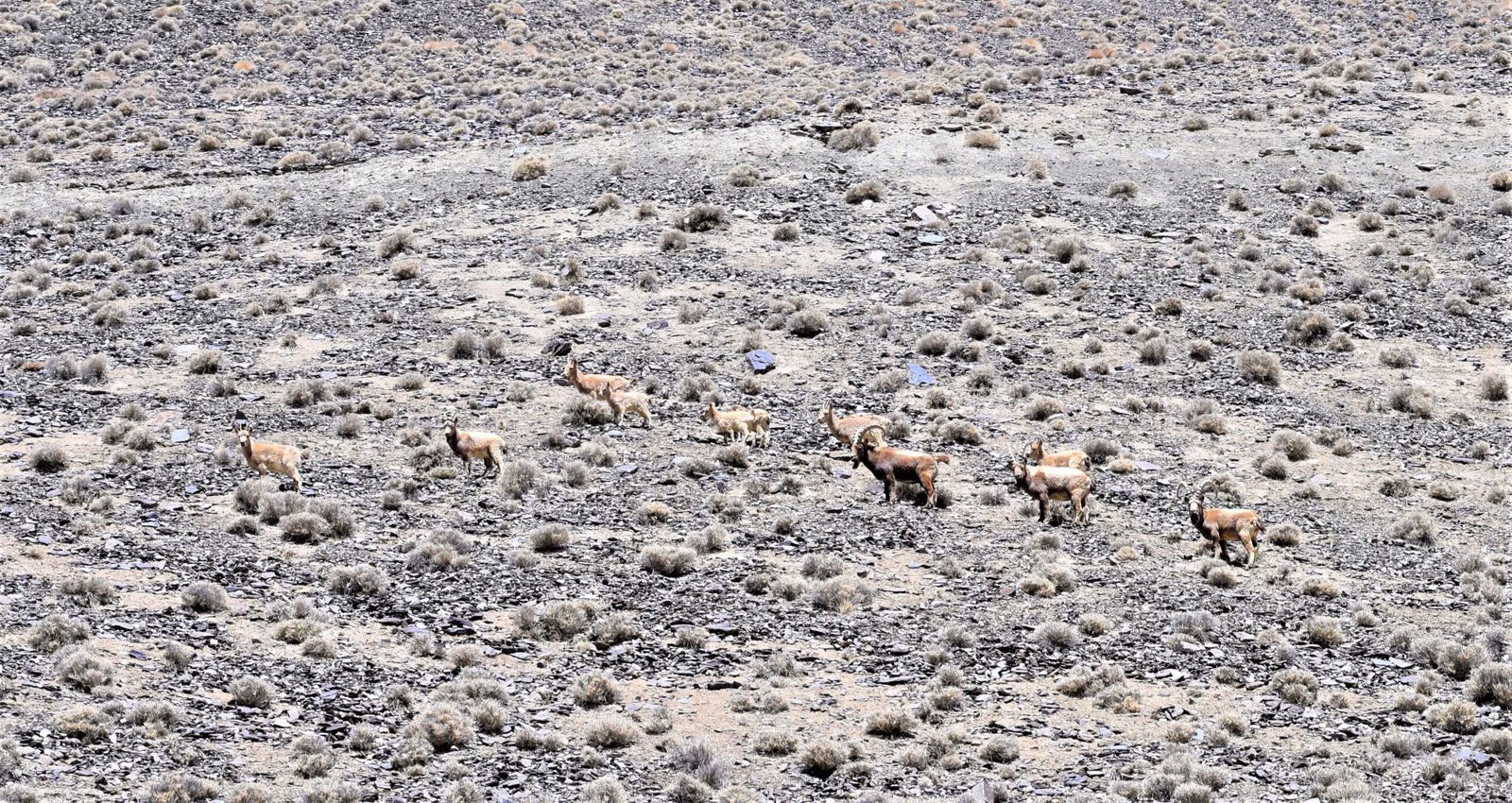
- One permit, one mature male. You hunt a single mature, old male of the permitted species, in the permitted conservation area, in season.
- One shot, specified gun. Dawn’s hunt reporting notes a single-shot rule with a specified gun for trophy hunting.
- Supervised. Government observers and community game scouts accompany and monitor the hunt. Your guides are local community members — they know the ground, the animals and the rules, and their judgement on which animal qualifies is part of the system.
- Physical demand. This is high mountain hunting at 3,000–5,500 m, on foot, in winter. Ibex country is the most accessible of the three; markhor ground is steep cliff terrain; blue sheep ground is the highest and most remote. Be honest with your outfitter about fitness — it decides which species and area are realistic for you.
- If you do not get the animal. Permits are for a season window, not a guaranteed kill. Ask your outfitter in advance what happens if the hunt is unsuccessful — re-hunt terms, refunds and timelines vary and must be in writing.
Step 5: Taking the Trophy Home — CITES and Shipping
After the hunt, the outfitter prepares the trophy — clean skulls and dried capes — and obtains export CITES permits. This matters most for markhor, which is CITES Appendix I: international movement of its trophies is strictly controlled and needs both export and import paperwork. Blue sheep and ibex trophies also move under the outfitter’s export documentation, and some outfitters can arrange for properly prepared trophies to travel as checked luggage rather than months of air cargo — ask which applies to your species and destination.
Trade sources quote trophy export (expediting, papers including export CITES, and shipping to the US) at around $1,500 per trophy, varying by species, destination and crate size; courier and destination charges may be extra. Your home country’s import rules are separate from Pakistan’s export rules — US hunters deal with Fish & Wildlife requirements, EU hunters with TRACES procedures — and your outfitter and taxidermist should confirm both sides before the trophy ships. Never let a trophy ship without its paperwork: an undocumented Appendix I trophy can be seized, and that is the end of it.
Scams and Red Flags — How to Tell a Legal Hunt from a Trap
- No auction, no hunt. If someone offers you a markhor, blue sheep or ibex hunt without mentioning the provincial auction, the permit or the conservation area, walk away.
- Full payment before the auction. Legitimate practice is a deposit/earnest payment with a written refund rule if the bid fails — not the full fee up front.
- Species not in the programme. Snow leopard, bear, Marco Polo sheep, urial outside its programme areas — anyone offering these in GB is offering an illegal hunt. The GB programme covers markhor, blue sheep and ibex only.
- Prices far below auction levels. A “markhor hunt” offered for a few thousand dollars is not a GB trophy permit; it is either a different (possibly illegal) arrangement or a fraud.
- No paperwork promise. A legitimate outfitter talks about CITES, gun permits and export documents before you pay. If paperwork is never mentioned, neither is legality.
- Illegal hunting is prosecuted. Three men were arrested in Balochistan in 2025 for illegal markhor hunting, with the animal recovered. The programme exists precisely so that hunting happens only through it.
Gear Worth Packing for a Mountain Hunt
Disclosure: as an Amazon Associate, we earn from qualifying purchases made through links on this page, at no extra cost to you.
Beyond the permit and the rifle, three items earn their weight on every Pakistan mountain hunt: KEEN Targhee 3 hiking boots for steep, rocky ground, a Sawyer Squeeze water filter for stream water on multi-day hunts, and an Anker PowerCore portable charger for GPS and communications. For judging trophy size at distance, also look at hunting rangefinders — your outfitter can advise which suits the species you are hunting.
Frequently asked questions
Can I bid at the GB auction myself?
No — permits are bid for by licensed outfitters on hunters’ behalf. You set the maximum bid and deposit; the outfitter bids.
How far ahead should I book?
6–12 months before the season. The auction is in September, gun permits need at least six weeks, and the season runs October to April — a booking made in-season is really a booking for next year’s auction.
What does a markhor hunt cost in total?
The permit alone starts at a $200,000 base and has reached $370,000 at auction; the full package (guiding, transfers, accommodation, trophy prep) is on top, and export shipping is extra. Get an itemised quote from your outfitter, not a single headline number.
Can I bring my own rifle?
Yes, bolt-action only, with a permit obtained by your outfitter at least six weeks ahead. Semi-automatic rifles and suppressors cannot be imported for hunting. Renting locally is simpler.
What if my bid loses at auction?
With a reputable outfitter, your deposit is refunded (terms and timing vary — get them in writing) and you can try again the next year.
Can I take the trophy home?
Only on an exportable permit, with export CITES paperwork from the outfitter and import paperwork for your own country. On a non-exportable permit, the horns stay with the wildlife department.