Last updated: 4 November 2026
Short Answer
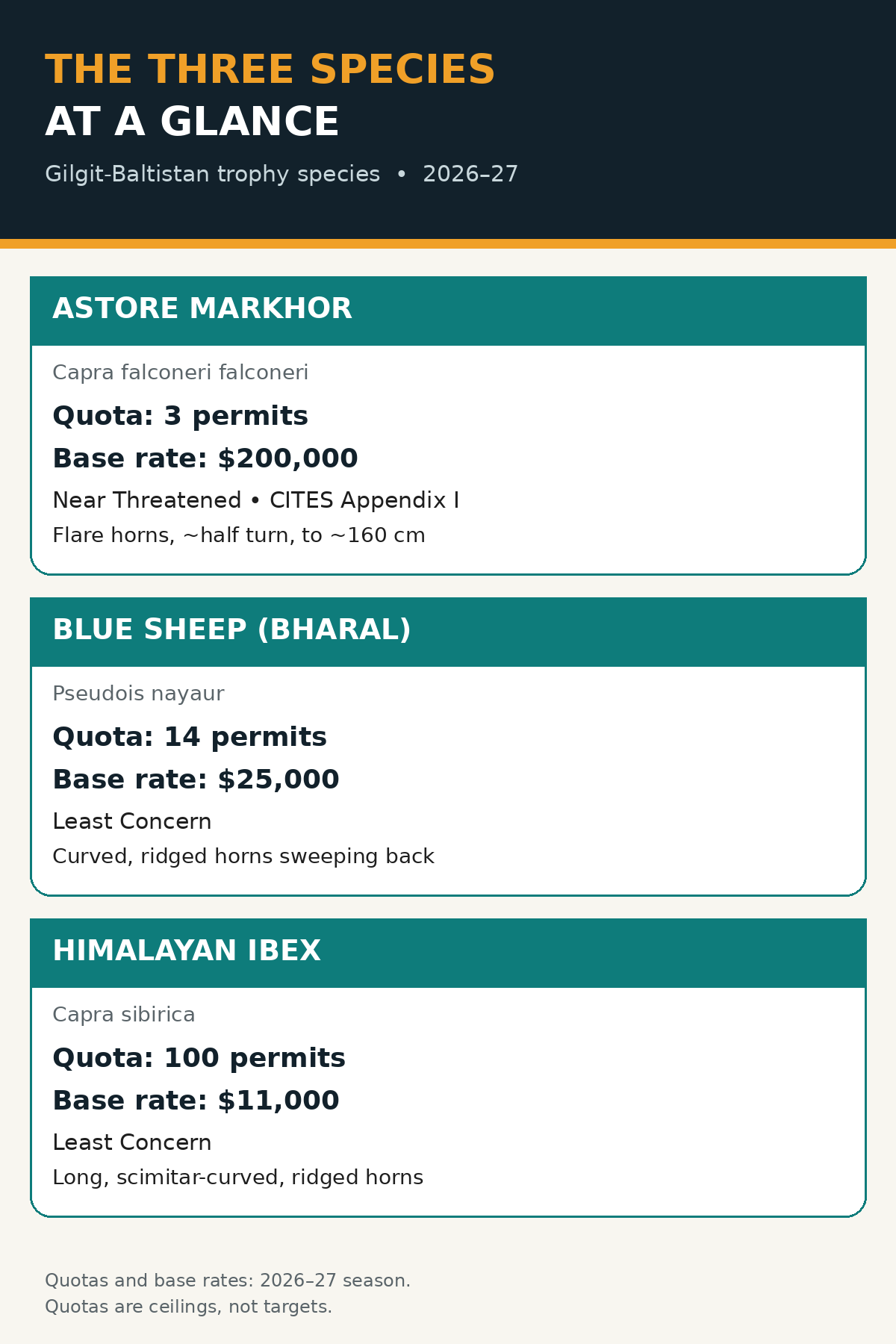
Only three species can legally be trophy-hunted in Gilgit-Baltistan, and they could hardly be more different: the Astore markhor — Pakistan’s national animal, a flare-horned wild goat whose permits now fetch up to $370,000 — the blue sheep (bharal), a high-alpine sheep of the Karakoram’s high valleys, and the Himalayan ibex, the region’s most widespread wild goat and the snow leopard’s main prey. Markhor is the rarest and most strictly limited (just 3 permits for 2026–27); ibex is the most numerous (100 permits). All three are hunted only as mature males, only in season, and only inside community conservation areas.
The Three Species at a Glance
| Astore markhor | Blue sheep (bharal) | Himalayan ibex | |
|---|---|---|---|
| Scientific name | Capra falconeri falconeri | Pseudois nayaur | Capra sibirica |
| What it is | Flare-horned wild goat | High-mountain wild sheep | Wild goat, the classic ibex |
| GB range | Steep rocky slopes: Haramosh, Jutial, Danyore, Astore, Nagar valleys | High alpine valleys of the Karakoram and Himalaya | All major valleys — Hushey, Braldo, Basha, Hoper, Hisper, Astore |
| Elevation | 600–3,600 m | High alpine slopes (above the tree line) | About 3,500–5,500 m |
| Horns | Males to ~160 cm along the spiral; Astore horns flare widely with only about a half turn | Curved, ridged horns sweeping back and out | Long, scimitar-curved, heavily ridged horns |
| IUCN status | Near Threatened (downlisted from Endangered in 2015); CITES Appendix I | Least Concern | Least Concern |
| 2026–27 quota | 3 new permits (plus 1 exportable permit carried forward from 2025–26) | 14 | 100 |
| 2026–27 base rate | $200,000 | $25,000 | $11,000 |
| Record GB permit | $370,000 (auction, 2025) | $40,000 (auction, 2025) | $13,200 (auction, 2026) |
1. Astore Markhor — The Headline Animal
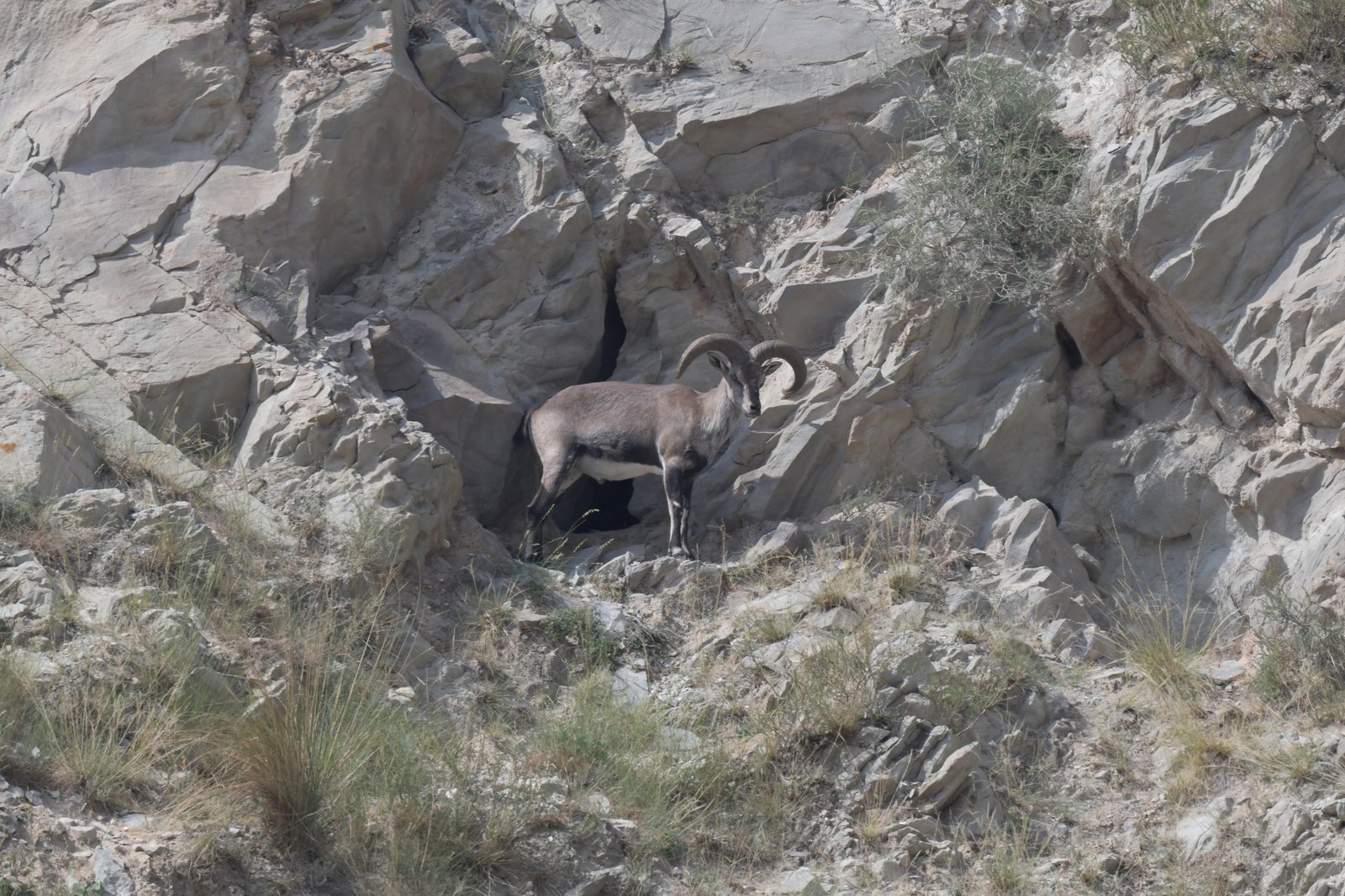
What it looks like. The markhor (Capra falconeri) is a large wild goat — adults stand 65 to 115 cm at the shoulder, the tallest of any wild goat, and weigh 32 to 110 kg. Its signature is the horns: tightly curled, corkscrew-like, closing together at the head and spreading upward toward the tips, with males reaching about 160 cm measured along the spiral. The Astore subspecies (C. f. falconeri) is the flare-horned form: large, flat horns that branch widely and then rise almost straight with only about half a turn. The coat is grizzled light brown to black, short and smooth in summer, longer and thicker in winter.
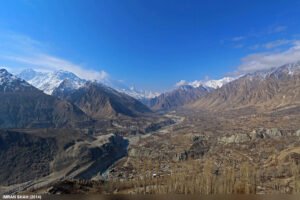
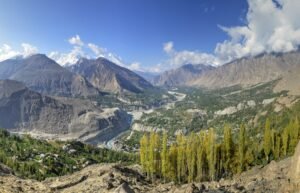
Where it lives in GB. Along the Indus and its tributaries: Haramosh, Jutial and Danyore around Gilgit, the Astore valleys, and Nagar — steep cliffs, rocky outcrops and broken slopes with oak, pine and juniper scrub, from 600 to 3,600 m. In GB the classic hunting conservancies read like a map of these valleys: Bunji, Jutial, Sassi-Harmosh, Haramosh, Dashkin, Doyan, Nanga Parbat.
Why it costs so much. Three reasons compound: rarity (the species was Endangered until 2015 and remains Near Threatened and CITES Appendix I, which strictly controls any international movement of trophies); tiny quota (three animals for all of GB in 2026–27); and the horns themselves — a 40–55-inch Astore trophy is among the most prized of all wild-goat trophies. The price ladder tells the story: $58,000 (2017–18) → $110,000 (2019) → $136,000 (2022) → $186,000 (2024) → $370,000 at auction (2025).
Conservation status, honestly stated. The markhor’s IUCN downlisting from Endangered to Near Threatened in 2015 reflected an estimated 20% population increase over the preceding decade, to roughly 5,800 animals (2013 estimate, projected stable). That recovery is real but fragile — and it is exactly why the quota stays at three. A species can be recovering and still be one bad decade from trouble.
2. Blue Sheep (Bharal) — The High-Valley Prize
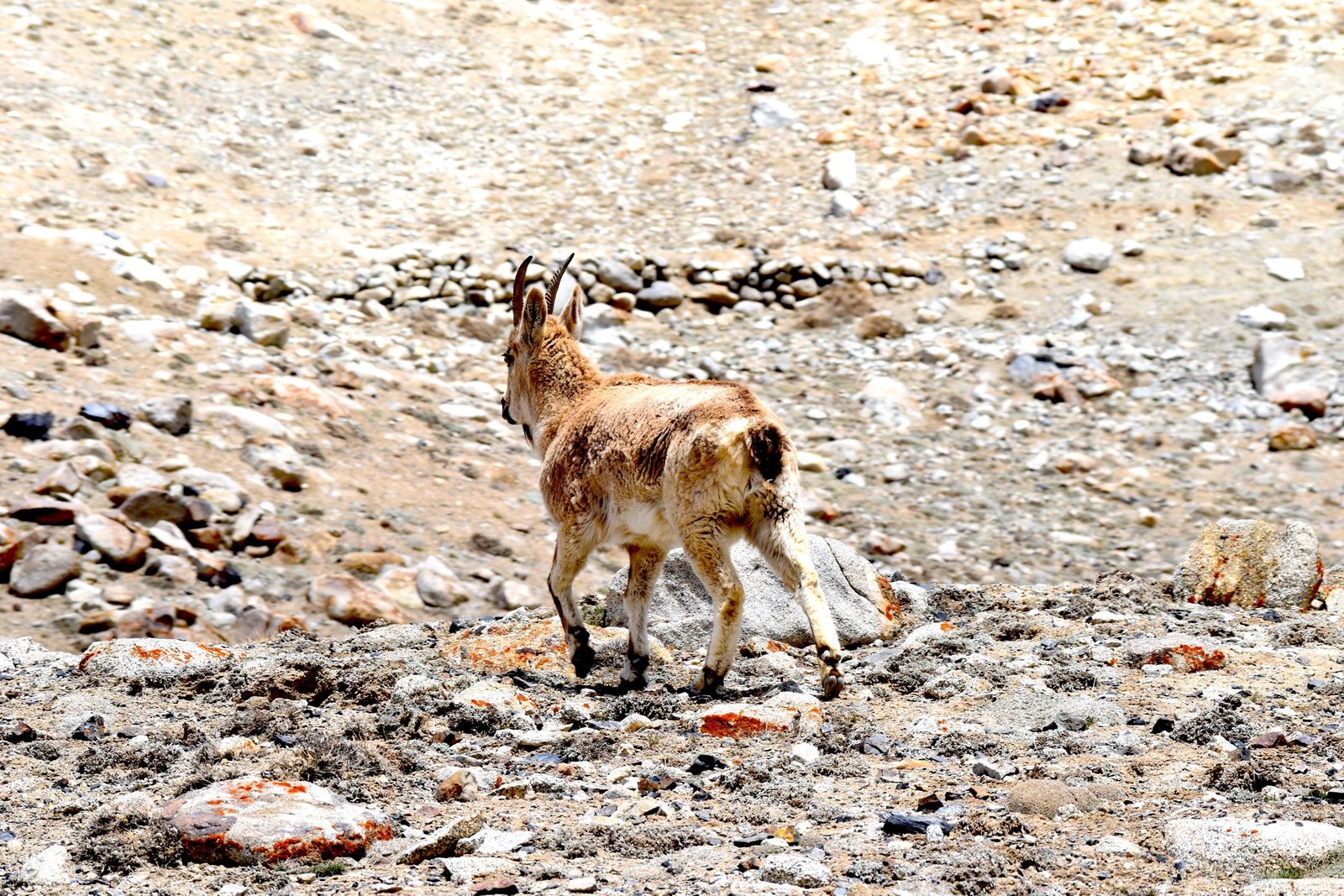
What it looks like. The blue sheep (Pseudois nayaur), also called bharal, is neither quite sheep nor goat in appearance — a stocky, slate-grey-blue animal with curved, ridged horns, built for the highest, barest slopes. Mountain hunters rate it among the world’s pinnacle sheep species, and it is available as a hunted species in only two countries: Pakistan and Nepal.
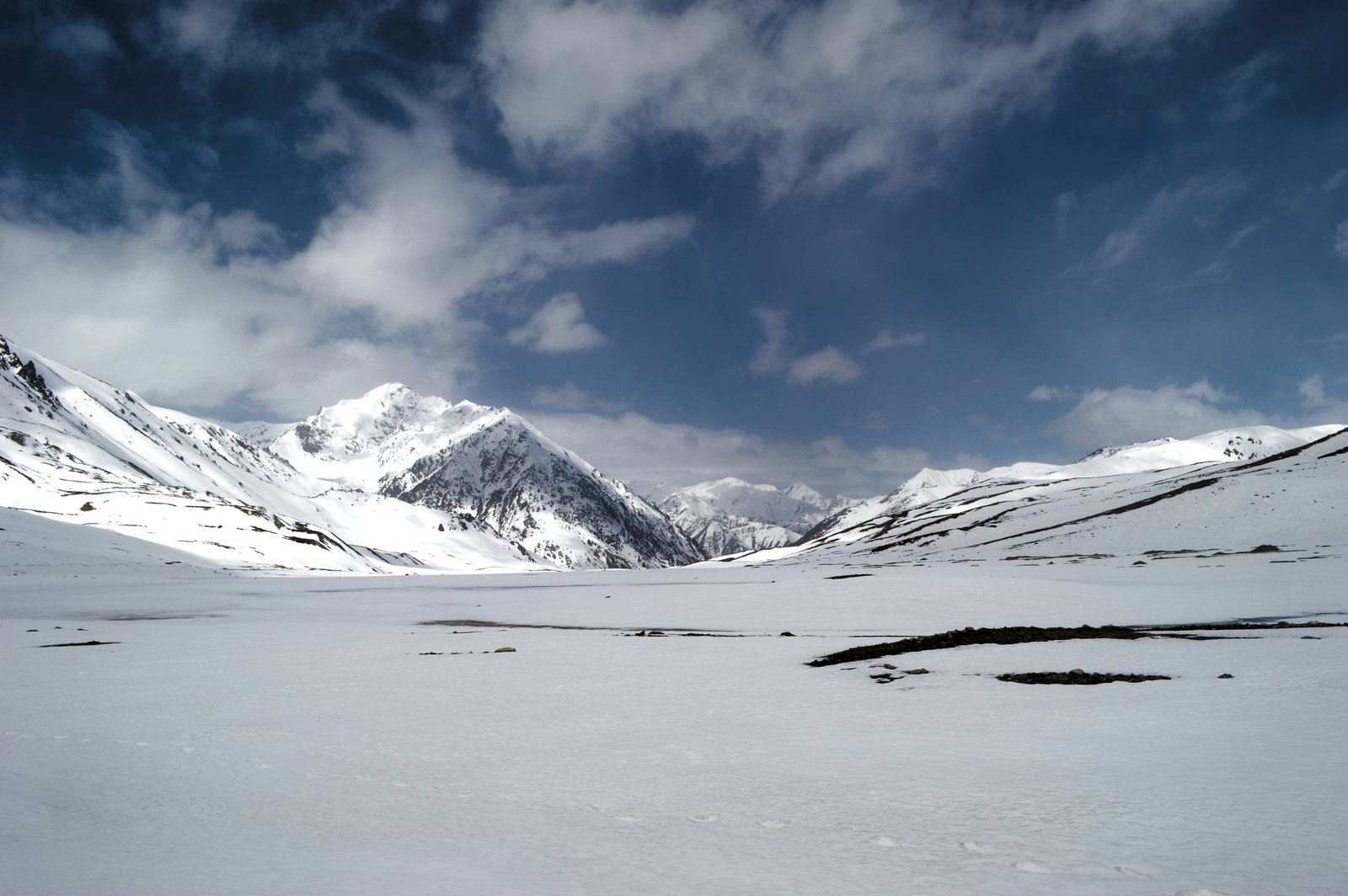
Where it lives in GB. The high alpine valleys of the Karakoram and Himalaya, above the tree line, in the kind of country where the air is thin and the slopes are scree. GB’s blue sheep habitat is a small fraction of the region’s suitable ground, which is part of why the quota is small — 14 permits for 2026–27, with a base rate of $25,000 and a 2025 auction top of $40,000.
Why it matters beyond hunting. Blue sheep are a key prey species in the high Himalaya, sharing their ground with snow leopards. Protecting blue sheep country — which the community conservation areas do, because the sheep are worth money alive as well as hunted — protects the whole high food chain. Unlike the markhor, the blue sheep is listed as Least Concern globally; its GB quota is about local scarcity and habitat, not global endangerment.
3. Himalayan Ibex — The Widespread One
What it looks like. The Himalayan (Siberian) ibex (Capra sibirica) is the classic ibex shape: a sturdy wild goat with long, backward-sweeping, heavily ridged, scimitar-curved horns. It is longer and heavier than the markhor, and the most familiar wild goat silhouette in GB’s mountains.
Where it lives in GB. Almost everywhere high: Hushey, Braldo, Basha, Hoper, Hisper and Astore valleys, at roughly 3,500–5,500 m, across a large share of GB’s area. It is the snow leopard’s most important prey species in the region — which is why ibex numbers are a rough proxy for the health of the whole high-mountain ecosystem.
Why the quota is 100. Because the population can carry it. Ibex are the most numerous of the three trophy species in GB, and the 100-permit quota (base rate $11,000 for 2026–27, auction top $13,200 in 2026) reflects that abundance. Even so, only a fraction of the quota is exportable in some seasons, and the same rules apply: mature males only, in season, inside a community conservation area, under supervision. In 2023–24, 51 ibex were actually hunted out of an 88-permit quota — quotas are ceilings, not targets.
How the Three Compare for a Hunter — and for Conservation
| Question | Markhor | Blue sheep | Ibex |
|---|---|---|---|
| How hard is the permit to get? | Hardest — 3 per season, auction bidding | Hard — 14 per season | Easiest of the three — 100 per season |
| What does it cost? | $200,000 base; up to $370,000 at auction | $25,000 base; up to $40,000 at auction | $11,000 base; up to $13,200 at auction |
| Can the trophy be exported? | Yes, on an exportable permit (CITES Appendix I paperwork) | Yes, on an exportable permit | Yes, on an exportable permit |
| What limits the hunt? | Tiny quota + CITES Appendix I | Small quota + extreme altitude | Quota is a ceiling; fewer hunted than permitted |
| Conservation role | Flagship: recovery story, community income | High-alpine ecosystem indicator | Snow leopard’s main prey; ecosystem proxy |
The Animals You Will Not Hunt in GB
GB’s mountains hold far more than these three species — snow leopard (Vulnerable), lynx, brown and black bears, wolf, Marco Polo sheep (now restricted in Pakistan to one small watershed near Khunjerab), Ladakh urial, musk deer and more. None of them are trophy-hunted under the GB programme. The programme covers markhor, blue sheep and ibex only. Anyone offering a snow leopard, bear or Marco Polo sheep hunt in GB is offering something illegal, and this guide’s booking companion explains how to check a permit’s legitimacy before paying anything.
Gear for Watching These Animals in the Wild
Disclosure: as an Amazon Associate, we earn from qualifying purchases made through links on this page, at no extra cost to you.
The same valleys that host trophy hunts also host wildlife watching, and the right gear matters at altitude: binoculars for wildlife viewing for spotting markhor on cliff faces, KEEN Targhee 3 hiking boots for rocky trails, and an Anker PowerCore portable charger for cameras and phones in the cold.
Frequently asked questions
What is the difference between Astore markhor and other markhor?
Horn shape and range. The Astore markhor (Capra falconeri falconeri) has large, flat horns that flare widely and rise almost straight with only about a half turn, and lives in northern Pakistan’s Indus valleys and around Chitral. The Kabul markhor’s horns twist in a tighter corkscrew.
Is the markhor endangered?
Not currently: it was downlisted from Endangered to Near Threatened by the IUCN in 2015 after population growth, but it remains on CITES Appendix I, which strictly controls international trade in its trophies. The GB quota of three reflects that caution.
Why are ibex permits so much cheaper than markhor?
Abundance. Ibex are widespread across GB’s high valleys and number far more than markhor, so the quota is 100 against 3 — and the market prices scarcity.
Do hunters shoot females or young animals?
No. Permits are for mature, old males only. That rule is central to the programme’s conservation claim: removing old males past their breeding prime affects the population far less than removing females or young animals.
Where is the best place to see these animals without hunting?
The same community conservation areas and national parks that host hunts also host wildlife viewing — Khunjerab National Park, Central Karakoram National Park and the Deosai plains for ibex and blue sheep country, and the Haramosh–Jutial valleys for markhor. Viewing needs local guides and the same respect for community rules as hunting does.