Short Answer
Content creation is how a tour guide wins foreign clients without paying for every enquiry. A traveller who has never met you will not send money to a stranger, but they will book the guide they have watched on video, whose face they know, whose trips they have seen, and whose answers already helped them. Post real trip footage, show your face, answer real questions, and do it every week. That is the whole job.
Why does content matter so much for a tour guide?
A tour guide sells trust before they sell a trip. Nobody can touch or test a trek before buying it. The buyer sits in another country, looks at a screen, and must decide whether to send money to a person they have never met, for a trip in mountains they have never seen.
Content is the only thing that closes that gap before the first message. A short video of you on the trail, a photo of a real group at a real viewpoint, an honest answer about altitude or road conditions, all of these do the selling while you are out guiding the next group.
This matters more in Gilgit-Baltistan than in most places. Our valleys are far away, the trips are expensive, and the buyer has real worries: is it safe, is the guide real, will the jeep actually come, what happens if the weather turns. No price list answers those questions. Your face, your voice and your past trips do.
TicketingHub, writing for tour operators, calls turning guides into content creators one of the lowest cost, highest return marketing strategies a tour operator can use, and notes that you do not need a fancy camera crew or a brand consultant to start. That matches what we see here: the guide is already on location, already talking to guests, already holding the product in their hands.
Why does content beat ads alone for winning foreign clients?
Ads rent attention. Content owns it. An ad stops the moment you stop paying. A good video keeps being found, saved and shared for months, and it keeps answering the same questions for every new traveller.
Travel buying takes time. Rework, a travel marketing resource, reports that buying cycles in travel span 3 to 12 months and that customers read 20 or more articles before inquiring. Your one ad might reach a traveller once. Your fifty posts reach them repeatedly through that whole journey, and each one makes you the familiar name when they finally decide.
Content also wins the trust test that ads cannot pass. A foreign traveller choosing between two guides will pick the one they have seen. TicketingHub puts it plainly: people buy from people, not logos. Seeing the actual guide who might lead their tour builds trust before the booking ever happens.
That does not mean ads are useless. Ads work best when they push content that already proves you are real. A Reel of a real group crossing Hussaini Bridge will beat a polished graphic with a price on it, every time. Make the content first, then put ad money behind the posts that already get saves, shares and messages.
What kind of content actually brings foreign clients?
Not all posts are equal. The posts that bring bookings show the trip as a guest will experience it, and they answer a question the traveller is already asking. Here is what works, in order of value.
| Content type | What it does | Example from a GB trip |
|---|---|---|
| Guide to camera tip | Proves you know the place and builds trust | “Do this first at Khunjerab Pass, 4,693 metres” |
| Real group moment | Shows the trip is real and fun | Guests laughing at the Passu Cones viewpoint |
| Before and after | Shows change and builds emotion | A nervous first timer, then the same guest at the lake |
| Honest conditions | Kills the fear that stops bookings | “The road to Fairy Meadows is rough, here is what it looks like” |
| Guest reaction | The strongest proof you can post | A 20 second clip, “what surprised you most” |
| Packing and prep | Answers the most asked questions | What to pack for the K2 Base Camp trek |
| Behind the scenes | Humanises the business | Loading jeeps at dawn, checking permits |
| Local story or legend | Gives a reason to choose you, not any guide | The story of Baltit Fort, told at the fort |
Notice what is missing from the list: price-only posts, stock photos of mountains with no people, and generic “book now” graphics. Those get scrolled past. Foreign clients want proof, not posters.
One more rule from the research: get permission before posting a guest. TicketingHub says the same. A short casual clip asking someone how the tour went can be powerful, but only with their yes. Most guests say yes when they had a good time, and a guest who says yes often shares the post with friends.
How do I turn one trip into a week of content?
One guided trip is not one post. It is raw material for a whole week. The trick is to capture more than you think you need while you are already out there, then cut it into pieces at home.
Alpn.ai, writing for tour operators, advises shooting 15 to 20 short video clips instead of 5 to 10, taking photos at every stage of the trip and not just the highlights, and writing down three to five things guests say or ask. Those real quotes become captions, hooks and video ideas.
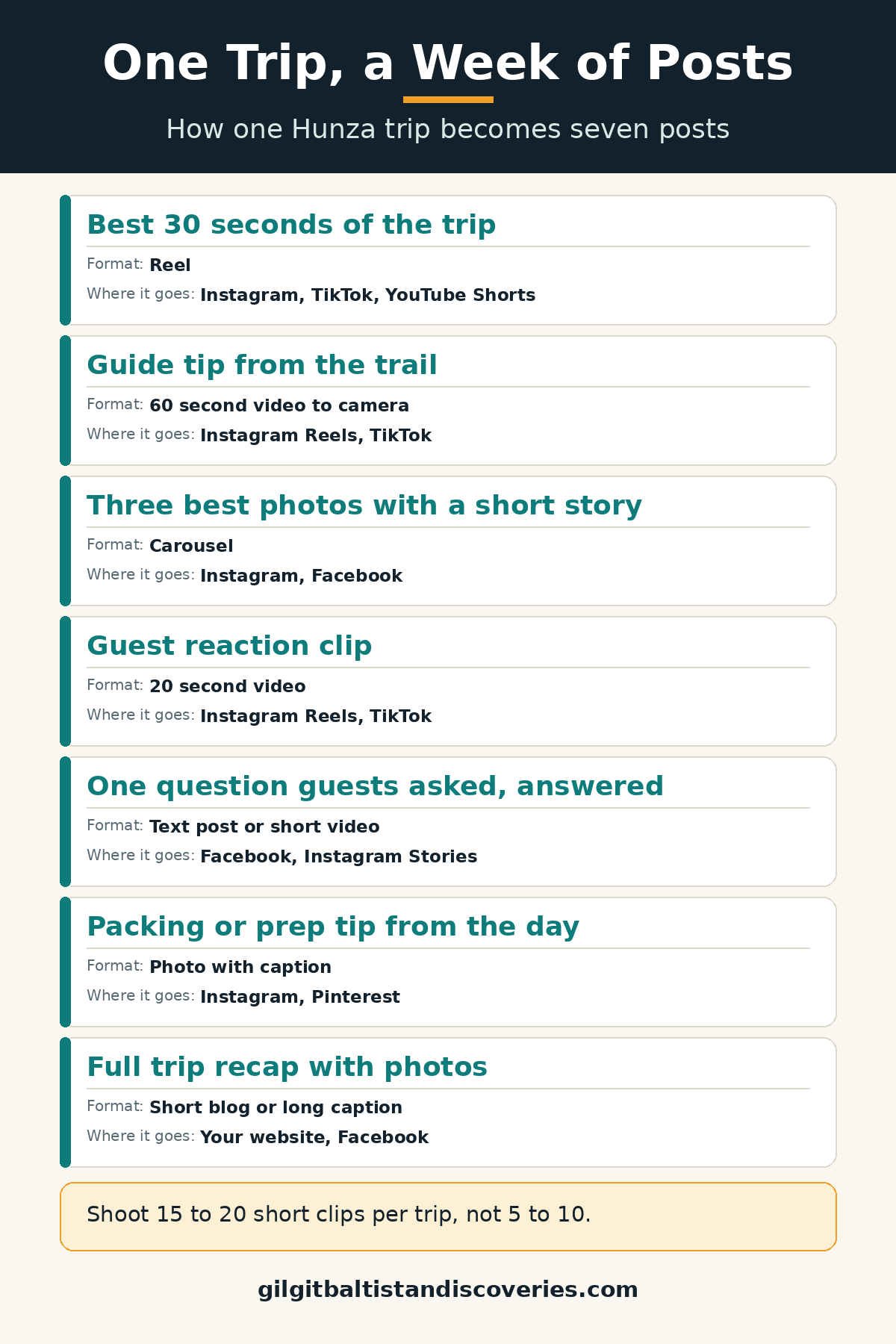
Here is how one Hunza trip becomes a week of posts.
| Piece | Format | Where it goes |
|---|---|---|
| Best 30 seconds of the trip | Reel | Instagram, TikTok, YouTube Shorts |
| Guide tip from the trail | 60 second video to camera | Instagram Reels, TikTok |
| Three best photos with a short story | Carousel | Instagram, Facebook |
| Guest reaction clip | 20 second video | Instagram Reels, TikTok |
| One question guests asked, answered | Text post or short video | Facebook, Instagram Stories |
| Packing or prep tip from the day | Photo with caption | Instagram, Pinterest |
| Full trip recap with photos | Short blog or long caption | Your website, Facebook |
Film horizontally and vertically where you can. Both orientations have a home. A vertical clip goes to Reels and Shorts, a horizontal clip goes to YouTube, and the same photos can become a Pinterest pin that keeps bringing visitors for months.
How often should a tour guide post?
Consistency beats volume. Zoro Social, writing for travel agencies, says most tour operators can keep a strong presence with four or five posts a week, led by short video. TicketingHub says the same in simpler words: it is better to be consistent with a small amount than to post a bunch and then go silent.
A realistic weekly plan for a working guide looks like this.
| Day | Post | Time needed |
|---|---|---|
| Monday | One Reel from the last trip | 30 minutes to edit and post |
| Tuesday | One photo with a useful caption | 10 minutes |
| Wednesday | Answer one guest question on video | 15 minutes to film and post |
| Thursday | Guest photo or reaction, with permission | 10 minutes |
| Friday | Trip availability or a seasonal tip | 15 minutes |
| Saturday and Sunday | Film on the trip, reply to comments and DMs | While guiding |
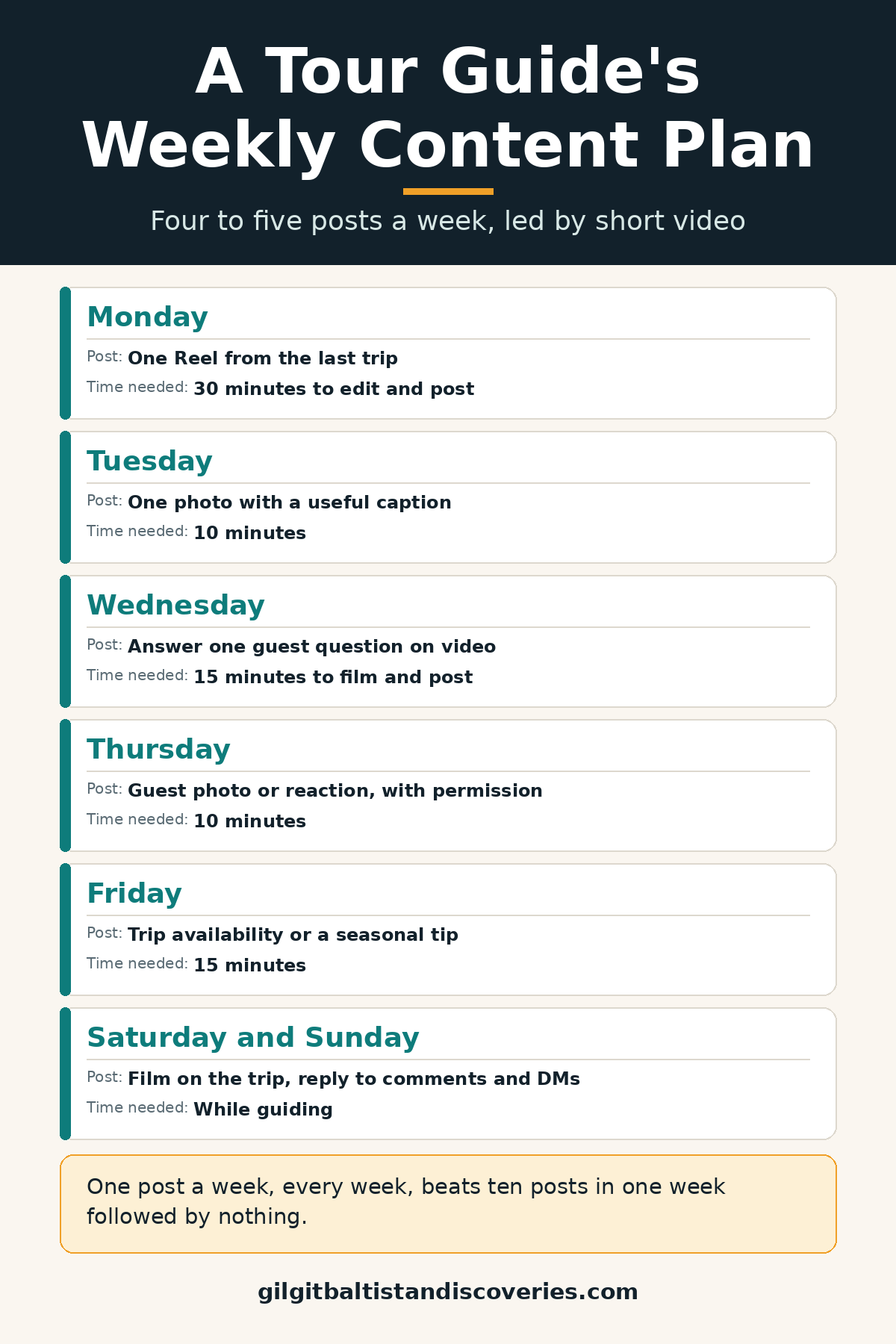
Two rules hold the plan together. First, film during trips you already run, and edit in one evening a week. Second, never let a busy week become a silent month. One post a week, every week, beats ten posts in one week followed by nothing.
Rework warns that SEO takes 12 to 18 months to compound, and that operators who commit to systematic content build a lasting advantage while those who dabble never see results. The same is true on social media. The guide who posts every week for a season starts getting messages that mention a specific video. The guide who posts once and stops gets nothing.
Do I need to show my face and speak on camera?
Yes, and this is the part most guides resist. Your face is the product. A foreign client is not buying a mountain. They are buying you, the person who will keep them safe on a glacier, find the jeep when the road closes, and know which guesthouse has hot water.
TicketingHub is direct on this: platforms like Instagram, TikTok and YouTube reward human driven content, and a smiling guide holding a camera is more likely to grab attention than a polished brand ad. A 30 second piece to camera from the person who will actually lead the trip does more for conversion than any drone shot, according to Socialk.it, writing on social media for travel agencies.
If being on camera feels hard, start small. Film your hands packing a bag. Record your voice over a view. Film the group from behind as they walk. Then try one short clip where you answer one question, in your own words, in one take. Nobody expects a presenter. They expect a real guide.
Speak simply. Short sentences. Subtitles on the video help travellers who do not speak English well. Post in English first, because your foreign clients search and book in English, and add your own language when it adds colour, such as a local greeting or a place name with its meaning.
How do I use reviews and testimonials the right way?
A review in your own words is a claim. A review in a guest’s words is proof. That is why testimonials work, and why they must be handled honestly.
Ask for the review on the trip, while the feeling is fresh. The best moment is at the end of a good day, when the group is relaxed. Ask one question, not five: “what surprised you most” or “what would you tell a friend back home”. Film the answer if they agree, or write down their exact words.
Then use the review with context. A quote means little on its own. A quote with the trip name, the month, and a photo of the place means a lot. “The K2 Base Camp trek was hard, but our guide knew every camp,” next to a photo of the group at Concordia, is worth more than a hundred likes.
Never invent a review, never pay for one, and never post a photo of a guest who did not say yes. One honest review from a real traveller in Germany or Japan does more for your next booking than ten generic five star graphics.
How do I reuse one trip across Instagram, TikTok, YouTube and Facebook?
Each platform has a different job. Posting the same clip everywhere is fine, but shaping it for each place works better.
Instagram Reels and TikTok are where strangers discover you. Short, vertical, open with the best moment, not a landscape shot. Hummingweb, writing on travel Reels, advises opening with an experience hook and filming the full day, from arrival to farewell. Add the trip name, the duration and a clear next step in the caption.
YouTube and YouTube Shorts are where people search before they decide. A ten minute walkthrough of a trekking route, filmed once, will answer the same questions for years. Shorts work like Reels for discovery, and a longer video builds the trust that closes the booking.
Facebook is where families and older travellers share and discuss. A photo album from a trip, a clear itinerary post, and a simple booking reminder work well there, and groups share them with friends.
Pinterest is a search engine, not a feed. People plan trips there deliberately and save to boards. A tall image with a clear title, such as a packing list or a 7 day itinerary, can keep bringing visitors to your site long after it leaves any feed.
One trip, cut four ways, is four chances to be found. That is the whole point of repurposing.
What mistakes stop content from bringing bookings?
Most guides do not fail because their content is bad. They fail because they stop, or because they post the wrong thing.
The common mistakes, and the fix for each:
- Only posting prices. A price with no proof is a number. Show the trip first, then the price, with what is included.
- Stock photos and empty landscapes. A mountain photo anyone could download proves nothing about you. Post your own trips, your own group, your own guide.
- No face, no voice. If nobody ever sees you, nobody trusts you. Show yourself, even briefly.
- Posting once, then disappearing. One post is not a strategy. The algorithm and the audience both forget you in a week.
- Copying other guides. A copied caption or a copied Reel makes you a worse version of someone else. Your own stories are the only thing nobody can copy.
- No next step. A beautiful video with no way to book is a missed enquiry. Every post needs one clear action: message us, check dates, or see the itinerary.
- Ignoring comments and DMs. A traveller who comments and gets no reply will book with the guide who answers. Reply fast, in the same language they wrote in.
Most of the mistakes on that list happen outside the ad dashboard, not inside it. Running ads is not just adjusting settings.
How do I know if my content is working?
Do not judge content by likes. Likes are the weakest signal. Judge it by what brings enquiries.
Watch these numbers every week: saves, shares, profile visits, DMs, and enquiries that mention a specific video or post. A Reel with 200 views and three DMs asking for dates is worth more than a Reel with 10,000 views and silence. Saves mean someone plans to come back. Shares mean someone told a friend. A DM that says “I saw your video about the Rush Lake trek” is a booking starting.
Video is worth the effort. Expedia Group Advertising found that 71 percent of travellers said video influenced their travel decisions, against 24 percent for static images, and that short form video swayed 49 percent of travellers. A 2025 Social Shepherd analysis, cited by Alpn.ai, found 87 percent of marketers report that video directly drives sales. Those are industry figures, not promises, but they point the same way: show the trip moving, not standing still.
Give it a season. Three months of steady posting is the minimum test. If saves, shares and DMs rise, keep going and double down on the format that works. If nothing moves after three months, change the format, not the goal: more of your face, more real moments, fewer graphics, and faster replies.
Last updated: 25 November 2026
Plan on two to three hours a week, not a full day. Film short clips during trips you already run, then spend one evening a week turning them into two or three Reels and a few photos with captions. Batch the editing, post on a fixed schedule, and skip a week rather than quitting when a trek runs long.
No. A phone made in the last few years is enough, and shaky real footage often beats polished video because it feels honest. Spend your money on a small tripod and a cheap microphone if you buy anything at all. Clean sound and steady hands matter more than camera price.
Expect three to six months before content turns into steady enquiries, and longer before it brings regular bookings. Travellers research for months, so your videos need time to be found, saved and shared. Guides who post once and stop see nothing. Guides who post every week for a season start getting DMs that mention a specific video.
Use old trips. A photo from last season, a tip you always give on the trail, a question guests always ask, or a short story about a place all make good posts. Answer one question a week on video and you will not run out of ideas. Your knowledge is the content, not only your current trips.
Post in English first, because your foreign clients search and book in English, and add your own language when it adds colour, such as a local greeting or a place name with its meaning. Keep captions simple and clear. Short sentences and subtitles on video help travellers who do not speak English well.
Yes, but only with permission. Ask guests on the trip if you can film them, and ask again before you post a close photo or a video where they speak. Most guests say yes when they had a good time. Never post a child without a parent saying yes in clear words.
Want help with your content?
Posting every week is hard when you are out on trips. Rakalogics is a marketing agency that runs Meta and Google ads and builds online stores for local businesses. If you want help turning your trips into bookings, visit rakalogics.com.