Short Answer
Facebook ads for tour operators work when one specific tour, with real dates and a real price, is shown to people in the countries your guests come from, and the click lands on a lead form or a WhatsApp chat, not your homepage. Facebook reaches the older travellers who book group tours, family trips and multi-week itineraries, while Instagram reaches younger travellers who discover trips visually. Run both from Meta Ads Manager, give Facebook the booking audience, and judge every ad on qualified enquiries with dates and a budget, never on likes.
A guide who only gets walk-ins: where this starts
Picture a guide in Karimabad. He has run treks for ten years. His bookings come from walk-ins at his shop, from hotel referrals, and from past guests telling friends. He has a Facebook page full of photos from his trips, but he has never run an ad, and his page reaches mostly people in Gilgit-Baltistan, not the travellers in the United States, the United Kingdom or Europe who would actually book a 14-day trek.
This guide is written for him, and for every operator in the same place. It starts from zero, explains every term in plain words, and walks in order from what an ad is, to why it works for foreign clients, to setup, targeting, budget and scaling. You do not need to know anything about ads to follow it. By the end, you will know how to run one campaign, read its results, and decide what to do next.
What is a Facebook ad, actually?
A Facebook ad is a post you pay to show to people you choose, instead of only to people who already follow your page. You pick the tour, the photo or video, the words, the countries, the age group and the daily budget, and Facebook shows it in those people’s feeds.
You build ads in Ads Manager. Ads Manager is the free dashboard from Meta, the company that owns Facebook and Instagram, where you build, run and measure ads. It is the only place to build a proper campaign. The Boost button inside the Facebook app is different: it promotes a post with almost no controls, and it brings likes, not bookings (Kirkoc). If you have only ever pressed Boost, you have never actually run an ad.
Meta owns both Facebook and Instagram, so one campaign in Ads Manager can show on both. That is why this guide talks about Meta, Facebook and Instagram together. Facebook is where the ad runs, Ads Manager is where you build it, and Meta is the company behind both.
Why does it work for foreign clients?
It works because the people who book a long trip are already on Facebook, and because Facebook lets you reach them at home, months before they travel.
A Tourism Economics study for Meta, from January 2024, found that 88 percent of visitors to travel websites are reached by Meta platforms, and 77 percent of the digital population in key outbound markets is reachable on Meta (Xingtu Online). The same study found Meta advertising supported 5.6 billion dollars of US tourism GDP and 3.7 billion dollars across the EU27.
The audience also fits. Facebook skews toward the 35 to 65 age group that books group tours, family trips and multi-week itineraries, not just the younger impulse traveller (Xingtu Online). These are the people with the money and the holiday time for a 14-day trek, and they plan months ahead, which gives your ads time to work.
It works differently from Google. Google catches people who are already searching for a tour. Facebook and Instagram put a tour in front of people who were not looking for it yet (Travelity). That is an advantage for a place like Gilgit-Baltistan, because most foreign travellers have never heard of it. The ad is how they find out it exists.
How are Facebook ads different from Instagram ads?
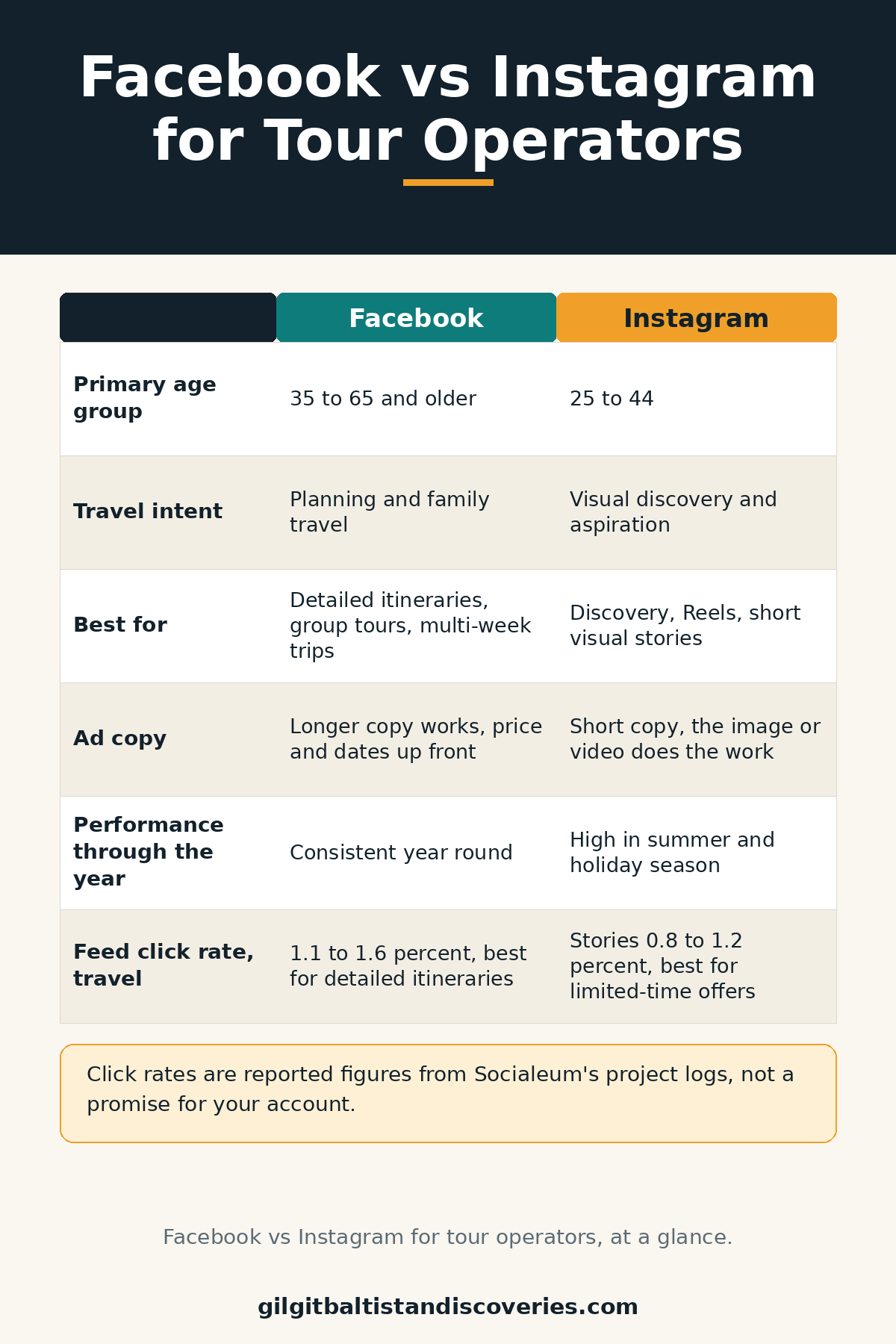
Both run from the same place, Meta Ads Manager, and the same campaign can show on both. The difference is who is looking and how they behave.
| Primary age group | 35 to 65 and older | 25 to 44 |
| Travel intent | Planning and family travel | Visual discovery and aspiration |
| Best for | Detailed itineraries, group tours, multi-week trips | Discovery, Reels, short visual stories |
| Ad copy | Longer copy works, price and dates up front | Short copy, the image or video does the work |
| Performance through the year | Consistent year round | High in summer and holiday season |
| Feed click rate, travel | 1.1 to 1.6 percent, best for detailed itineraries | Stories 0.8 to 1.2 percent, best for limited-time offers |
The click rates in this table are reported figures from Socialeum’s project logs, not a promise for your account. Use them to set expectations, not to judge a test in its first week.
The practical rule is simple. Give Facebook the audience that books: older travellers, families, group tours, multi-week itineraries, with dates and prices in the ad. Give Instagram the audience that discovers: younger travellers, Reels, short visual stories, the dream first and the details later. Run them as separate campaigns so you can see which one brings enquiries, because a like on Instagram and a deposit from Facebook are not the same result.
How is a Facebook campaign built?
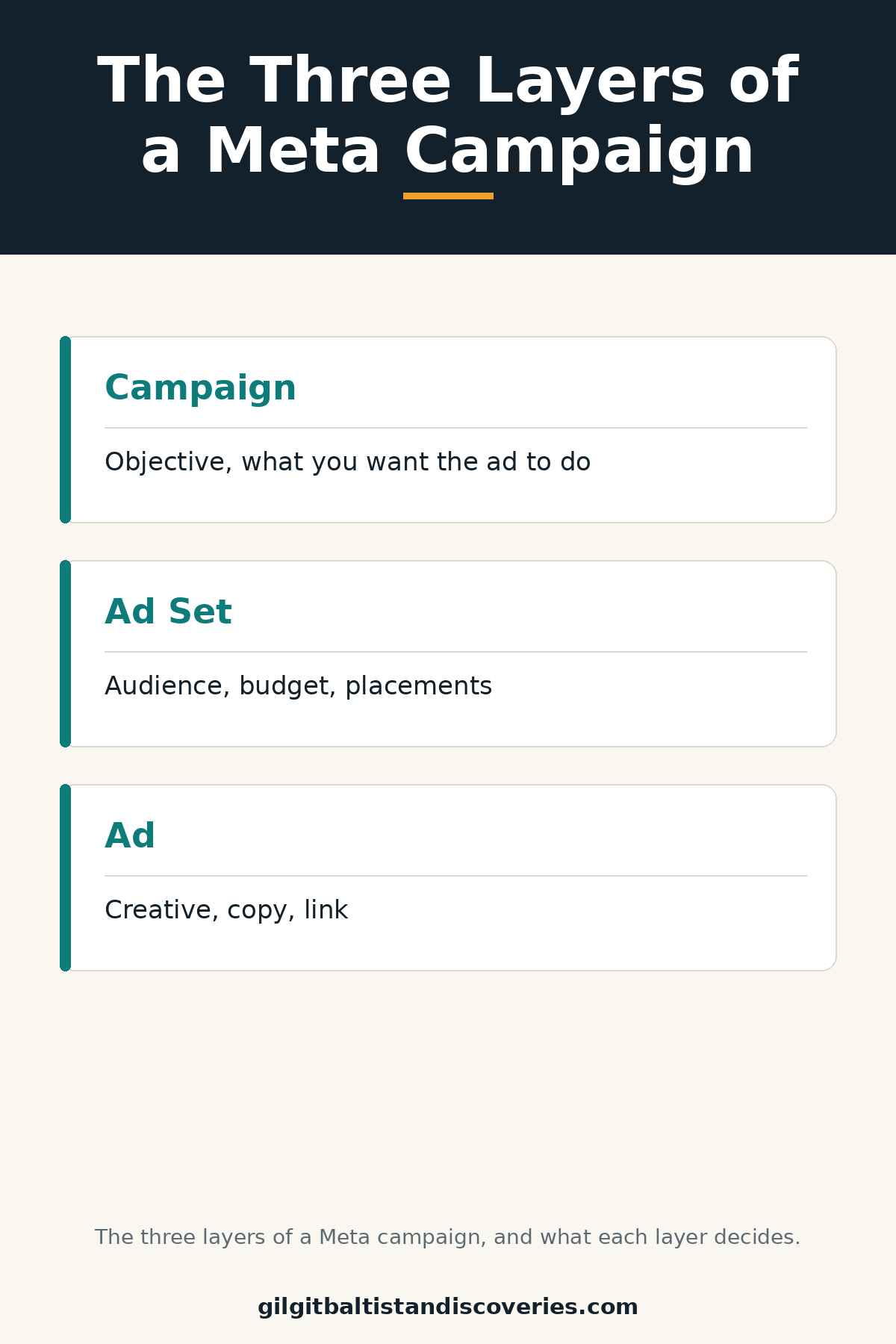
Every Meta campaign has three layers, and each layer decides one thing. The diagram below shows the three layers.
The campaign is the objective, what you want the ad to do. For a tour operator, a lead generation campaign usually works best, because prospects can fill out a form directly (The Travel Agents Academy). The objective is the goal you pick first, and everything else follows from it.
The ad set is the audience, the budget and the schedule. This is where you tell Meta who should see the ads, how much you will spend, and when. One campaign can hold several ad sets, each aimed at a different country or audience, so you can compare them.
The ad is the creative, the images, videos and text people actually see. One ad set can hold several ads, so you can test which photo or video brings more enquiries.
Run prospecting and retargeting as separate campaigns, because they do different jobs. Prospecting means ads shown to people who have never heard of you. It takes most of the budget, and it is the slowest and hardest to judge. Retargeting means showing your ad again to people who already visited your tour page, watched your videos or engaged with your account. It takes a smaller budget, works faster, and usually gives the best return in a tour account (Travelity).
One more rule from the same source: keep retargeting windows short, days to a few weeks, not months, and always exclude people who have already booked, using an audience built from your own data. Travel has dates, and a person who looked at a June departure in January is a different lead from one who looked yesterday.
Who should you target for international leads?
Target the planners at home, not the whole world. Travelity, a guide written for tour operators, describes three audiences, and only two matter for a Gilgit-Baltistan operator selling from abroad.
First, planners at home. Set location to the countries your guests come from, in their language, and time the campaign to their planning window. This is the audience for multi-day, private and higher-value tours booked in advance, which is exactly what a K2 trek or a 7-day Hunza itinerary is.
Second, people like your bookers. A custom audience is a list you give Meta, such as the email addresses of past guests, so Meta can show ads to those exact people. From that list, build a lookalike audience. A lookalike audience means Meta finds new people who look similar to your past guests, same age band, same interests, same behaviour. A customer list of past guests who agreed to hear from you is the strongest signal you can give Meta.
What you cannot do any more is stack dozens of interests and expect precision. Meta’s automated audience is now the default, and it splits your inputs into two kinds. Enforced controls are location, language, minimum age, and exclusions built from your own custom audiences. Suggestions only are interests, lookalikes, age and gender. Meta treats these as hints and delivers beyond them when it predicts better results, and for the most common campaign goals you cannot switch that off. Interest-based exclusions were removed in March 2025, and many detailed interest categories have since been merged or retired (Travelity).
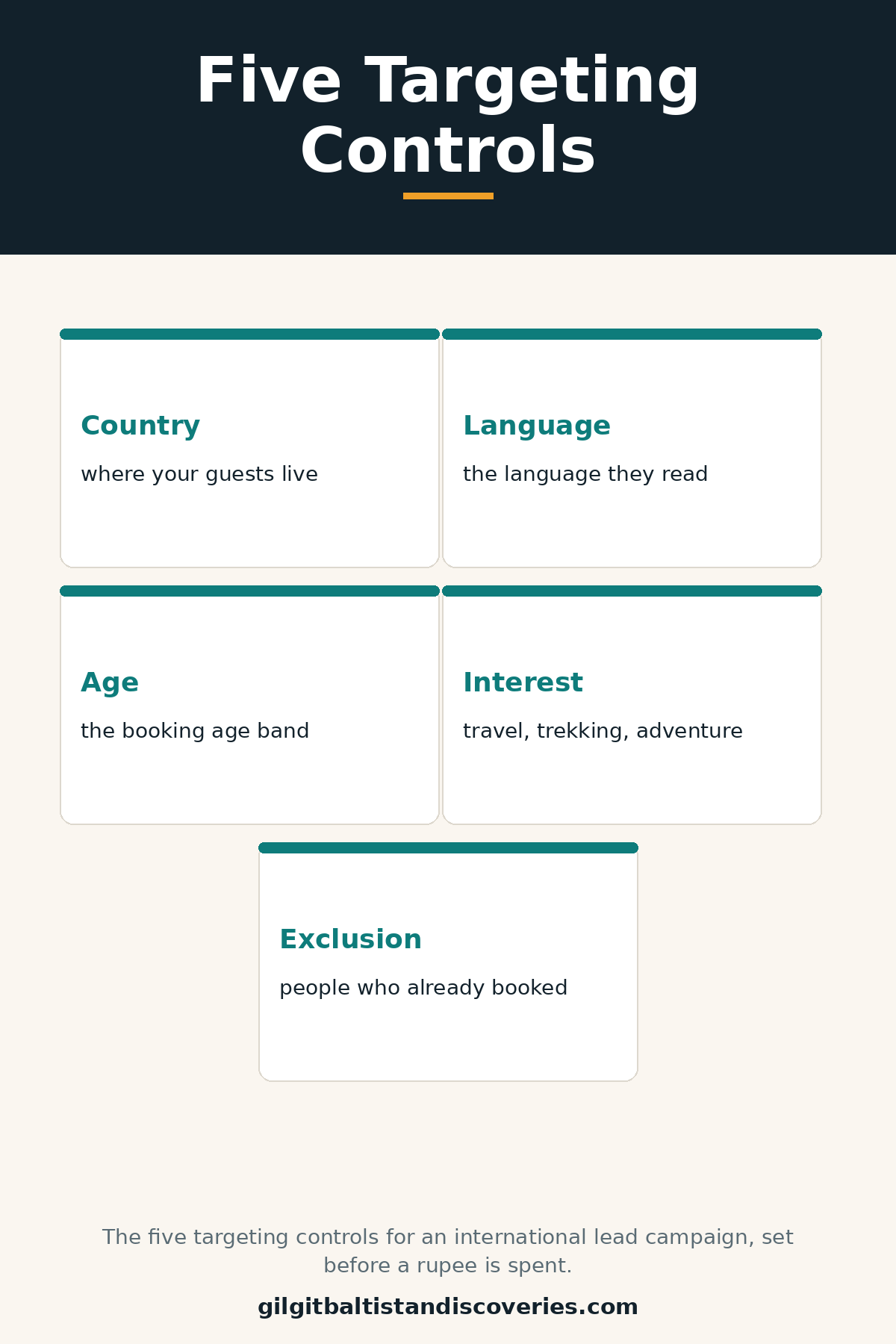
So set location and language deliberately, feed Meta good first-party data from your own guest list, and let the creative tell the wrong people to scroll past. A photo of a snowbound pass with the words “K2 Base Camp, 21 days, June departures” filters out everyone who was never going to trek, better than any interest stack. The diagram below shows the five targeting controls.
| Control | What to set | Why it matters |
|---|---|---|
| Country | The countries your guests come from, 2 to 4 to start | Location is enforced, so this is the one control Meta cannot ignore |
| Language | The language your guests read, usually English | Stops your budget going to people who cannot read the offer |
| Age | The booking age band for the trip, often 35 to 65 | Older travellers book group and multi-week trips |
| Interest | Travel, trekking, adventure travel, mountaineering | A suggestion only, Meta treats it as a hint |
| Exclusion | People who already booked, from your own guest list | Stops you paying to reach people who already paid |
Lead forms, website or WhatsApp: which destination works?
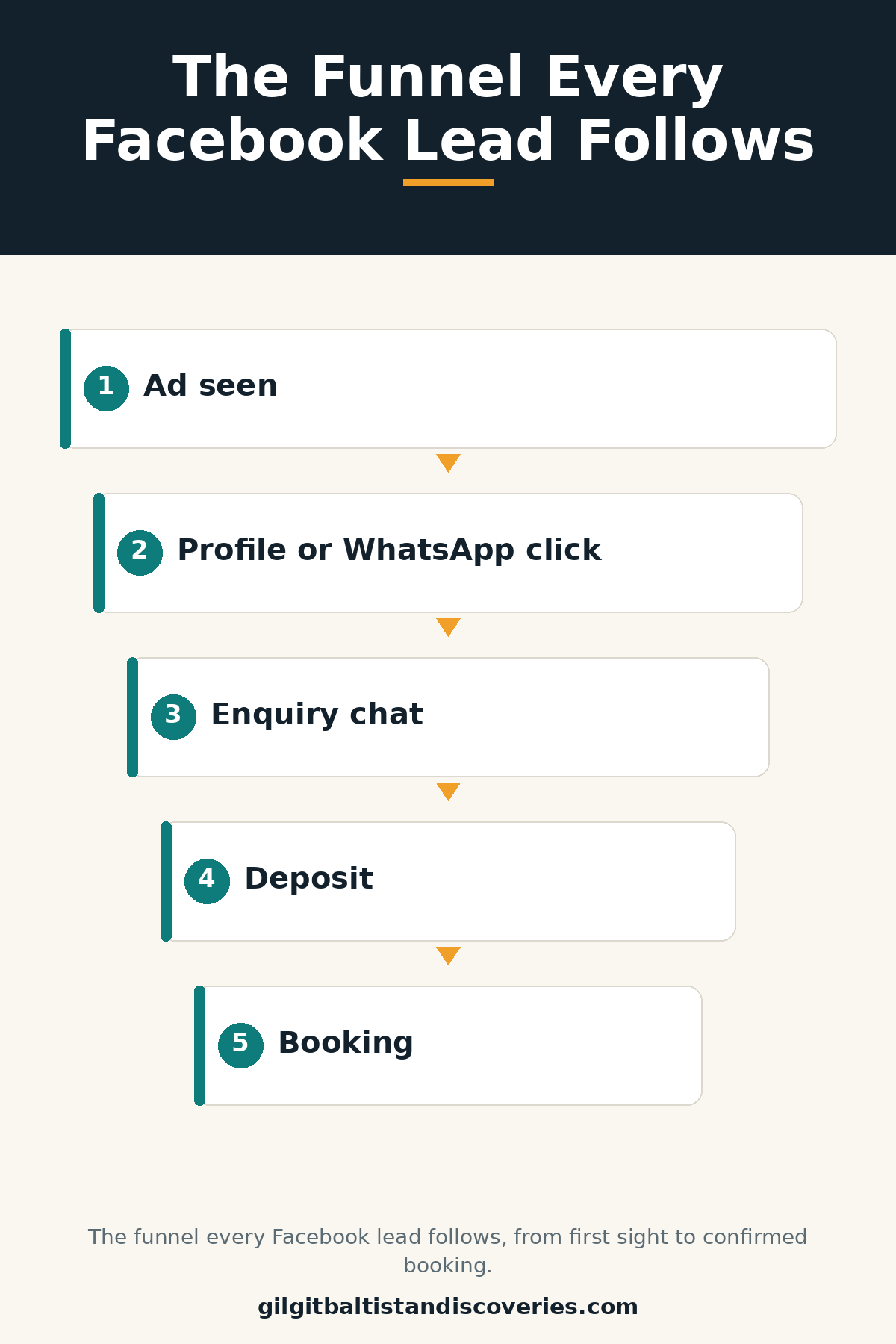
Use all three, in order, because different travellers commit in different ways. The diagram below shows the funnel, from the ad being seen to the booking being confirmed.
A lead form catches the people who will not leave the app. A lead form is a short form that opens inside Facebook, so the person never leaves the app, and Facebook fills in their name and contact details for them. Meta calls these lead ads (Kirkoc; Xingtu Online). Ask for name, phone or WhatsApp number, travel dates and group size. Four fields is enough. Every extra field costs you leads.
WhatsApp catches the people who want to ask two questions before they commit. Someone taps the ad and lands straight in a WhatsApp chat, and many travellers prefer to ask a quick question before they commit (Kirkoc). For a small operator in Gilgit-Baltistan, this is often the strongest destination, because the chat is where trust is built and the deposit is agreed.
Your website closes the sale. The ad promises the trip, the tour page proves it with dates, what the price includes, the hotel standard and where the trip starts. Do not send ad traffic to your homepage. Build a funnel that sends each ad to the page for that one tour, because a person who clicked on a K2 trek does not want to hunt through your whole site (The Travel Agents Academy).
The funnel every lead follows looks like this: the ad is seen, the person clicks to your profile or straight into WhatsApp, the enquiry chat happens, the deposit is paid, the booking is confirmed. If any step is slow or confusing, the lead dies there, and no amount of ad spend brings it back.
What creative converts on Facebook?
Short, mobile-friendly video outperforms static images, and it does so consistently (The Travel Agents Academy). But the video has to show the real trip, not a slideshow of stock mountains.
Three formats convert for tour operators. First, a storytelling carousel that shows a journey across several images, from arriving in Gilgit to standing at Concordia to the last night in Skardu. A carousel is one ad that holds several images or videos the viewer can swipe through. Second, user-generated style content that looks like a regular post from a traveller rather than an ad, because people buy from people, not logos. Third, a testimonial video, a past guest saying in their own words what the trek was like, with their face on screen.
The copy follows one formula. Open with a hook, then tell a short story that paints a picture of the experience, acknowledge how overwhelming planning can be, and close with a call to action (The Travel Agents Academy). Put the offer in the first seconds: what the trip is, where it goes, how long it is, and the from-price. Add captions, because most people watch without sound.
Facebook Feed suits longer copy and detailed itineraries, so use that space. Put the price range, the dates and the trip length in the ad itself. That feels like giving information away, but it is a filter: people who cannot afford it or cannot travel then never click, and you stop paying for them.

How much should you spend to test?
Start small, then test properly. FareHarbor notes a daily budget can start as low as 5 dollars a day. That is enough to learn how Ads Manager works, but not enough to judge whether an ad brings bookings.
For a real test, use the starting point published for adventure travel advertisers: 25 to 50 dollars a day on one tour and one audience, a traffic campaign at 15 to 20 dollars a day, video views at 5 to 10 dollars a day, and expect 4 to 8 weeks before you have enough data to optimise (The Ad Recipe playbook for adventure guides, reviewed September 2026). That is a starting point, not a promise, and your costs will differ.
Two well-funded ad sets beat ten starved ones. Meta learns best with around 50 conversion events a week per ad set, so spreading a small budget across many audiences means none of them ever learns (Travelity). A conversion event is one counted action, such as a form fill or a paid deposit, and Meta needs enough of them to learn who to show your ad to.
| Test | Daily budget | What it tells you |
|---|---|---|
| Learn the mechanics | 5 dollars a day | How Ads Manager works, without risk |
| Prospecting, one tour, one audience | 25 to 50 dollars a day | Whether strangers enquire with dates and a budget |
| Traffic to the tour page | 15 to 20 dollars a day | Whether the page holds attention |
| Video views, Reels and Feed | 5 to 10 dollars a day | Which creative stops the scroll |
| Retargeting, page visitors and video viewers | 10 to 20 dollars a day | Whether lookers come back and book |
Judge the test on cost per qualified enquiry, not cost per click. Travel benchmarks from WordStream and LocaliQ, reported for 2025, put travel and hospitality at 0.63 dollars per click, a 2.82 percent conversion rate against an 8.95 percent all-industry average, and 22.50 dollars per action or lead (GHL Tourism Snapshot). Travel converts below the platform average because trips rarely sell on the first impulse click. Nurture is the whole game, so a cheap click that never replies is worth less than an expensive lead that pays a deposit.
How do Pixel and Conversions API prove what worked?
Without tracking, you are guessing which ad brought the booking. The Meta Pixel is a small piece of code you add to your website that tells Meta what visitors did, such as viewing a tour page or filling in a form. The Conversions API, often shortened to CAPI, is a second connection that sends the same events from your own server instead of the visitor’s browser, so the booking is still counted when a browser blocks the Pixel. Meta describes it as a connection between your marketing data and its systems, used to improve targeting, cost per result and measurement (Full Season Media).
Use both where you can. Sending the same event through the browser and the server gives Meta two chances to see it, and that redundancy recovers bookings lost to blockers and privacy settings. The risk is double counting: Meta can count the same booking twice, unless you deduplicate. Deduplication works on matching keys, the Pixel eventID must match the Conversions API event_id, and the event name must match too. When both match, Meta discards the later copy. The window is 48 hours, so both copies must arrive within 48 hours of the first (Full Season Media).
Map each booking stage to one Meta event, using Meta’s own standard events as described in the Pixel reference (via Takat.ai):
| Booking stage | Meta event | What it means |
|---|---|---|
| A question before booking, a call, a chat, an email | Contact | The person initiates contact with your business |
| A form filled in, an enquiry sent | Lead | A sign up is completed |
| A slot is booked, a date is held | Schedule | The person books an appointment to visit |
| A booking is paid online, a deposit or full payment | Purchase | Currency and value are required |
For a tour operator, the honest setup is simple. Fire a Lead event when the form is filled in, a Contact event when the WhatsApp chat starts, and a Purchase event when the deposit is paid, with the booking reference as the event ID so Meta counts it once. Make a test booking and confirm Meta records it before you spend real money. Optimise your ads on the confirmed booking, not on clicks, because clicks never paid a deposit.
How does retargeting turn lookers into bookings?
Most people who click a tour ad do not enquire on the first visit. A long-haul trip is a considered purchase, and the person needs time, a second look, and often a conversation with a travel partner. Retargeting is how you stay in front of them during that window. It means showing your ad again to people who already visited your tour page, watched your video or engaged with your account.
Build three retargeting audiences. First, people who visited the tour page but did not enquire, shown the same tour with its dates and price. Second, people who watched your video to the end, shown a testimonial from a past guest on that same trip. Third, people who started a form or a chat but did not finish, shown a simple reminder with one clear next step.
Keep the windows short, days to a few weeks, and always exclude people who have already booked. A person who booked in March does not need a June departure ad in May, and every rupee spent on them is wasted.

When should you run campaigns, and how do you scale a winner?
Time your campaigns to the planning window of your guests, not to your own quiet season. Americans and Europeans plan a long-haul trip months ahead, and European demand is visibly seasonal and weather-driven, while American demand is steadier and spread across the year (Xingtu Online). For a June K2 departure, the campaign should be running in January, February and March, when the planning happens, not in May, when the decision is already made.
Facebook performance stays consistent year round, which is an advantage over platforms that spike and fade with the season (Socialeum). Use that steadiness for prospecting in the planning months, then shift budget to retargeting as departure dates approach, because the people who already looked are the ones most likely to book now.
Scaling means doing more of what already works, in small steps. When an ad set brings enquiries with dates and a budget, raise its budget a little at a time and watch the cost per enquiry after each step, because raising it too fast resets what Meta has learned. Then add a second winning creative to the same ad set, so Meta has a fresh ad to show the same audience. Then duplicate the winning ad set into a new country, one at a time, and widen the lookalike audience, so Meta has more people like your past guests to find. Do one change at a time, so you always know which change caused the result.
Stop a campaign when it fails the test, not when you get bored of it. If an ad set has spent its test budget and brought no qualified enquiries, stop it, change one thing, the creative, the audience or the offer, and test again.
What mistakes waste a tour operator’s budget?
The Boost button is the first mistake. Boosting a post from the Facebook app has far fewer targeting and tracking options than Ads Manager, and it brings likes, not bookings (Kirkoc). Always build the campaign in Ads Manager.
Targeting the whole world is the second. A worldwide audience burns your budget on people who will never fly to Pakistan. Pick two to four countries, one language, and one age band, and let the creative do the filtering.
No tracking is the third. Without the Pixel, and the Conversions API where you can add it, you cannot tell which ad brought the booking, so you keep spending on the ads that bring clicks and stop the ones that bring deposits.
Slow replies are the fourth, and the most expensive. Contacting a web lead within an hour makes you about 60 times more likely to qualify it than waiting a day (Harvard Business Review, via GHL Tourism Snapshot). A lead that waits a day is usually a lead that booked with someone else.
The fifth is sending ad traffic to your homepage. The person clicked on one tour, so send them to that tour’s page, with its dates, its price and its booking button, and nothing else competing for their attention.
Neither is better on its own. Facebook reaches the older travellers who book group tours, family trips and multi-week itineraries, and it suits longer copy and detailed itineraries. Instagram reaches younger travellers who discover trips visually. Run both from Ads Manager, give Facebook the booking audience and Instagram the discovery audience, and judge each on enquiries, not likes.
Start with 5 dollars a day to learn Ads Manager, then test at 25 to 50 dollars a day on one tour and one audience for four weeks. That is a starting point, not a promise. Judge the test on cost per enquiry, and only raise the budget on the ad set that brings enquiries with dates and a budget.
Use all three, in order. A lead form inside Facebook catches people who will not leave the app, and it pre-fills their details. WhatsApp catches people who want to ask two questions. Your website closes the sale with dates, prices and what is included. Never send ad traffic to your homepage, send it to the page for that one tour.
Put the price range, the dates and the trip length in the ad itself, so people who cannot afford it or cannot travel then never click. Ask for travel dates and group size in the form, and reply within the hour. Exclude people who already booked, and stop any ad set whose enquiries never mention dates.
Expect four to eight weeks before you have enough data to judge a test, because a long-haul trip is a considered purchase, not an impulse buy. Retargeting brings the fastest results, since those people already know you. Prospecting is slower, and travel converts below the all-industry average, so judge the campaign on qualified enquiries first and bookings second.
Yes, if you want to know which ad worked. The Pixel is code in the visitor’s browser that reports actions to Meta. The Conversions API sends the same events from your server, which recovers bookings lost to blockers. Send both, deduplicate on the booking reference, and optimise on confirmed bookings, not clicks.
Want help running your ads?
Rakalogics is a marketing agency that runs Meta and Google ads for tour operators and local businesses. If you want help setting up your campaigns, tracking your bookings and turning enquiries into deposits, visit rakalogics.com.
Last updated: 25 November 2026